

Early in the morning, Mrs. Nguyen Thi Sau, who has been making traditional cakes for over 20 years in Long Xuyen ward, placed a tray of pork skin cakes on the table, her hands nimbly cutting each piece of the vibrant green cake, fragrant with pandan leaves and coconut milk. Meanwhile, her youngest daughter, Tran Mai Xuan, was answering orders from customers on social media. Mrs. Sau smiled kindly and said, "Before, I mainly made cakes to sell at the market, only making extra for large orders. Now it's different. I sell a small portion at the market to maintain regular customers who buy them for breakfast, and the rest my family sells online. The day before, my daughter posts an advertisement, and when people order something, we gather the orders and go to the market to make them according to the quantity, then deliver them the next day. Some days we sell up to a hundred boxes of cakes."
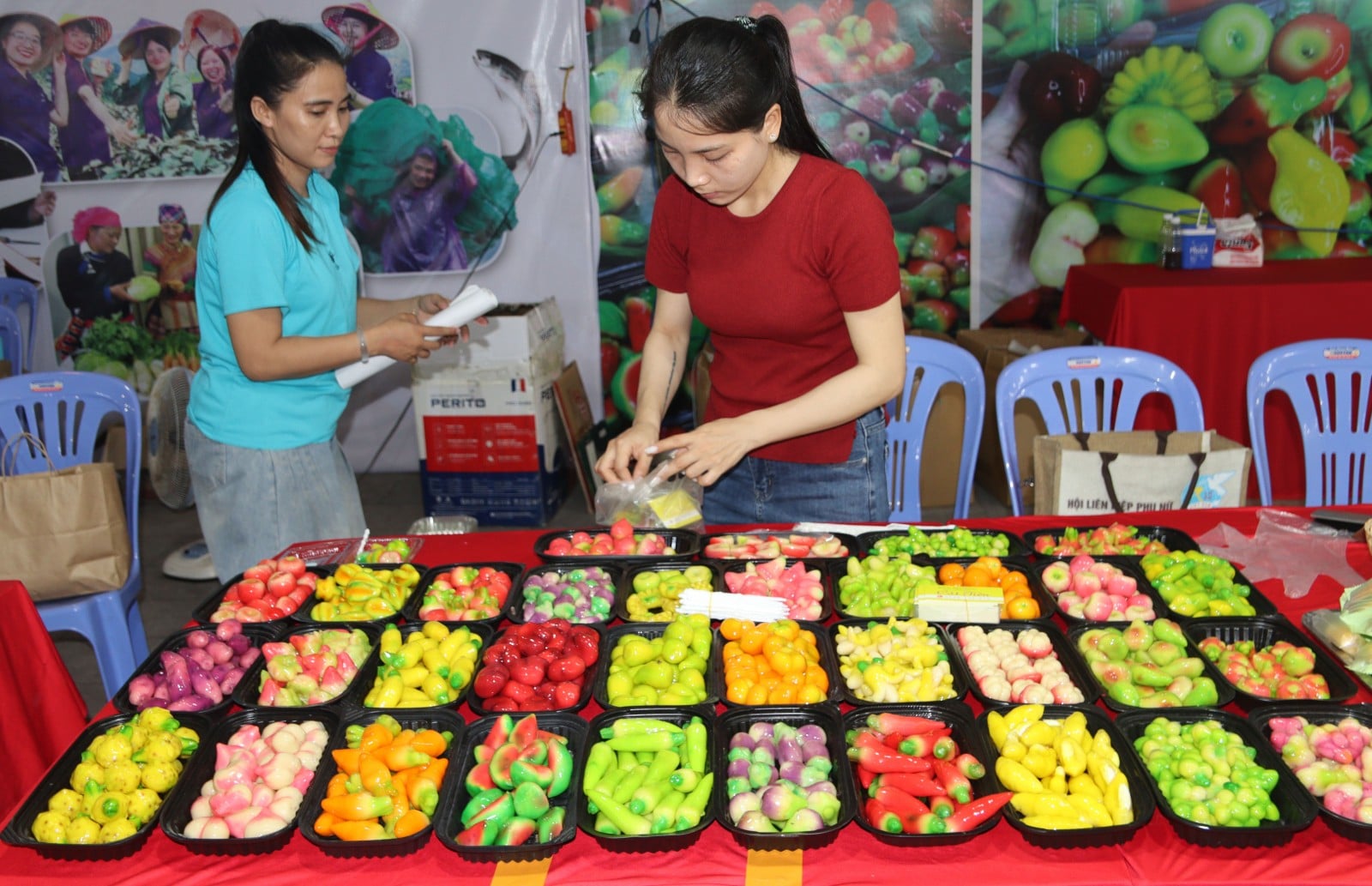
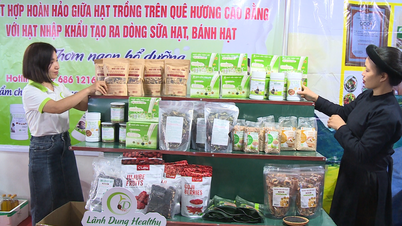
Traditional Vietnamese cake stall at the 2026 Entrepreneurs' Festival, Long Xuyen ward. Photo: KHANH AN
According to Mrs. Sau, customers now prefer traditional Vietnamese cakes because they are both delicious and evoke a sense of familiarity. Tired of rice dishes like pho, they choose a box of sweet cakes for breakfast. It's a satisfying meal, suitable for busy work schedules, and quite economical. Many people from far away order them to give as gifts to friends or send to relatives far from home. "There are a few ladies from Ho Chi Minh City who order them every week. They say eating a piece of cake reminds them of their childhood, sitting and waiting for their grandmother to steam cakes by the wood-fired stove. Hearing that makes me happy. That's also a memory for me, seeing adults busily making cakes for their children and grandchildren. Over time, my grandparents passed away, and I continued to preserve my cake-making skills," Mrs. Sau recounted wistfully.
Ms. Nguyen Huyen Tram, residing in Thanh My Tay commune, also grew up learning to make cakes from her mother's kitchen. She chose to stay connected to her home kitchen and her hometown, rather than seeking work elsewhere like her peers. Ms. Tram recounted that initially, she wanted to travel far and experience new environments. However, the COVID-19 pandemic disrupted everything, and those who traveled far sometimes didn't even have time to return. "Therefore, I feel that the decision to stay in my hometown is right for me. Making cakes may not make you rich, but it's enough to cover daily living expenses," she confided.
Ms. Tram even quipped that for the past 28 years, she's eaten more traditional cakes than rice. Her favorite is the bamboo root-shaped rice cake. Unfortunately, she's not very good at timing the dough fermentation. In hot weather, the dough rises very quickly; in cooler weather, the rate slows down, and if it's done at the wrong time, the batch of cakes is ruined. Her mother, who uses rice wine yeast and palm sugar flour, advised her: "When the dough is ready, tiny bubbles will appear, and stirring will make a pleasant sizzling sound, like the dough is 'breathing.' That's when the yeast is working well, and the cake will easily develop a bamboo root-like texture, be translucent, chewy, soft, and fragrant with the scent of palm sugar." Ms. Tram applied this secret, and in return, the number of customers buying her cakes has increased significantly.
Traditional Vietnamese cakes are no longer just found in markets; they're now taking center stage at fairs everywhere, even having their own folk cake festivals across the country. One of the most sought-after items recently is palm sugar rice cake. This cake, with its natural yellow color, subtly sweet taste, and delicate aroma, is associated with the Bay Nui region. According to the bakers, the secret lies in the pure palm sugar and the dough fermentation process. Besides rice cakes, steamed banana cakes and mung bean cakes shaped like fruits are also quite common at food fairs.
Nguyen Minh Khang (23 years old), a resident of Chau Doc ward, is used to city life and is familiar with fried chicken and spicy noodles. But traditional Vietnamese cakes remain a "specialty" for him. "Every time I go to a fair, I always visit the traditional cake stall. Eating these dishes feels light, not heavy, and more familiar than fast food. I like steamed banana cake and pork skin cake the most; generally, I like all kinds of cakes with rich coconut milk," Khang expressed.
Changes in sales methods are opening up more opportunities for traditional cake makers. Previously, cakes were mainly sold on the same day at local markets, resulting in rather unstable sales. Now, many places know how to vacuum-pack and refrigerate cakes for long-distance shipping. Some businesses even invest in attractive packaging and printed product labels to participate in fairs, OCOP programs, or regional specialty markets.
Nevertheless, the bakers still maintain the traditional methods in every step. Many places still use wood-fired stoves and steam the cakes in large steamers, just like their grandparents did in the past. Mr. Vo Van Tam, a specialist in making palm sugar rice cakes in Tinh Bien ward, said: "The soul of traditional cakes lies in their simplicity, without being overly elaborate in preparation or presentation. What's important is that when you eat it, you get the fragrant aroma of coconut and sticky rice, and taste the sweetness of the palm sugar from your hometown – that's when you feel the love of the baker. Industrial cakes can't have these things."
According to Mr. Tam, the good news is that today's young generation is starting to show more interest in traditional cakes. Many are learning the craft and posting videos introducing local cakes on social media. With young people carrying on the tradition, older generations like him feel much more at ease.
These cakes from the Mekong Delta have thus traveled far beyond the familiar bamboo groves and riverside docks. Sometimes they are neatly packed in boxes and shipped to the cities, other times they appear in vibrant colors on social media. But wherever they are, people still recognize the unique flavor of their homeland, a simple, sweet taste, just like the way people in the Mekong Delta have lived and treated each other for so long.
KHANH AN
Source: https://baoangiang.com.vn/banh-que-niu-long-nguoi-a486372.html
![[Photo] General Secretary and President To Lam presides over a working session with the Central Policy and Strategy Committee on the development of the materials industry.](https://vphoto.vietnam.vn/thumb/1200x675/vietnam/resource/IMAGE/2026/05/21/1779359935432_a3-bnd-3129-1412-jpg.webp)

![[Photo] National Assembly Chairman Tran Thanh Man working with the Standing Committee of the Law and Justice Committee](https://vphoto.vietnam.vn/thumb/1200x675/vietnam/resource/IMAGE/2026/05/21/1779378929214_ndo_br_1-4610-jpg.webp)




























































Comment (0)