


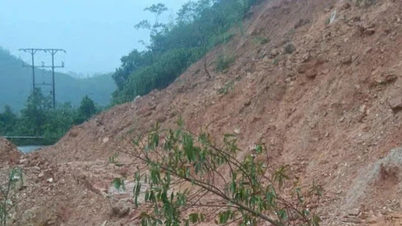
After prolonged rains, the dirt road connecting Provincial Highway 237D to Ban Chanh village (Loi Bac commune) is covered in mud, making it slippery and muddy. During the dry season, the road surface becomes uneven with numerous potholes, and dust flies everywhere whenever a vehicle passes by.
This is the first section of the inter-village road leading to the villages of Bản Chánh (Lợi Bác commune); Song Sài village, part of Nà Miền village (Na Dương commune) and Cốc Sâu village (Xuân Dương commune). Although the entire route is still unpaved, extending to the villages further inland, the nearly 2,500-meter section from the provincial road is the most severely degraded.
In Bản Chánh village (Lợi Bác commune), there are currently 123 households with nearly 540 people who regularly travel on this road. The households' economy mainly relies on agricultural production, but every harvest season brings with it the worry of transporting agricultural products due to the extremely difficult road conditions.
Ms. Vi Thi Khem, a resident of Ban Chanh village, shared: "My family grows one sao (approximately 1000 square meters) of cucumbers. When it's time to harvest, I have to carry them on my back for almost an hour to sell them. On rainy days, it's even harder; the road is slippery, and sometimes I even slip and fall."
According to Ms. Khem, because the roads are difficult to travel on, traders refuse to come directly to the area to buy agricultural products. Even if they do come, the price is often forced down due to high transportation costs.
Besides affecting the consumption of agricultural products, students in the area also face many difficulties. On days with heavy rain, the slippery roads cause them to frequently fall off their bikes, getting covered in mud on their way to school.

According to Mr. Hoang Van Duy, Party Secretary and Head of Ban Chanh village: This road was paved with asphalt around 2010. However, after many years of use, along with the effects of weather and a lack of repair funds, the road has seriously deteriorated for more than a decade.
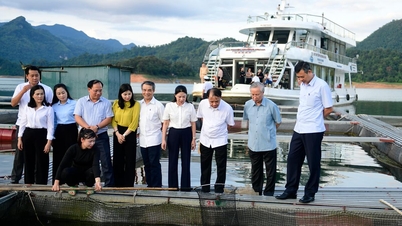
Within this area lies Ban Chanh Lake, boasting beautiful natural scenery and significant potential for ecotourism and experiential tourism development. Furthermore, Loi Bac commune is also planning to develop a cage fish farming model that leverages the advantages of the lake. However, the deteriorating transportation infrastructure is becoming a major bottleneck. Difficult roads hinder the transportation of materials and goods, and simultaneously limit the commune's ability to attract investment and exploit its tourism potential.
Ms. Pham Minh Hue, Chairwoman of the People's Committee of Loi Bac commune, said: "This road is of great importance to the lives of the people as well as the socio-economic development orientation of the commune. For many years, people have hoped that the road would be invested in and upgraded soon to facilitate travel and goods transportation. Furthermore, if the road is improved, the commune will have the conditions to implement and realize its development plans, including the development of tourism and cage fish farming to increase people's income."
Amidst expectations for economic development, rural construction, and the exploitation of the lake region's tourism potential, the greatest desire of the people remains a well-invested, safe road, thereby opening up opportunities for economic development and improving the lives of the people in this still disadvantaged region.
Source: https://baolangson.vn/duong-lay-can-buoc-phat-trien-5091258.html
![[Photo] General Secretary and President To Lam works with the Party Committee of the Ministry of Health on the work of Vietnamese traditional medicine.](https://vphoto.vietnam.vn/thumb/1200x675/vietnam/resource/IMAGE/2026/05/20/1779294323718_a1-bnd-2978-3319-jpg.webp)
![[Image] "Journey of Hope" promotes the organ and tissue donation movement in Vietnam.](https://vphoto.vietnam.vn/thumb/1200x675/vietnam/resource/IMAGE/2026/05/20/1779294400833_1-8910-jpg.webp)
![[Photo] National Assembly Chairman Tran Thanh Man working with the Standing Committee of the National Assembly's Delegation Affairs Committee.](https://vphoto.vietnam.vn/thumb/1200x675/vietnam/resource/IMAGE/2026/05/20/1779294340023_ndo_br_1-1691-jpg.webp)






































































Comment (0)