

Tattoos and body piercings are considered trendy hobbies chosen by many, but people forget that this habit can cause many health problems.
Easy to do, but difficult to do.
Ms. PHD (20 years old, Binh Thanh District) experienced swelling and redness in her ear, yellow pus discharge, and fever after getting her ear pierced. She was diagnosed with an ear piercing infection.
Ms. D. had previously had two earlobe piercings, and this time she had another piercing done on her outer ear. Two days after the piercing, Ms. D. experienced pain and burning in her outer ear, but thought it was a normal reaction after the procedure.
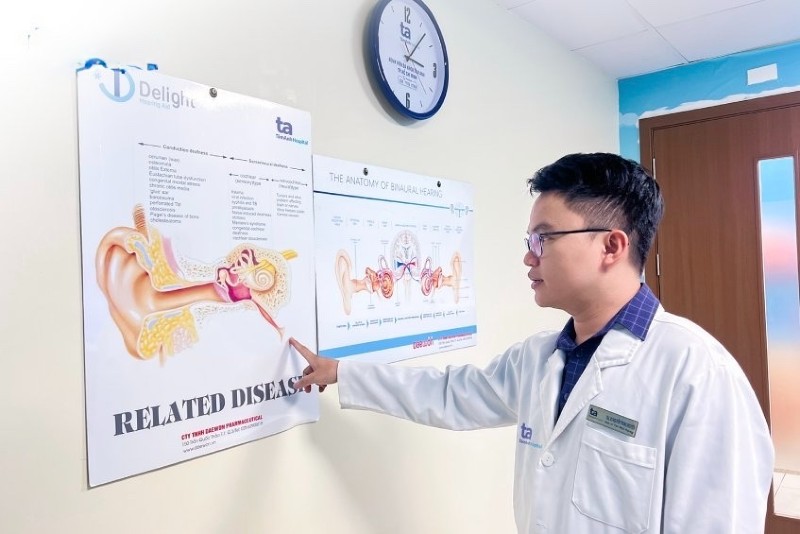 |
| The doctor is explaining the anatomical structure of the ear to a patient. |
After a week, she tried various ways to care for the pierced area, but the pain in her ear did not subside. She also experienced swelling, redness, pus formation, heat, and burning at the piercing site. Ms. D. then went to a medical facility for examination.
Based on the patient's medical history, physical examination, and ear, nose, and throat endoscopy, the doctors determined that the patient had an infection in the ear piercing site and prescribed antibiotics and anti-inflammatory medication for treatment, along with local antiseptic.
With the growing trend of getting tattoos, doctors say that while getting a tattoo is easy, removing it is incredibly difficult and poses numerous health risks. LVB (32 years old, from Binh Thuan province) got his first tattoo five years ago while working abroad in Africa.
Feeling homesick and wanting to motivate himself, he got a full back tattoo of his parents. Later, when things weren't going well at work, he followed friends' advice and got another tattoo of a dragon soaring through the clouds in black ink along his left arm to change his luck.
Before his luck could change, he was scolded and almost disowned by his parents when they discovered their only son had tattoos. His parents were upset because they had raised him to be fair-skinned and healthy, and had tried their best to keep him free of scars, only for him to have tattoos all over his body. In his hometown, most people with tattoos are often stereotyped as bad people.
When picking up his children from school, going to the market, or going out, he frequently receives disapproving glances. His sadness turned into regret when his eldest daughter refused to go to kindergarten because her classmates ostracized her, calling her father and her bad people. He also couldn't get a job at the factory near his home, despite being in his field, because of the owner's "unwritten rule" against hiring people with tattoos.
Mr. B regrets his decision and wants to remove the tattoo, but it's not that simple. A beauty salon quoted a price of 60 million VND to remove a tattoo on just his arm, six times the cost of getting the dragon tattoo, and even then, they couldn't guarantee complete ink removal.
Mr. B had previously had a tattoo removed, but the laser treatment was too painful, causing burns, blisters, and skin inflammation. Simultaneously facing financial difficulties, Mr. B temporarily gave up, accepting the need to wear long-sleeved shirts when going out.
As for HLQK (17 years old, Dong Nai), after getting a tattoo, she regrets it and has no choice but to go to the hospital once a month to try to restore her skin to its normal color.
Six months ago, K. secretly got a tiger tattoo on her back, imitating her idol. Unexpectedly, the tattoo artist was inexperienced. After six hours of painful, tearful tattooing, K. received an ugly, poorly drawn tiger image with a skin infection stretching from her shoulder to her waist.
K. had to tell her parents so she could go to the hospital for treatment of the infection. After waiting three months for the wound to heal completely and the ink color to stabilize, her parents took K. to have the tattoo removed at a multi-specialty medical facility in Ho Chi Minh City.
Late regrets
According to doctors, infections after piercing are common among some young people who have multiple piercings in their earlobes or outer ear. Piercing is a fairly popular way to enhance one's appearance.
Previously, earlobe piercings were commonly placed in locations without cartilage, rarely causing complications. However, nowadays, many young people prefer piercings in various locations involving cartilage in the earlobe. The earlobe has soft tissue and fat, and strong blood circulation, so piercings in this location heal quickly and are less prone to infection.
The earlobe and cartilage have thicker, firmer tissue and less blood circulation. Piercings in these locations will take longer to heal. Ear cartilage infections can cause more serious problems beyond fever, bleeding, and swelling, such as systemic infections, affecting the entire body if not treated promptly.
There are many reasons why ear piercings can become infected, such as: improper sterilization of the piercing site; unsterilized piercing tools or earrings; inadequate cleaning of the piercing site after piercing; or repeatedly touching the piercing with unwashed hands.
Some symptoms of piercing infection include: fever, pus discharge, redness, swelling, itching, burning... If the infection (ear cartilage, outer ear, earlobe, etc.) is not treated promptly, it can cause abscesses, spread infection leading to cellulitis, chronic otitis externa, and hearing loss...
Dr. Nguyen Trung Nguyen, from the Ear, Nose, and Throat Center at Tam Anh General Hospital in Ho Chi Minh City, advises that when needing ear piercing, people should choose experienced, reputable establishments that ensure hygiene. After getting their ears pierced, they should wash their hands thoroughly with soap or hand sanitizer before touching the pierced area, and use cotton swabs moistened with saline solution to clean the pierced area twice a day.
Keep the piercing in place until the wound is completely healed, which can take up to 6 weeks. Avoid swimming in pools, ponds, lakes, rivers, streams, or even taking a bath after getting your ears pierced. Do not apply any medication to the piercing without consulting a doctor first.
If you experience symptoms such as inflammation and ulceration of the piercing site, continuous bleeding after 2 days of piercing, swelling and redness of the piercing area that spreads, high fever, continuous yellow pus discharge, etc., you should see an ENT specialist for guidance on treatment and to minimize complications.
Regarding the arduous journey of tattoo removal, according to Dr. Quach Thi Bich Van, a dermatologist and cosmetic skin specialist at Tam Anh General Hospital in Ho Chi Minh City, the number of tattoo removal cases there is trending upwards.
Currently, hospitals and clinics receive an average of 130-150 tattoo removal requests per month, an increase of about 30% compared to the same period last year, and two-thirds of the clients are male.
A study published in the U.S. National Library of Medicine, involving 1,100 tattooed adults in the U.S., showed that 18.2% regretted one or more of their tattoos, and those who regretted getting tattoos had been doing so for longer. Additionally, 52.1% were interested in removing, covering, or modifying one or more tattoos. Currently, no survey in Vietnam has recorded these figures.
According to Dr. Van, the common thread among those seeking tattoo removal is their age range of 15-35. The most frequently removed tattoos are large, unattractive, old, blurry, or faded; couple tattoos, names or portraits of ex-lovers; gruesome, bizarre, or negative tattoos; and tattoos in hard-to-cover locations such as the face, neck, nape, arms, feet, or even eyebrows and eyelids.
"The most common reasons for tattoo removal are regret, anxiety about the tattoo affecting work, studies, relationships, or that it is no longer suitable for the present," said Dr. Van.
However, tattoo removal is far more complicated than tattooing. A tattoo artist can complete a small, simple tattoo in just a few tens of minutes, or several days for a large, colorful, and effect-enhancing design. With good pain management, the process can be repeated, reducing the time and allowing for tattooing anywhere as long as the necessary equipment is available.
Conversely, if you want to remove a tattoo quickly and effectively, the only method is surgical removal of the tattooed area. This is a major medical intervention that requires a licensed medical facility and may involve anesthesia or local anesthetic. Even when performed by a doctor, this method still carries the risk of infection and unsightly scarring after surgery.
Pico laser tattoo removal is considered highly safe, as it precisely targets the pigment while causing minimal damage to surrounding tissue, is highly effective, and has minimal post-inflammatory hyperpigmentation. However, this method requires many months or years of treatment and the cost is relatively high.
Each laser tattoo removal session should be spaced an average of 4 weeks apart to allow the skin time to recover and for the tattoo ink particles to be collected and eliminated by white blood cells.
Using laser energy to treat tattoos also has certain side effects in the treated skin area. Therefore, it's not possible to treat a very large area in a single session, Dr. Van added.
Large, complex tattoos with multiple colors and ink that penetrates deep into the dermis are more difficult to remove. Multicolored tattoos require a combination of lasers or other tattoo removal methods, such as chemical peels or dermabrasion.
Older, homemade tattoo inks respond better to laser treatment. Professional, long-lasting inks, such as yellow, red, and blue, require the use of multiple lasers with different wavelengths and several treatment sessions.
It's very difficult for tattoos to disappear 100% or for the skin to return to its normal color. The speed of treatment response depends largely on the composition of the tattoo ink, the depth of the ink in the skin, and the individual's body constitution.
Doctors recommend that when seeking tattoo removal, individuals should visit a medical facility with a dermatology department for a direct examination and consultation on a specific treatment plan, as well as guidance on post-treatment care to minimize complications and achieve the best results.
![[Photo] My Son at night: A thousand-year-old heritage site amidst the Milky Way](https://vphoto.vietnam.vn/thumb/1200x675/vietnam/resource/IMAGE/2026/04/15/1776261039184_ndo_br_chon6-jpg.webp)

![[Photo] National Assembly Chairman Tran Thanh Man arrives in Türkiye to attend IPU-152](https://vphoto.vietnam.vn/thumb/1200x675/vietnam/resource/IMAGE/2026/04/15/1776261003665_tnk10-jpg.webp)
![[Photo] Mrs. Ngo Phuong Ly meets and exchanges views with Mrs. Peng Li Yuan](https://vphoto.vietnam.vn/thumb/1200x675/vietnam/resource/IMAGE/2026/04/16/1776277858080_phu-nhan-1-jpg.webp)
![[Photo] National Assembly Chairman Tran Thanh Man attends the opening session of IPU-152](https://vphoto.vietnam.vn/thumb/1200x675/vietnam/resource/IMAGE/2026/04/16/1776277863731_ctqh5-jpg.webp)
![[Photo] The General Secretary, President and his wife meet with Vietnamese-Chinese friendship leaders.](https://vphoto.vietnam.vn/thumb/1200x675/vietnam/resource/IMAGE/2026/04/15/1776264829725_vna-potal-tong-bi-thu-chu-tich-nuoc-to-lam-gap-mat-nhan-sy-huu-nghi-viet-nam-trung-quoc-8703641-3130-jpg.webp)


















































































Comment (0)