

The above is advice from Mr. Nguyen Trung Nguyen, an English teacher in Hanoi , on how to do well on the high school graduation exam in English.
Common question types
According to this teacher, English has consistently had relatively low scores in the high school graduation exam in previous years, partly because many students lack confidence or effective strategies for studying and taking the exam.
Based on the sample test, the 2024 high school graduation exam in English will still consist entirely of multiple-choice questions, with 50 questions and a time limit of 60 minutes. The question types will likely remain the same: sentence completion, synonyms and antonyms, pronunciation and stress, conversational English, paragraph completion, reading comprehension, error identification, and sentence rewriting.

Mr. Nguyen Trung Nguyen, an English teacher in Hanoi (Photo: Provided by the interviewee)
The knowledge tested in the exam will undoubtedly be grammar and vocabulary that students have learned in the high school English curriculum, especially the 12th-grade English program. Therefore, if you have a solid grasp of the knowledge outlined in the textbook curriculum, achieving a good score should not be difficult.
Specifically, regarding grammar, students need to review and systematize their knowledge of parts of speech (nouns, adjectives, adverbs), prepositions, pronouns, verbs (verb tenses, passive voice, gerunds), auxiliary verbs (modal verbs), conjunctions, conditional sentences, relative clauses, and comparative adjectives and adverbs. In addition, they should pay attention to knowledge related to direct and indirect speech.
Regarding vocabulary, students need to reread the reading passages studied in the 12th grade curriculum to reinforce and master the important vocabulary they have learned.
How to approach different question types to achieve high scores.
However, to achieve high scores, students also need to develop their test-taking skills to handle different question types in the exam, such as synonym-antonym questions, paragraph completion questions, and reading comprehension questions.
For example, in multiple-choice questions to complete a passage, if students have good test-taking skills, they will find that the exam consists of four types of questions: questions about relative pronouns, quantifiers, linking adverbs, and vocabulary questions.
For questions about relative pronouns, the exam will only ask you to choose the relative pronouns "who, which, whom, that," not "where, when, whose, how, why, or WH-ever." Therefore, when encountering this question in the "fill-in-the-blanks" section, pay attention only to the answers containing "who, which, that, or whom." Choosing the correct answer will then become much simpler.

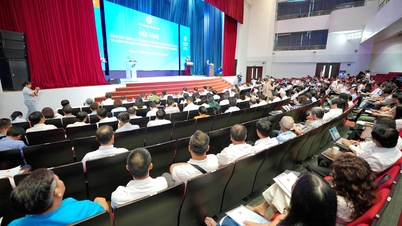
Candidates should not be overconfident with easy questions (Photo: Manh Quan).
(Excerpt from the sample exam - 2024)
"Air travel to distant places results in huge amounts of carbon emissions (28) _____ contribute to global warming."
Question 28: A. where B. when C. which D. who
We can immediately eliminate A and B, and choose C because the noun immediately preceding the "____" mark refers to an object.
Or another example is the error-finding type of question. We'll see that out of three error-finding questions, there will often be one with an incorrect personal pronoun, one with an incorrect verb tense, and one with an incorrect semantic meaning. If we practice a lot, we can easily choose the correct answer for these seemingly difficult questions.
When you see an answer containing a personal pronoun, you can circle that answer. When you see an answer containing a verb and time is mentioned in the sentence, circle the verb answer because those are incorrect options.
(Excerpt from the sample exam - 2024)
Question 45: All office workers are required to wear her name tags in the workplace.
A. office B. required C. her D. workplace
-> Choose C.
Question 46: Many doctors in our hospital volunteer to help people in remote areas last year.
A. Many B. our C. volunteer D. areas
-> Choose C.
Don't underestimate the question of "preventing paralysis."
The high school graduation exam is always designed to be comprehensive, meaning there will always be questions designed to help students avoid failing, which are very easy, but unfortunately many students are overconfident and make mistakes on these questions. Therefore, when taking the exam, students should be careful and always remember the "principle of caution": do not underestimate easy questions, and do not overestimate difficult questions, because whether easy or difficult, the points are the same. Only circle an answer when you are absolutely sure it is correct (for questions you can answer well).
"From today until the exam day, there is only a short time left. During this time, you should not review the knowledge you have learned throughout the past school year. Instead, collect exam papers from previous years, as well as sample exam papers, and seriously work on those papers. Afterwards, evaluate your results and learn from your experience."
Another important point is to always prepare yourself physically and mentally, avoiding eating unfamiliar foods before the exam to prevent any unfortunate incidents. In addition, students need to be familiar with the exam regulations to avoid regrettable violations.
Source: https://dantri.com.vn/giao-duc/ghi-nho-nguyen-tac-than-trong-khi-lam-bai-thi-tot-nghiep-thpt-mon-tieng-anh-20240622100242048.htm







































































































Comment (0)