

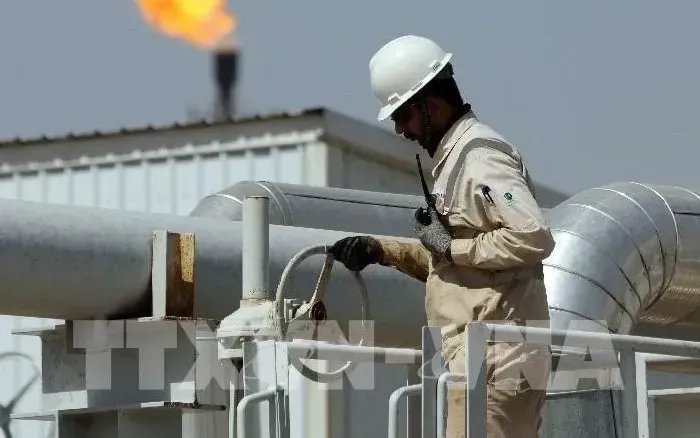
Oil prices rise, Europe fears supply shortages.
Energy strategists warn that Europe could face a real oil shortage within weeks, as global inventories plummet and US-Iran tensions show no signs of easing.
According to CNBC, many experts believe the oil market is currently only maintaining a "facade of stability," while physical supply is becoming increasingly strained. Societe Generale warned that even if the Strait of Hormuz reopens in early June, the global oil supply chain will still need at least 52 days to fully recover. The Strait of Hormuz currently accounts for about 20% of global oil and gas supply, but the flow has been severely disrupted since the US-Iran conflict erupted in late February. In early week trading, Brent crude rose to over $110 per barrel, while US WTI crude surpassed $106 per barrel. Some experts warn that if the crisis persists, oil prices could approach $150 per barrel this year.
The Director of the International Energy Agency (IEA), Fatih Birol, warned that commercial oil reserves are rapidly depleting and will only last for a few weeks due to the continued blockade of the Strait of Hormuz. He noted that while efforts to release strategic reserves have added 2.5 million barrels per day to the market, this supply is not inexhaustible.
To ease the pressure, the US announced it would extend the sanctions waiver for Russian oil shipped by sea for another 30 days.
Regarding diplomatic efforts, observers note that a fragile ceasefire is being maintained with Pakistan acting as a mediator. Although Iran revealed that the US had agreed to a temporary sanctions waiver during negotiations, experts at the energy consulting firm Ritterbusch and Associates assess that progress toward a diplomatic solution has been minimal since mid-March 2026.
Capital Economics, a research firm, warns that if the Strait of Hormuz is not reopened in the next few weeks, major economies face the risk of recession and escalating inflation. This scenario could force central banks, including the US Federal Reserve, to trigger a new cycle of interest rate hikes.
Source: https://vtv.vn/gia-dau-tang-chau-au-lo-ngai-thieu-cung-100260519092719766.htm
![[Image] Hanoi's urban life under the challenge of a "scorching hot" environment](https://vphoto.vietnam.vn/thumb/1200x675/vietnam/resource/IMAGE/2026/05/25/1779706979265_nang-nong-t5-2026-minh-duy-7-4636-jpg.webp)




![[Image] Close-up view of the interchange connecting the two expressways and Long Thanh Airport.](https://vphoto.vietnam.vn/thumb/1200x675/vietnam/resource/IMAGE/2026/05/25/1779703378210_ndo_br_z7863716673926-224453a31600126cce10622af6290afd-4549-jpg.webp)
















































































Comment (0)