

In this context, family values are considered a "green driving force"—a direct endogenous resource that determines the quality of sustainable development, creating soft power for the nation to integrate and thrive in the new era.

The joy of reuniting with loved ones for officers, doctors, and nurses of Field Hospital Level 2 No. 4 after a year of service at the United Nations peacekeeping mission in South Sudan. Photo: Minh Duc/VNA
Synchronized cultural ecosystem
The Resolution of the 13th National Congress of the Communist Party of Vietnam clearly defined the country's development goals until 2045, emphasizing the building of national values, cultural values, and standards for Vietnamese people. However, for these resolutions to be implemented effectively, a new, more systematic approach is needed.
From a research perspective, Dr. Nguyen Viet Hung, former Head of the Party Building Department at the Ho Chi Minh City Academy of Cadres, argues that the highlight of current strategic orientations is their comprehensiveness and synchronicity. The cultural ecosystem encompasses values ranging from the individual Vietnamese people's values during the process of opening up and integration to family, community, and social values. In particular, the traditional "family - village - nation" philosophy has been modernized. This represents the compression, integration, and adaptation of cultural values for new development, helping us to both promote national identity and embrace modernity.
In that ecosystem, the family plays the role of a "cell," the origin and nurturing ground for the first moral values. The recognition of culture as a "soft power" of the regime is not merely theoretical but a culmination of historical practice and the urgent demands of the times.
Analyzing the core components of this "cell" in more detail, Dr. Vu Ngoc Hoa, Deputy Director of the Ho Chi Minh City branch of the Academy of Public Administration and Management, argues that Resolution No. 80-NQ/TW has established a system of Vietnamese family values comprising four pillars: prosperity, happiness, progress, and civilization. Just four words, seemingly simple, yet containing profound meaning. The first two are "prosperity" and "happiness".
If "well-being" is defined in terms of material well-being, "happiness" is viewed from a spiritual perspective. This harmonious combination creates a solid foundation for a family. However, in the current era, our Party has added two more values: "progress" and "civilization." This affirms that the modern Vietnamese family not only preserves tradition but also must absorb the best of humanity to develop, explains Dr. Vu Ngoc Hoa.
The concept of "green momentum" is often mentioned in economics in the sense of environmental protection, but in the socio-cultural field, it carries a deeper and more humanistic meaning. It is the capacity to drive development from within, based on ethics and social responsibility.
According to Dr. Vu Ngoc Hoa, the core issue lies not only in identifying values but in transforming them into concrete actions. The "green driving force" here is development that does not sacrifice the future for short-term gains, and it is about respecting people and the environment.
To achieve this, Dr. Vu Ngoc Hoa proposed a four-step roadmap: First, education must be the foundation for transforming values into habits and norms into character. Second, values need to be institutionalized into specific policies, placing people at the center of all creativity and governance. Third, build a social environment that honors goodness, decent people, and responsible businesses. Finally, the role of the media is extremely important in making a beautiful lifestyle more accessible and appealing.
"When values are not only discussed in forums but are lived out daily in every home, culture will truly become a green driving force for Vietnam's sustainable development," affirmed Dr. Vu Ngoc Hoa.
To further clarify the process of disseminating these values, Dr. Nguyen Viet Hung argued that it must begin in the family, then spread to schools, community organizations, and eventually form a larger community at the national level, and even higher at the regional and international level. This is precisely the compression, integration, and transformation of cultural values for new development, allowing us to simultaneously promote national identity and modernity, bridging theoretical understanding and practical experience.
"When we consider culture as a 'green driving force' that is the soft power of the regime and the revolutionary , scientific nature of the Party, culture will help establish its important role in the development of the country and the regime in the new era," Dr. Nguyen Viet Hung confidently believes.
From "building a home" to a strong government.

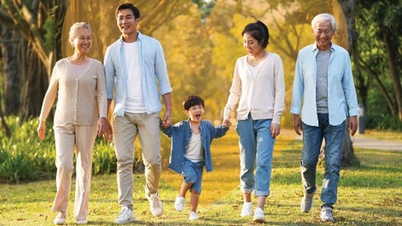
A family takes a commemorative photo on the occasion of the 50th anniversary of the Liberation of Southern Vietnam and the reunification of the country (April 30, 2025). Photo: Khanh Hoa/TTXVN
For family values to truly permeate daily life, the role of grassroots organizations is irreplaceable. In many localities, the movement to build a cultured way of life has undergone significant transformations, no longer remaining at the level of mere formal titles.
Mr. Huynh Gia Giang, Chairman of the People's Committee of Ban Co Ward, Ho Chi Minh City, believes that the ultimate goal of all cultural policies must be the happiness of the people. The shift from the criteria of "Culturally Advanced Family" to "Happy Family" is a qualitative step forward. This is because happiness encompasses prosperity, harmony, and satisfaction with the services provided by the local government.
In reality, in many neighborhoods, protecting family values sometimes begins with very specific and decisive actions. Ms. Ngo Thi Thanh, Secretary of the Party Branch of Neighborhood 30, Dien Hong Ward (Ho Chi Minh City), shared about the active network of association officials who are always closely involved with each household.
"We respond immediately when problems arise, from mediating conflicts to intervening in child abuse. Our highest goal is to protect the rights of women and children and maintain the stability of the home," Ms. Thanh said.
Simultaneously, shaping the values of young people through practical activities is the best way to create natural "resistance" against distorted narratives or acts of sabotage against the ideological foundations of hostile forces.
Mr. Le Van Minh, Secretary of the Party Committee of Dien Hong Ward, Ho Chi Minh City, shared his experience in organizing movements to connect young people with the community. Instead of dry lectures, young people are encouraged to participate in "neighborly solidarity" activities, assisting residents in using online public services or participating in charitable programs.
"Through ordinary but community-oriented activities, young people feel proud of their contributions. This happiness and sense of responsibility create strong resilience, helping them to be 'immune' to manifestations of 'self-evolution' and 'self-transformation'," Mr. Le Van Minh affirmed.
From the perspective of young people, Ms. Nguyen Thi Ngoc Tram, a Party member of the Office of the People's Council and People's Committee of Ban Co Ward, believes that the family is not only "a place to return to" but also the first environment for shaping a citizen's character. The younger generation has the responsibility not only to preserve family traditions but also to strive for "progressive" and "civilized" values such as gender equality, respect for children's rights, and a green, clean, and environmentally friendly lifestyle.
"I always remind myself to be 'close to the people,' to process applications on time and not cause inconvenience to the people. This is how I bring the value of 'dedication' from my family into serving the people, transforming family culture into a practical strength to build a strong government apparatus," added Ms. Ngoc Tram.
It can be said that family values are the "core" of national values. When each family truly becomes a "fortress" of compassion, integrity, and responsibility, the nation will have a solid foundation to face any changes.
The journey towards 2045 requires solid steps from the "cells" of the family – the "green driving force" for sustainable development. This is not only an aspiration for a materially prosperous Vietnam, but also for a nation rich in spirit, where cultural identity and human values are preserved and strongly promoted in the flow of the times.
According to VNA
Source: https://baoangiang.com.vn/gia-dinh-dong-luc-xanh-cho-phat-trien-ben-vung-a485976.html

![[Image] Close-up view of the interchange connecting the two expressways and Long Thanh Airport.](https://vphoto.vietnam.vn/thumb/1200x675/vietnam/resource/IMAGE/2026/05/25/1779703378210_ndo_br_z7863716673926-224453a31600126cce10622af6290afd-4549-jpg.webp)



![[Image] Hanoi's urban life under the challenge of a "scorching hot" environment](https://vphoto.vietnam.vn/thumb/1200x675/vietnam/resource/IMAGE/2026/05/25/1779706979265_nang-nong-t5-2026-minh-duy-7-4636-jpg.webp)








































































Comment (0)