

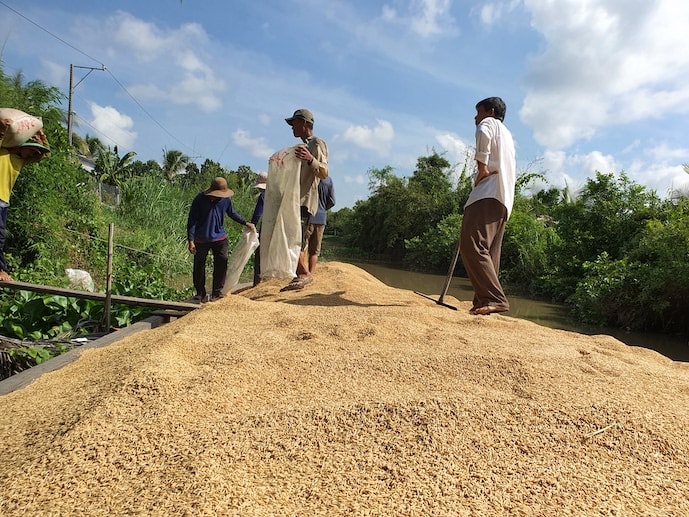
In the Mekong Delta, the price of CL 555 raw rice decreased by 50 dong, to 8,200 – 8,300 dong/kg; OM 380 decreased by 100 dong, to 7,850 – 7,900 dong/kg. Other raw rice varieties such as IR 504, OM 18, OM 5451 and Jasmine generally maintained stable prices.
At retail markets, rice prices remained stable. Fragrant rice ranged from 18,000 to 22,000 VND/kg; regular rice from 15,000 to 16,000 VND/kg; and Nang Nhen rice continued to be the highest at 28,000 VND/kg.
The glutinous rice and by-product segments also maintained stable prices. Fresh and dried glutinous rice commonly ranged from 7,700 to 8,000 VND/kg, while dried IR 4625 glutinous rice reached 9,700 to 9,900 VND/kg. OM 5451 broken rice was priced at around 7,400 to 7,500 VND/kg; bran fluctuated from 7,700 to 7,800 VND/kg; and rice husk was at 1,000 to 1,150 VND/kg.
In provinces such as An Giang, Dong Thap, Hau Giang, Kien Giang , and Can Tho, the summer-autumn rice crop is being harvested sporadically, but purchasing power is slow. Fresh rice prices are mostly stable.
According to the An Giang Provincial Department of Agriculture , rice prices today remain stable: Dai Thom 8 and OM 18 rice at 6,800 VND/kg; Nang Hoa 9 from 6,650 – 6,750 VND/kg; OM 5451 from 6,200 – 6,400 VND/kg; IR 50404 from 5,400 – 5,600 VND/kg; OM 380 from 5,200 – 5,400 VND/kg.
According to the Vietnam Food Association (VFA), Vietnamese export rice prices on June 11th showed no new fluctuations. Specifically, 5% broken rice remained at US$393/ton, higher than Pakistan (US$392/ton) and India (US$384/ton), but lower than Thailand (US$401/ton). 25% broken rice and 100% broken rice were offered at US$364 and US$321/ton, respectively.
On the supply side, An Giang province aims to plant 618,000 hectares of rice in 2025, with an expected yield exceeding 4 million tons. A key focus of the local rice industry is the shift towards high-quality, environmentally friendly production for official export.
Farming models based on the "1 must, 5 reductions" standard, VietGAP, and GlobalGAP are being widely adopted. Many growing areas have obtained international codes and certifications, helping An Giang rice expand exports to demanding markets such as the US, South Korea, and the EU.
Currently, over 90% of An Giang's rice exports are concentrated in Asia, with the remainder distributed to Europe, Africa, and Oceania. However, export activities still face numerous challenges due to the impact of the global economic recession and geopolitical tensions.
Although India has resumed rice exports, this is expected to have little impact on Vietnam's market share of high-quality rice. Indian rice mainly falls into the category of low-cost raw materials, while Vietnam, especially An Giang province, is promoting fragrant, specialty, and organic rice varieties, targeting the premium segment.
The An Giang Department of Industry and Trade announced that it will continue to strengthen trade promotion, connect businesses with trade attachés, and expand international distribution channels. Notably, from 2025, the province will implement a project to build the An Giang rice brand to enhance its position in the global market through official exports and cross-border e-commerce.
Source: https://baonghean.vn/gia-lua-gao-hom-nay-11-6-gao-nguyen-lieu-giam-nhe-10299396.html








































































Comment (0)