

As a precaution, since we have not yet been able to retrieve the original documents, we understand and place the time when Hui Bon Hoa, also known as Uncle Hoa, came to establish his business in Southern Vietnam between 1865 and 1875, corresponding to his age of 20.
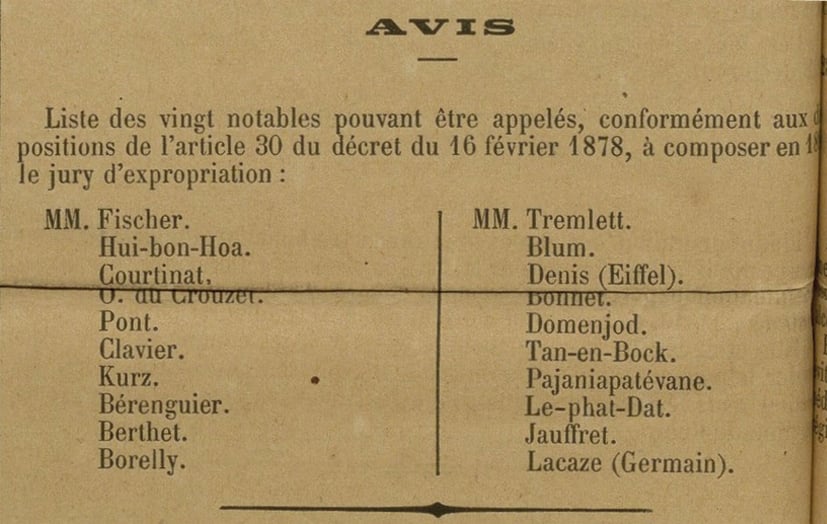
Announcement that Hui Bon Hoa was elected to the jury of Cochinchina - Photo: Source: Official Gazette of French Cochinchina, December 16, 1895
According to her great-granddaughter Odette Hui Bon Hoa, as reported in Air Corsia's ARIA newspaper, before her 20th birthday (in 1865), Hui Bon Hoa boarded a ship and fled her homeland during a famine.
When he arrived in Saigon, the young man had only a mat as his luggage.
Crossing the sea to Saigon
The story of "Hui Bon Hoa and his son, with only a few silver coins in their pockets, trudging into Vietnam," as often written by later generations, is probably just a literary interpretation. Between 1865 and 1875, Hui Bon Hoa never brought, and could not have brought, any of his children with him.
Family history records that Hui Bon Hoa's eldest son, Trong Mo, was adopted by an uncle (in his hometown).
As for the second son, Trong Huan, according to the memorial stele at the tomb in Di An, Binh Duong , he was born in Xiamen in 1876.
The third child, Trong Tan, was also born in Xiamen at the end of 1878 (because his father returned there). Later, the whole family migrated to Quanzhou.
On the other hand, the Chinese have always had a strong sense of community, so Hui Bon Hoa must have traveled on the ship with people from his extended family or been welcomed and sponsored by fellow countrymen at his destination, as was the immigration rule at the time.
Hui Bon Hoa's fourth son, Trong Binh or Tang Phien Hui Bon Hoa, was born in Saigon in 1893, 15 years after Trong Tan.
If he was the sixth child in the family, as Chen Bichun wrote, then between Trong Tan and Trong Binh there were two sisters, because Hui Bon Hoa had a total of four sons. The next child (Khien Ha Hui Bon Hoa) was born in 1894 also in Saigon, thus making him the seventh child and automatically a "French citizen" like Tang Phien because his father had acquired French citizenship.
Chen Bichun noted that Hui Bon Hoa and his wife had 11 daughters. If so, since he died in 1901, it doesn't make much sense that they had eight more daughters in the last seven years of his life. Unless there were more sisters between Trong Tan and Trong Binh, and Trong Binh wasn't the sixth child but even younger. We only know about seven of Hui Bon Hoa's children.
Hui Bon Hoa had to travel frequently between Saigon, Xiamen, and Quanzhou until his wife (Mrs. Trinh, born in 1855) and children moved to Saigon with him. If he had been in Southern Vietnam since 1865, after a decade Hui Bon Hoa would surely have settled down in his work and life.
So why didn't he bring his wife and children with him when he got married? Why did he let her give birth in Xiamen and then migrate to Quanzhou? Could it be that Hui Bon Hoa arrived in Saigon later than 1865, contrary to what some accounts suggest?
In any case, the story of Hui Bon Hoa's separation and reunion, or the story of Hui Bon Hoa's struggles to build a career as a single man, reflects the typical situation of Chinese people living abroad.
Before Hui Bon Hoa "entered the French village," the population of Saigon (excluding Cholon) as of December 31, 1886 (according to the 1887 French Annam Yearbook) was 18,009 people (8,846 men, 4,091 women, 5,072 children), of which only 3 men, 3 women, and 19 children were Chinese who had acquired French citizenship.
The Vietnamese population is 8,986 people, including 2,517 men, 2,767 women, and 3,702 children; this ratio reflects the typical population balance of native Vietnam.
The Chinese community comprises 6,649 people (equivalent to 74% of the Vietnamese population), but the majority are male – 4,856 people (almost double, 193%, compared to Vietnamese men in Saigon) – while there are only 817 women (Chinese women make up less than 17% of Chinese men) and 976 children.
This severe gender imbalance partly reflects the political and economic context of Saigon at the time, a place of promise for arduous work and entrepreneurship for Chinese men, rather than a place of permanent residence for their families, and undoubtedly posed many socio-cultural challenges for the contemporary authorities.
The Chinese immigrants who had acquired French citizenship, owned properties, and had connections with the government, served as effective intermediaries in managing political, economic , and socio-cultural activities related to the Chinese community in Saigon.
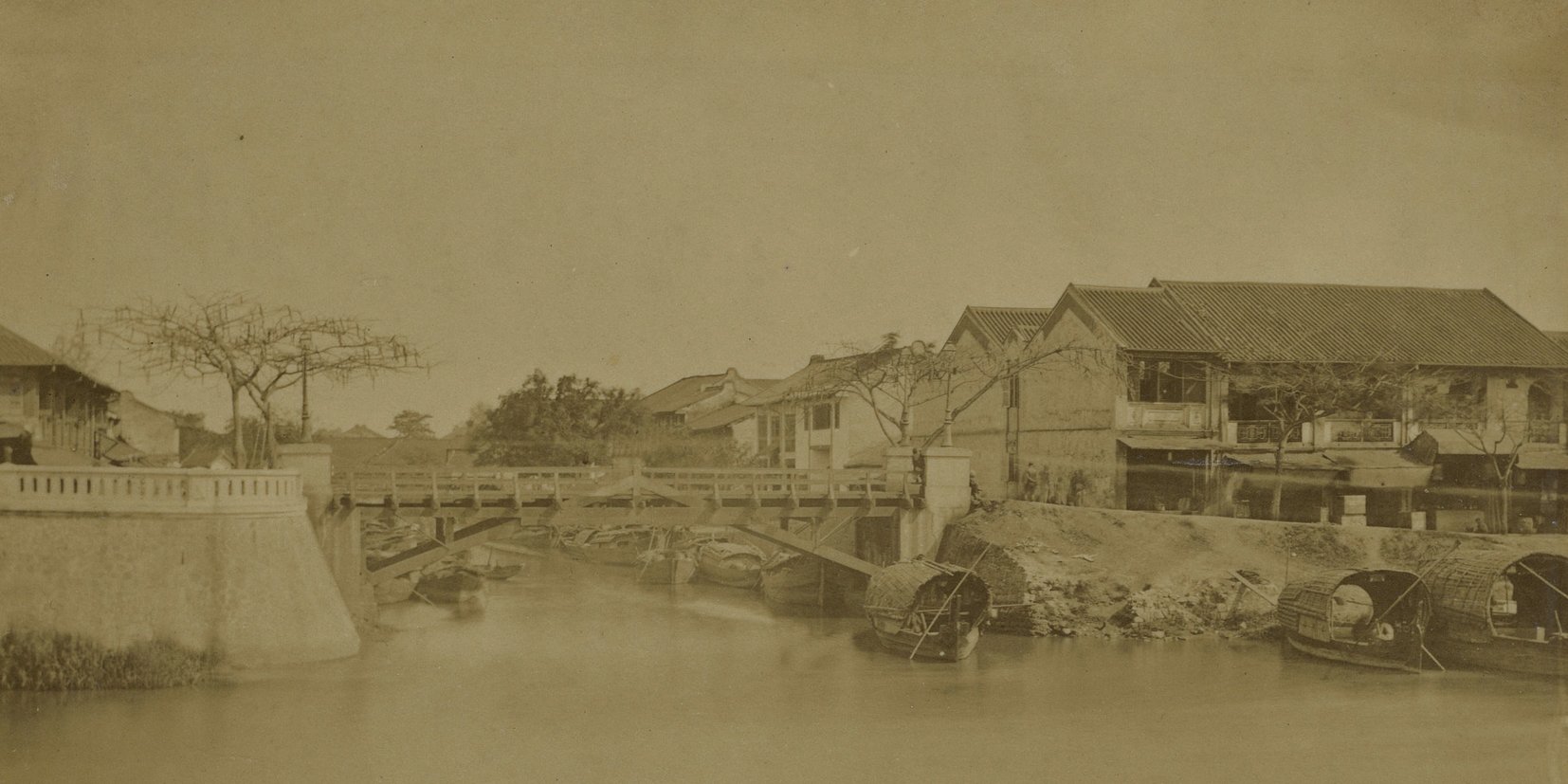
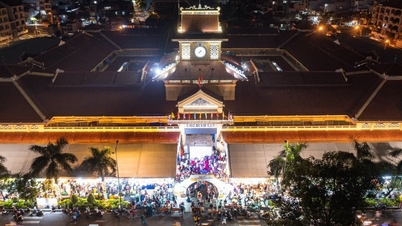
A view of Cholon Market around the 1890s - Photo: Source: Digital Library, University of Côte d'Azur, Nice
Uncle Hoa - a man who worked as a juror in Southern Vietnam.
During the years 1870-1875, Hui Bon Hoa was not yet a well-known name among the Chinese community. People often mentioned the Wang Tai family (also known as Chiong Lam or Truong Bai Lam, from Hong Kong) who owned a brick and tile factory in Saigon and also traded in rice;
The A Pan family ran a beverage and food business and also owned a brick and tile factory; the Tan Keng Sing brothers (Tran Khanh Tinh, from Singapore), including Tan Keng Ho (Tran Khanh Hoa), who once served on the Saigon City Council; the Ban Hap family (Nhan Van Hop) traded in rice, contracted opium, and also managed a pawn shop in Cho Lon...
In 1881, A Pan joined the Saigon City Council. He also took over the Saigon pawnshop, in which the Ogliastro family had invested, with Mr. Lamache acting as a sworn agent. The Ogliastro family then partnered with Blutstein, and Blutstein was the director of the pawnshop.
At this time, it is highly likely that Hui Bon Hoa is working for A Pan. He and a cousin from the same hometown named Hui Toan (also known as Huynh Truyen) have applied for French citizenship but have not yet been approved.
In 1884, announcements in several issues of the French-run Cochinchina Official Gazette stated that A Pan had returned to China due to health reasons, delegated (the administration of A Pan et Cie) to Hui Toan and Hui Bon Hoa, and then transferred the directorship and operation of the Saigon pawnshop to Hui Bon Hoa.
In 1885, it can be said that the Huynh (Hui) family completely took over the A Pan Company, renaming it Hui Toan et Cie with Mr. Hui Toan as representative and Mr. Hui Tchoau participating (Official Gazette of French Indochina, July 6, 1885).
In 1887, Hui Bon Hoa was granted French citizenship. Mr. A. Ogliastro joined the Saigon Chamber of Commerce, whose members included Ban Hap and Wang Tai. Oscar du Crouzet joined the Cholon City Council (which included Ban Hap).
In the same year, an article published in the Official Gazette of French Cochinchina on June 30, 1887, stated that Hui Toan had been selected to the jury of Cochinchina, which consisted of 20 socially respected individuals. Hui Toan also served his term in 1889.
From 1887 onwards, the Huynh family, starting with Boun Tchao Sia in general and Hui Bon Hoa in particular, gradually expanded their business and gained a reputation, alongside the Wang Tai and Ban Hap families and other prominent Chinese immigrants.
In addition to their previous business activities and pawnshop contracting, the A Pan family began to focus on accumulating land and building rows of rental properties (for both business and residential purposes), meeting the essential needs of newly immigrated Chinese in Saigon, or possibly other segments of the population as well.
But this activity only just began; it only became widespread when Hui Bon Hoa's sons, Trong Huan and Trong Tan, came to Saigon to help their father.
On December 16, 1895, the Official Gazette of French Cochinchina reported that Hui Bon Hoa had been selected to be on the jury list for Cochinchina.
This list includes a name familiar to Hui Bon Hoa, O. du Crouzet, a Vietnamese name who would later become very famous, Le Phat Dat, also known as Huyen Si ("the best scholar"), and also the name of a Chinese immigrant, Tan En Bock (son of Tan Keng Ho). Hui Bon Hoa was also elected to the jury in the 1901 term, but he died that same year.
**********************
On July 11, 1896, all three plots of land were transferred to the Hui Bon Hoa family. At this time, just three months after the land was transferred, the transfer value had skyrocketed to 1,300 piastres.
>> Next installment: Hui Bon Hoa's family and Uncle Hoa accumulate land in Saigon.
Source: https://tuoitre.vn/giai-ma-lai-chu-hoa-dai-gia-lung-lay-sai-gon-ky-3-hanh-trinh-chu-hoa-lap-nghiep-mien-dat-hua-20250322101344976.htm









































































Comment (0)