

Lower emissions, increased income for farmers.
According to the Ministry of Agriculture and Environment , for many years, the biggest competitive advantage of agricultural products has been their price and production volume. However, in the context of major import markets increasingly raising green standards, traceability requirements, and demands for transparency in carbon emissions throughout the entire production chain, reducing emissions is no longer simply an environmental issue, but a condition for agricultural products to maintain their competitiveness.
Now, low-emission production is no longer an experimental option but is gradually becoming a necessity for key agricultural sectors. Although not yet reaching 100%, the fact that 22 provinces and cities have developed plans to implement the "Reduced Emission Crop Production Project for the period 2025-2035, with a vision to 2050" shows that reduced-emission agricultural production is no longer a pilot project but has moved into the action phase, requiring the consensus and determination of localities.
For the agricultural sector, the central goal for the 2026-2030 period is to establish large-scale, low-emission agricultural production, linked to the circular economy , digital transformation, and efficient resource management. This transformation is being implemented synchronously across many key export sectors.
Deputy Minister of Agriculture and Environment Hoang Trung stated that, in the context of Vietnam's commitment to achieving net-zero emissions by 2050, the agricultural sector must undergo a strong transformation towards greener, lower-emission practices while still ensuring economic efficiency and increasing farmers' income. The implementation of the project needs to be linked to the goals of reducing input costs, increasing product value, meeting green standards for export markets, and gradually building a brand for "low-emission agricultural products" in Vietnam.
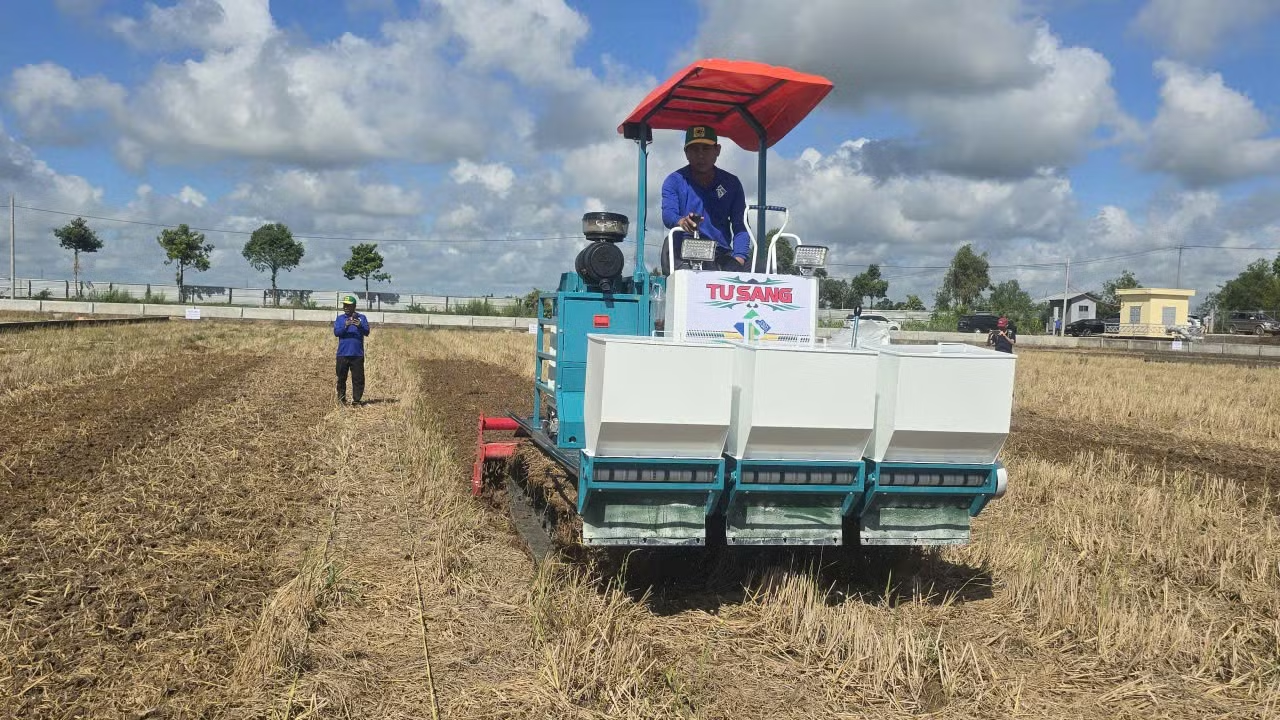
While previously, emission reduction was primarily discussed within the rice industry, its scope has now expanded to include other key sectors such as coffee, corn, and durian. These are all commodities with significant export value and are facing increasing pressure from international market environmental standards.
Currently, the focus of the agricultural sector is not on selling carbon credits or participating in the international carbon market, as this is still a complex process that requires many years to perfect the mechanisms. To meet the requirements of green development, Mr. Trung believes that the biggest priority now is to establish new production processes that help agricultural products meet the demands of the future market.
In the long term, Mr. Trung said that the Ministry of Agriculture and Environment will continue to improve policy mechanisms, build a set of criteria for emission-reduction farming, develop brands for low-emission agricultural products, and form large-scale production areas linked to value chains and a synchronized emission data system. This will be an important foundation for the industry to gradually participate in the carbon market and carbon credit trading mechanisms in the future.
Mechanisms are needed to encourage public participation.
However, according to experts, without establishing appropriate market mechanisms, it will be difficult to maintain long-term public participation, as green transformation requires changes in production practices as well as additional initial investment. Therefore, building a "low-emission agricultural product" brand, assigning planting area codes, and establishing a traceability system are considered crucial solutions to increase product value.
For farmers, determining how much emissions are reduced and what the target is is the responsibility of the technical and management systems. The most important thing for them is that the process must help make production more efficient, reduce costs, and increase income. Therefore, according to him...
According to Hoang Van Hong, Deputy Director of the National Agricultural Extension Center, the technical procedures provided to farmers need to be simple and easy to apply, while still meeting international requirements for emission measurement.
“For farmers, the most important thing is to guide them to follow the correct procedures. In reality, they don't understand the concept of emission reduction. Simply following the correct emission reduction procedures will result in reduced-emission products. We train and educate farmers on implementing emission reduction procedures for rice, corn, coffee, and durian. For crops with high emissions like sugarcane, coconut, passion fruit, and dragon fruit, a more detailed roadmap is needed. Most importantly, we need to develop emission reduction production procedures. From there, agricultural extension officers will organize training for grassroots extension workers, and then farmers will be trained to understand the techniques,” Mr. Hong shared.
According to Mr. Nguyen Nhu Cuong, former Director of the Department of Crop Production, rice is currently leading in reducing emissions in the crop production sector with the "1 must, 5 reductions" process, which has been successfully applied in both the South and the North; followed by corn, coffee, and durian; and soon it will expand to other crops with billion-dollar export potential such as bananas, coconuts, passion fruit, and pineapples.
Therefore, it is urgent to develop and issue low-emission farming practices for each specific crop to serve as a basis for communication and mobilization of local people to support them. For long-term crops, according to Mr. Cuong, the focus should not only be on reducing emissions but also on researching and evaluating the carbon absorption capacity of this group of crops to gain a comprehensive understanding of green production.
Regarding the issue of carbon credits, Mr. Cuong emphasized that participating in the voluntary carbon credit market is very difficult due to high costs and involves many complex steps. Given the small-scale production in Vietnam, careful economic efficiency calculations are necessary instead of simply "following trends." If conditions are met and prices are favorable, participation in the carbon credit market is advisable. However, if conditions for selling credits are not yet met, it is necessary to affirm that emission reduction contributes to the NDC (Nationally Determined Contribution). From there, he suggested that the State should have policies to invest in and support the agricultural sector – a sector that is inherently risky and vulnerable.
Source: https://cand.vn/giai-phap-de-san-xuat-xanh-hon-phat-thai-thap-hon-post811844.html
![[Image] Hanoi's urban life under the challenge of a "scorching hot" environment](https://vphoto.vietnam.vn/thumb/1200x675/vietnam/resource/IMAGE/2026/05/25/1779706979265_nang-nong-t5-2026-minh-duy-7-4636-jpg.webp)

![[Image] Close-up view of the interchange connecting the two expressways and Long Thanh Airport.](https://vphoto.vietnam.vn/thumb/1200x675/vietnam/resource/IMAGE/2026/05/25/1779703378210_ndo_br_z7863716673926-224453a31600126cce10622af6290afd-4549-jpg.webp)












































































Comment (0)