

For many years now, every evening, the literacy class taught by Captain Lo Van Thoai, a professional soldier (Nam Lanh Border Guard Post - Son La Provincial Border Guard), has been lit up. The students are ethnic minority people from Muong Va commune, Sop Cop district, Son La province, aged 15 to 60.
"People are very happy to have access to literacy."
Visiting Captain Lo Van Thoai's literacy class in Pa Khoang village, Muong Va commune, one can see the extremely serious and disciplined learning atmosphere, just like a regular school class. Here, people not only learn to read and write, but Captain Thoai also inspires them about the meaning of literacy and learning, so everyone understands that learning is good for them and for their daily work.
Captain Thoai, born in 1981, is of Lao ethnicity. Born in Muong Va commune, Captain Thoai understands the lifestyle and culture of the local people. He joined the military in February 2002 and currently works in the Community Mobilization Team at the Nam Lanh Border Guard Post. Since March 2019, Captain Thoai has been working to eradicate illiteracy in Pa Kach village, Muong Lan commune. From 2022, this literacy program has expanded to many other villages in Nam Lanh and Muong Va communes of Sop Cop district.
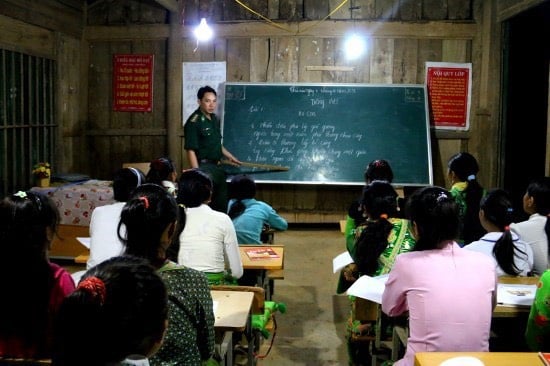
The literacy class is taught by military officer Lo Van Thoai.
"Nam Lanh and Muong Va are border areas with rugged terrain, difficult roads, low literacy rates, and underdeveloped economies , especially in the border villages. During a work trip in 2022 to Muong Va commune, we visited Pa Khoang village, about 20 km from the commune center. Here, the illiteracy rate is very high, outdated customs persist, and child marriage is still common. I wanted to teach the villagers to read and write, to write their names, to read newspapers, to learn household economic methods, and to apply scientific advancements to production," said Captain Thoai, explaining the reason for the literacy class currently being maintained in Pa Khoang village.
Driven by these concerns, Captain Thoai worked with local Party committees and authorities to obtain a list of illiterate and re-illiterate people in the village. He then advised the Party committee and unit commanders to coordinate with the district's education and training department to open this special literacy class.
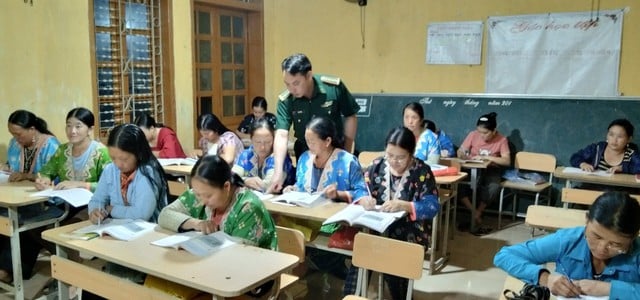
Captain Thoai recalled: "Initially, it was very difficult to persuade the villagers to attend the classes because they were the main laborers, working hard in the fields year-round. It took a while of campaigning, going to each house to persuade them, before they agreed to come to class. From 8 students, now many people voluntarily apply to join the class. They are very happy to have literacy."
Raising public awareness
Sharing his experience in eradicating illiteracy, Captain Thoai said that he applied the "four together" principle: eating together, living together, working together, and speaking the ethnic language together, to create a suitable and effective teaching method. From not knowing letters or numbers, after a period of time, they can read, write, and save the names of relatives in their phones. Many people realize that learning to read and understand not only helps them understand books but also greatly benefits their daily lives, such as: paying attention to their children's education and health care, learning about livestock farming for economic purposes, and becoming more confident in communication... Thanks to knowledge and understanding, the people's awareness of protecting security and order, and protecting border sovereignty, has also been increasingly enhanced.
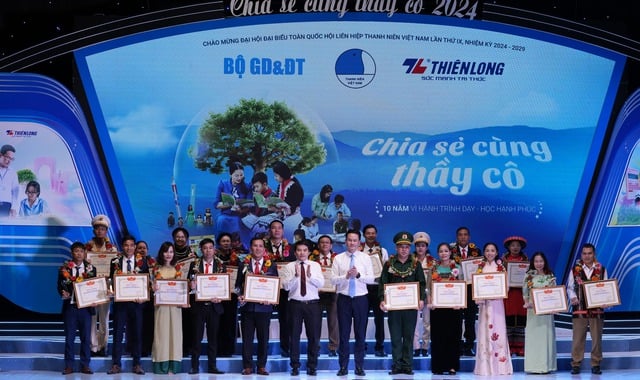
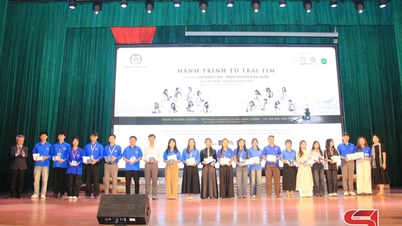
Captain Lo Van Thoai (in uniform, front row) was honored in the "Sharing with Teachers" program in 2024. (Photo provided by the subject)
In addition to literacy campaigns, Captain Thoai is also considered a cultural activist, actively disseminating information about the law, such as the Marriage and Family Law, to people in border areas. According to Captain Thoai, in ethnic minority villages, children as young as 13 or 14 years old get married and have many children despite difficult economic conditions. Furthermore, consanguineous marriage is common, resulting in many children being born with poor health.
"When attending classes, people are exposed to knowledge about marriage and family, health, and medicine, so their perceptions have gradually changed. They no longer urge their children to get married early, thanks to which the rate of child marriage has decreased to only about 1% - 2%; there is no longer consanguineous marriage, and people are more concerned about their physical health and mental well-being," Captain Thoai proudly shared.
It is also thanks to these literacy classes that, by learning to read and write, many people are able to search for agricultural technical documents on the internet to apply to agricultural production. A typical example is Ms. Giang Thi Pa De - Head of the Women's Association in Pa Khoang village.
Ms. Giàng Thị Pạ Dê shared: "Before, because I was illiterate, I always had to ask others to write applications for me, but now I can do it myself. Besides actively participating in social work, I also know how to sell goods online, which helps me earn extra income to support my children. Everyone here loves Teacher Thoại because he has helped dozens of people learn to read and write."
Having served 23 years in the military, protecting the nation's borders, Captain Lo Van Thoai, a professional soldier, is considered a shining example of border defense, helping people overcome illiteracy and build a new life.
For his contributions, Captain Lo Van Thoai received two commendations from the Ministry of Education and Training; he was also one of 60 exemplary teachers honored in the "Sharing with Teachers" program in 2017 and 2024, organized by the Vietnam Youth Union in coordination with the Ministry of Education and Training and Thien Long Group.
Captain Lo Van Thoai expressed: "I am deeply moved when the villagers affectionately call me 'Teacher Thoai' or 'the teacher in military uniform'. This gives me more motivation in teaching as well as guiding the villagers in economic activities, contributing to building and protecting the villages in the border region."
Source: https://nld.com.vn/gieo-chu-o-vung-cao-196250412213405874.htm









![[Photo] Prime Minister Pham Minh Chinh receives the Chinese Ambassador to Vietnam](https://vphoto.vietnam.vn/thumb/1200x675/vietnam/resource/IMAGE/2026/04/05/1775397481797_ndo_br_dsc-5512-jpg.webp)




































Comment (0)