Unique rock musical instruments and caves.
The Dak Son stone xylophone, a national treasure, was discovered in 2014 in Dak Son village, Nam Xuan commune, Krong No district (formerly Dak Nong province). Scientists have identified the stone xylophone as one of the oldest musical instruments in Vietnam.
Immediately after its discovery, the Dak Nong (formerly) Provincial Museum surveyed the site, collaborated with the Southern Region Institute of Social Sciences (Ho Chi Minh City) to conduct archaeological assessments and measure sound frequencies (2016), and simultaneously excavated to clarify its connection with the Dak Son relics (2017). The instrument was crafted from rhyolite stone, a type of stone characteristic of the Central Highlands and Southeast Vietnam.
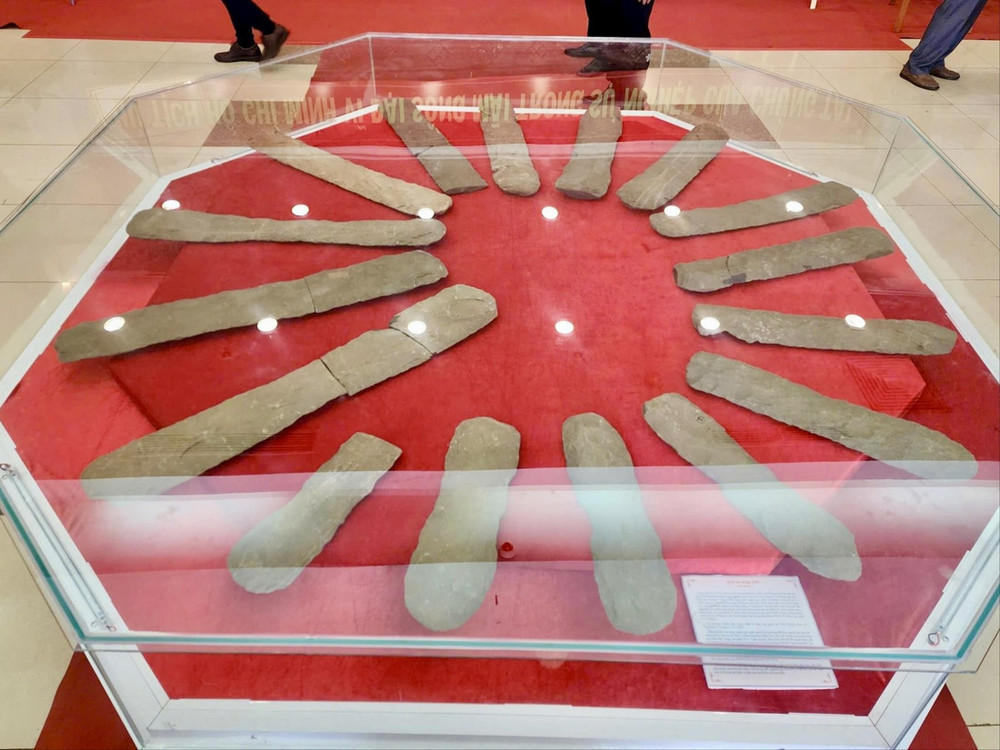
Dak Son stone musical instrument set
The instrument, dating back 3,500-3,000 years, consists of 16 bars (11 intact, 5 broken bars that can be reassembled), rectangular and waist-shaped. Each bar averages 57cm in length, 12.4cm in width, and 3cm in thickness, weighing approximately 3.9kg, with a range of 191.9Hz to 4,500Hz.
The C3-C4, C7, and C8 cave complexes have also recently been classified as National Monuments. These caves were formed between 200,000 and 600,000 years ago from lava flows from the Nam B'Lang volcano.
Caves C3-C4, nearly 1km long, located in Buon Choah and Nam Da communes, Krong No district, former Dak Nong province (now Lam Dong province), are considered one of the most beautiful and unique caves in the UNESCO Dak Nong Global Geopark. The Ministry of Culture, Sports and Tourism has classified this cave complex as a National Monument in Decision No. 1014/QD-BVHTTDL dated April 14, 2025.
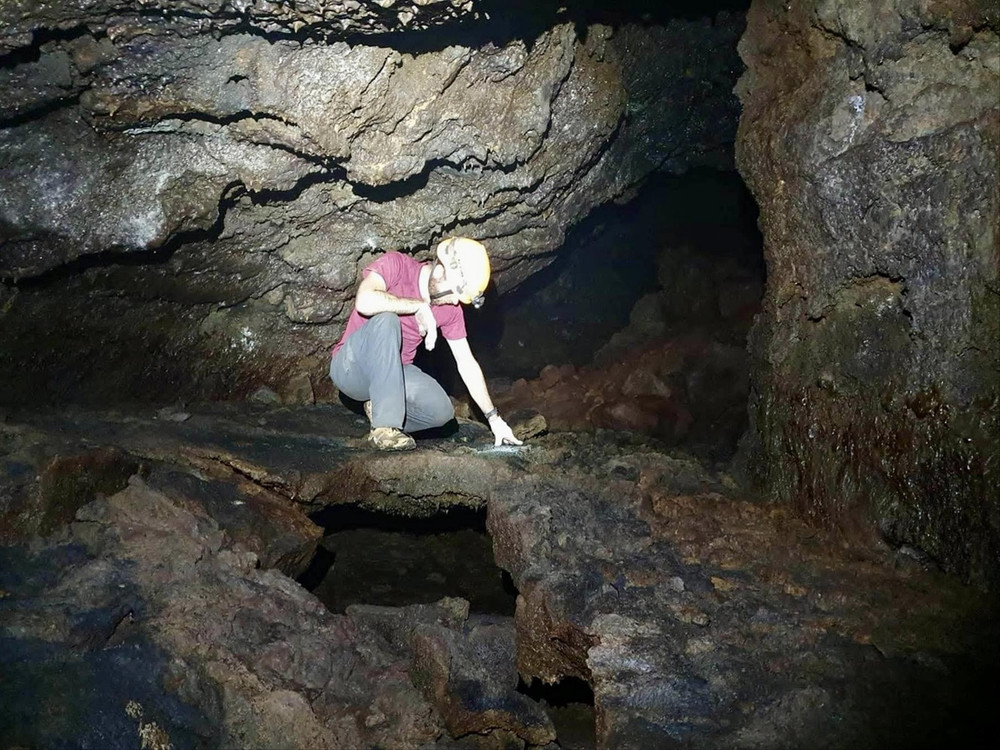
Cave 7 has just been recognized as a national-level scenic site.
Caves C7 and C8 are located in Nam Da commune, Buon Choah commune, and Dak Sor commune, Krong No district, former Dak Nong province. These are two representative caves in the Krong No volcanic system. Notably, cave C7 is 1,200m long and has been recognized by UNESCO as the longest lava cave in Southeast Asia. On September 9, 2025, the Ministry of Culture, Sports and Tourism recognized C7 and C8 as National Monuments according to Decisions No. 3245/QD-BVHTTDL and 3246/QD-BVHTTDL.
“The Dak Son stone xylophone has exceptional historical, archaeological, and cultural value, confirming it as a unique indigenous product of the Central Highlands from prehistoric times. From the sound of the stone xylophone, we seem to hear the sounds of a thousand years ago echoing to the present day and reverberating into the future.”
Associate Professor Bui Van Liem, Standing Vice President and General Secretary of the Vietnam Archaeological Association
The Tam Blang M'prang Bon festival (the ceremony of offering sacrifices to the village and planting trees) of the M'Nong people in Nam Nung commune (Lam Dong province) has also been recognized as a National Intangible Cultural Heritage. The festival is usually held every 3-5 years during the dry season (January-March annually), attracting a large number of villagers. This is an opportunity for the community to rest after the farming season, celebrate together, give thanks to the gods, and pray for health, a bountiful harvest, and peace in the village.
The festival, deeply rooted in the M'Nong ethnic identity, not only preserves long-standing traditions but also creates a cultural space for community bonding, where people meet, share, and strengthen solidarity. Through this, they pray for good health, peace in life, and success in agricultural production.
Expectations for a breakthrough in cultural tourism.
Lam Dong province currently has 144 historical and cultural relics and scenic spots ranked by the State; 3 national treasures; 10 intangible cultural heritage sites recognized as national heritage sites and 7 heritage sites inscribed by UNESCO.
At the ceremony recognizing three national heritage sites, Mr. Nguyen Van Loc, Director of the Department of Culture, Sports and Tourism of Lam Dong province, emphasized: “The simultaneous recognition of three heritage sites not only acknowledges their exceptional value in archaeology, geology, and culture, but also marks an important turning point in the conservation and promotion of the local cultural heritage. This will be the foundation for Lam Dong to open up many opportunities for sustainable socio-economic development, especially in the field of cultural tourism.”
Mr. Loc said that in the coming time, the Department will advise the Provincial People's Committee to implement many specific solutions: strengthening the promotion and advertising of heritage; building cultural and experiential tourism tours associated with treasures and scenic spots; organizing exhibitions and thematic events; and combining the development of accommodation and culinary services to attract domestic and foreign tourists.
The Dak Son stone xylophone could become the heart of art performances, linked to experiential tourism at the museum. The Tam Blang M'prang Bon festival will be held annually, opening up opportunities for tourists to immerse themselves in the life of the M'Nong community.
The C3-C4, C7, and C8 volcanic cave systems will be a specialized exploration route, adding to the map of adventure ecotourism. "We are committed to preserving and spreading the value of this heritage so that it becomes a shared asset of the community, while contributing to the development of tourism and promoting the image of our province," Mr. Loc affirmed.
Meanwhile, Vice Chairman of the Lam Dong Provincial People's Committee Dinh Van Tuan stated that, with its strategic location connecting the Central Highlands, the South Central Coast, and the Southeast region, along with its diverse topography from plateaus to the sea, Lam Dong has a solid foundation for developing a multi-sectoral, sustainable, and distinctive economy.
“In this new phase, the province has identified three pillars—culture, tourism, and trade—as both key economic sectors and spaces for the convergence of intellect, identity, and technology, opening up breakthroughs for Lam Dong to converge and shine.”
"With the attention of the central government, the province has intensified efforts to preserve, conserve, and promote the value of tangible and intangible cultural heritage," Mr. Tuan said.
Source: https://tienphong.vn/kho-bau-giua-dai-ngan-post1781024.amp


![[Photo] Admire the coral "masterpiece" amidst the million-year-old heritage of Dak Lak province.](https://vphoto.vietnam.vn/thumb/1200x675/vietnam/resource/IMAGE/2026/05/31/1780221235105_anh-man-hinh-2026-05-31-luc-16-53-27.png)
![[Photo] The General Secretary, President and his wife begin their state visit to the Philippines.](https://vphoto.vietnam.vn/thumb/1200x675/vietnam/resource/IMAGE/2026/05/31/1780230559452_anh-man-hinh-2026-05-31-luc-19-28-11.png)
![[Photo] Solemn bathing ceremony and Buddha procession in Hue](https://vphoto.vietnam.vn/thumb/1200x675/vietnam/resource/IMAGE/2026/05/31/1780228263543_1-jpg.webp)
![[Image] Hanoi Police officially crowned champions of V-League 2025/2026](https://vphoto.vietnam.vn/thumb/1200x675/vietnam/resource/IMAGE/2026/05/31/1780244769054_ndo_br_039d561b692be875b13a-jpg.webp)




















![[Video] Sunset at Lap An Lagoon – Where the sun sets over the fishing nets](https://vphoto.vietnam.vn/thumb/340x192/vietnam/resource/IMAGE/2026/05/31/1780192137701_beach-landscape-sea-water-nature-grass-745871-pxhere-com.jpeg)




























![[Photo] Admire the coral "masterpiece" amidst the million-year-old heritage of Dak Lak province.](https://vphoto.vietnam.vn/thumb/402x226/vietnam/resource/IMAGE/2026/05/31/1780221235105_anh-man-hinh-2026-05-31-luc-16-53-27.png)





























Comment (0)