Reporter (R): Sir, why is the Hung Kings Commemoration Day considered a unique cultural feature of our nation? Assoc. Prof. Dr. Bui Xuan Dinh: We should call it, and need to call it, the Commemoration Day of the Hung Kings for greater accuracy. According to linguists, Hung King is a Sino-Vietnamese concept, and the Chinese characters were only adopted by our ancestors at the beginning of the Common Era; while the worship of the nation's ancestors originated at the latest in the 7th century BC. According to linguists, "Hung King" originates from the ancient Tay Thai language, meaning "Pò khun," or "Father of a region." Returning to the story of the Hung Kings Commemoration Day, it can be said that this is a unique cultural feature of the ethnic groups in Vietnam and of the Vietnamese nation. To understand this clearly, we need to recall the origins of the worship of the Hung Kings.
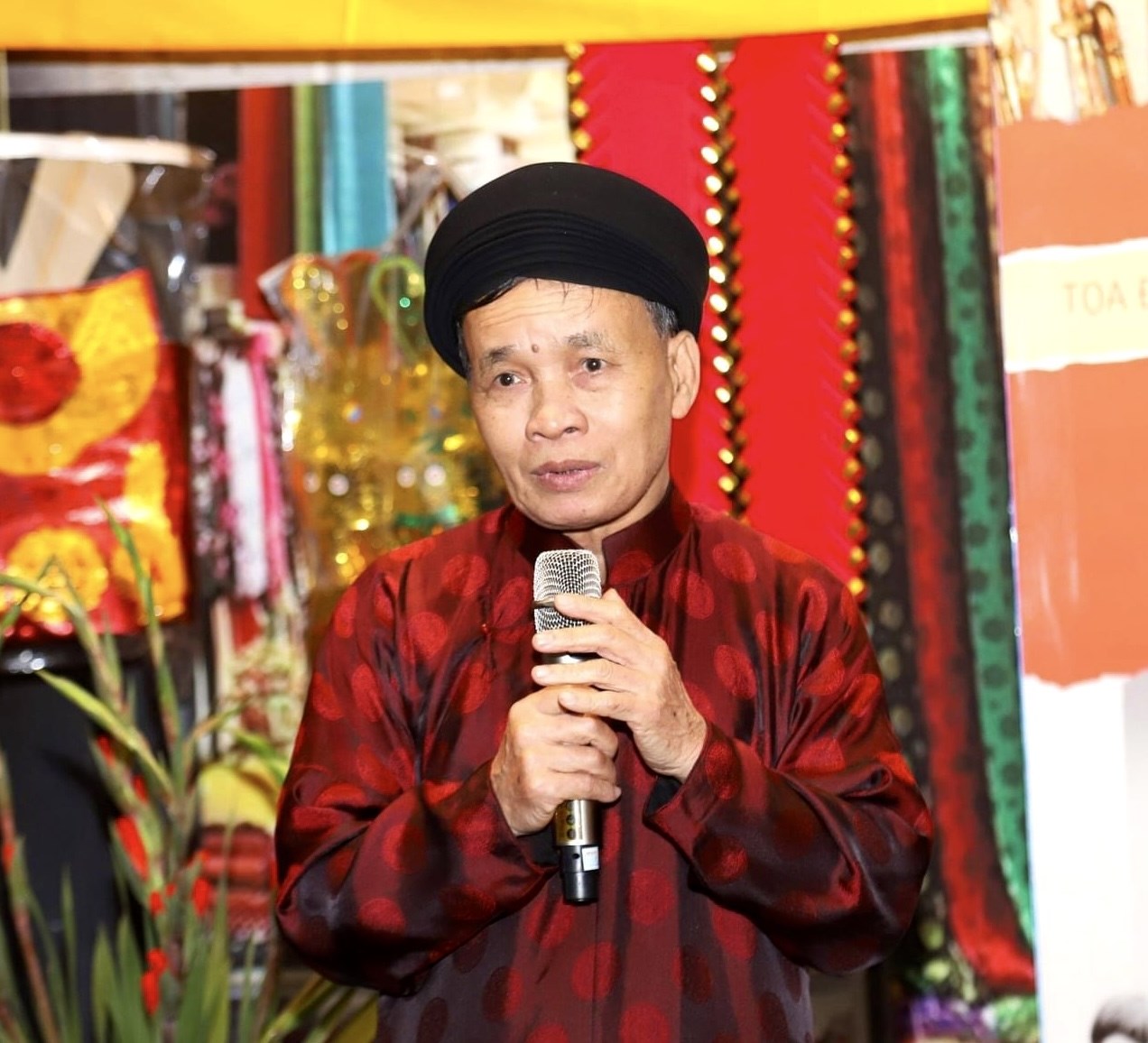 |
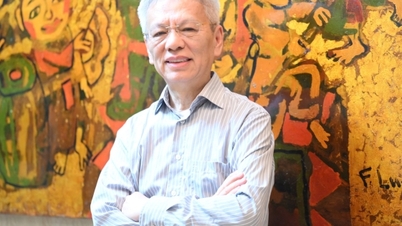
Associate Professor, Dr. Bui Xuan Dinh. |
Archaeological sources indicate that approximately 4,000 years ago, humanity entered the Bronze Age, resulting in significantly higher labor productivity than before. This revolutionary change in production and
economics led to a turning point in society: the matriarchal clan system weakened and was replaced by the patriarchal clan system; the patriarchal family and monogamy replaced the matriarchal, polyandrous family; men rose from a low, dependent status to become heads of the family; and the worship of patriarchal clan ancestors, with its clear and standardized rituals, institutions, and customs, undertaken by men, emerged, replacing the worship of matriarchal clan ancestors. Vietnam also followed this trend. According to archaeological evidence, in the midland and delta regions of present-day Northern and North Central Vietnam, approximately 3,500-4,000 years ago, the Lac Viet group (comprising ethnic groups speaking the Viet-Muong, ancient Tay-Thai languages, and some Mon/Khmer languages) directly created continuous cultures, from Phung Nguyen (2,000-1,500 BC), Dong Dau (1,500-1,000 BC), Go Mun (1,000-700 BC), and developing into the brilliant Dong Son culture (700 BC to 100 AD), based on an economy of wet rice cultivation combined with handicrafts, the most unique of which was bronze casting with its characteristic product being bronze drums. The significant socio-economic changes created conditions for clans to unite into tribes, forming tribal groups. The leaders of these tribes and ethnic groups... These influences extended to other regions. Eventually, a more capable leader won over the other leaders and ascended the throne, known as King Hung. This ascension was the result of the establishment of the aforementioned cultures, signifying the founding of the first state: the Van Lang State (around the 7th century BC), which spanned many generations of kings (King Hung). This was a rudimentary state. King Hung was considered the leader of a vast region, tasked with governing the nation. The concept of "King Hung" is an ancient Vietnamese concept, linked to the thoughts and feelings of generations of Vietnamese people from the early days of nation-building. Thus, the emergence of the custom of ancestor worship in the paternalistic family of the Vietnamese people and some ethnic groups in our country is linked to the worship of those who contributed to laying the foundation of the nation. This is the unique feature of the Hung Kings' Commemoration Day that no other country possesses.
PV: Over time, how has the Hung Kings' Commemoration Day changed, sir? Associate Professor, Dr. Bui Xuan Dinh: According to historical sources, in ancient times, our ancestors organized the Hung Kings' Commemoration Day in the autumn (during the eighth and ninth lunar months). Later (some documents record that during the Hong Duc era of King Le Thanh Tong, 1470-1497), the court chose the 11th and 12th of March as the Commemoration Day. In the second year of Khai Dinh (Dinh Ty, 1917), Le Trung Ngoc, the Governor of
Phu Tho province, submitted a proposal to the Ministry of Rites to designate the 10th of March annually as a national holiday (national ceremony, national commemoration); while the 11th of March was celebrated by the local people to remember the Hung Kings and remind all Vietnamese people to remember and worship their ancestors. This is recorded on the stele "Hung Vuong Tu Khao" erected by Tham Tri Bui Ngoc Hoan, Governor of Phu Tho province, in the 15th year of Bao Dai (1940), currently located at the Upper Temple on Hung Mountain. Thus, since 1917, the Hung Kings' Commemoration Day has been observed. The Hung Kings' commemoration on the 10th day of the third lunar month was officially legalized. From the Later Le Dynasty onwards, the dynasties managed the Hung Temple by directly entrusting its upkeep, repairs, worship, and the commemoration of the Hung Kings on the 10th day of the third lunar month to the local people. They were exempt from land tax, personal tax, military service, and corvée labor. In the second year of Gia Long's reign (1803), the court stipulated that the Hung Kings' temple in Hy Cuong commune (the present-day Hung Temple) would have 52 laborers dedicated to protecting, restoring the monument, and organizing worship services.
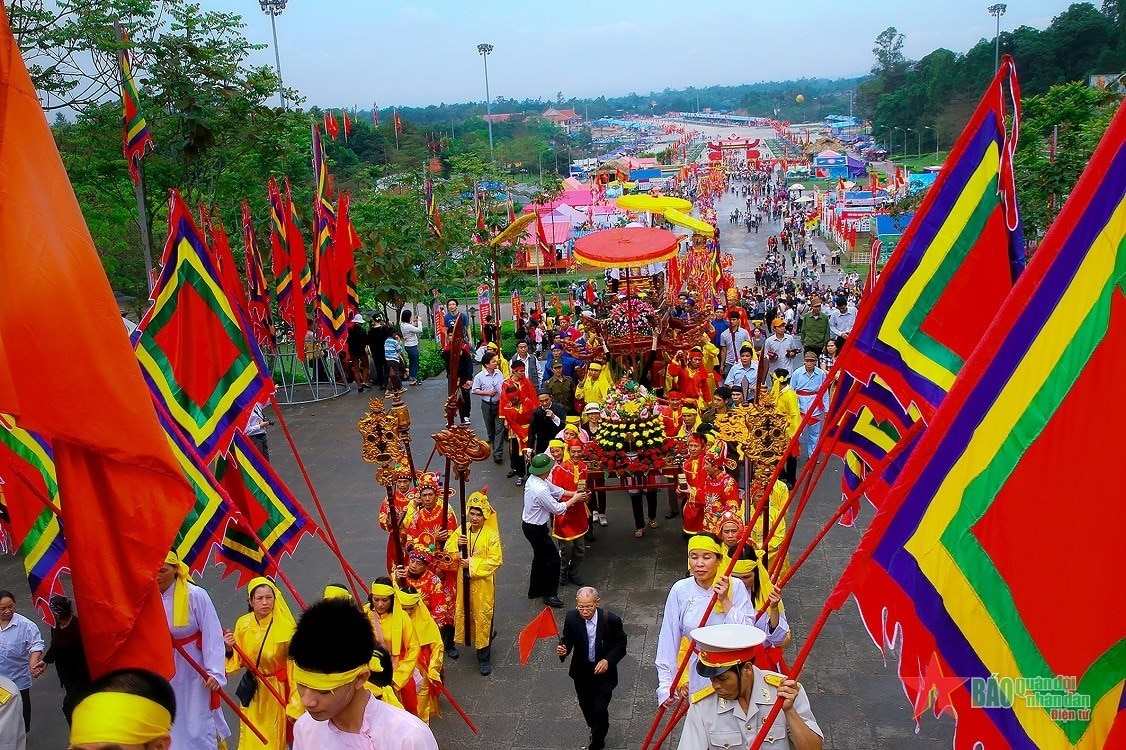 |
Procession and incense offering ceremony for Hung Kings' Commemoration Day 2023. Photo: NGUYEN ANH TUAN |
Today, the commemoration of the Hung Kings' Ancestral Anniversary has undergone many changes compared to the past, such as: The commemoration period is longer, lasting 10 days, from the 1st to the 10th, to allow people from all localities (including Vietnamese people abroad) to attend the ceremony and engage in cultural exchange; the Hung Kings' Ancestral Anniversary has been elevated to a "festival" with different scales and forms of organization, and there are specific regulations on the scale of the Hung Kings' Ancestral Anniversary in even, round, and odd years; The Hung Kings Commemoration Day is now a national holiday, so since 2007, on the 10th day of the third lunar month, workers have been granted a day off with full pay (previously, President Ho Chi Minh signed Presidential Decree No. 22/SL-CTN on February 18, 1946, allowing civil servants to take a day off on the 10th day of the third lunar month each year to participate in activities commemorating the Hung Kings and honoring the nation's origins; however, this regulation was not maintained later due to objective reasons). Because the festival is held over a long period, the festival space has expanded, the economic conditions of the population have improved, and the transportation system and means of transport are becoming increasingly modern; therefore, today, each Hung Temple Festival attracts a large number of people from all over the country and abroad. The diverse cultural,
sports , entertainment, and recreational activities, along with abundant services, also generate significant revenue for the locality, contributing to economic development.
PV: Currently, besides Phu Tho, many places across the country have temples dedicated to the Hung Kings and hold ancestral commemoration ceremonies there. Does this retain the same significance as when we hold the ceremony at the Hung Temple in Phu Tho, sir? Assoc. Prof. Dr. Bui Xuan Dinh: With remembrance and gratitude for the immense contributions of the Hung Kings, people in many localities throughout the country, from North to South, have built temples dedicated to the Hung Kings and held ancestral commemoration ceremonies at these sites, equally solemn and respectful. This stems from the tradition of venerating the Hung Kings and also reflects the historical and cultural imprint left in the process of territorial expansion. This enriches the tradition of worshipping the Hung Kings, but it does not diminish the crowded and solemn atmosphere of ancestral worship at the Hung Temple in Phu Tho, because this is the center of sacredness, a point that attracts the admiration of people from all walks of life across the country for the contributions of the Hung Kings.
PV: In recent years, the number of people attending the Hung Temple Festival has been overwhelming, leading to crowding, pushing, and even safety hazards... How can we preserve and promote the beauty of this great national holiday, both in its inherent meaning and in its conduct and practices, sir? Assoc. Prof. Dr. Bui Xuan Dinh: To mitigate these shortcomings, a comprehensive approach is needed. First, we must manage the flow (time and number of visitors) to the main worship area, rearrange the sales points, and organize recreational activities in a reasonable manner; law enforcement agencies must resolutely handle violations... And above all, we must strengthen propaganda efforts to raise awareness, improve attitudes, and promote appropriate behavior among those attending this sacred and meaningful festival, as well as festivals throughout the country.
PV: Thank you very much! DUONG THU (compiled)
source 



![[Podcast] Capital City Law 2026: Increased penalties for violations in the fields of culture and advertising](https://vphoto.vietnam.vn/thumb/402x226/vietnam/resource/IMAGE/2026/06/03/1780487283783_4522222.png)


























![[Video] Sunset at Lap An Lagoon – Where the sun sets over the fishing nets](https://vphoto.vietnam.vn/thumb/1200x675/vietnam/resource/IMAGE/2026/05/31/1780192137701_beach-landscape-sea-water-nature-grass-745871-pxhere-com.jpeg)


























Comment (0)