

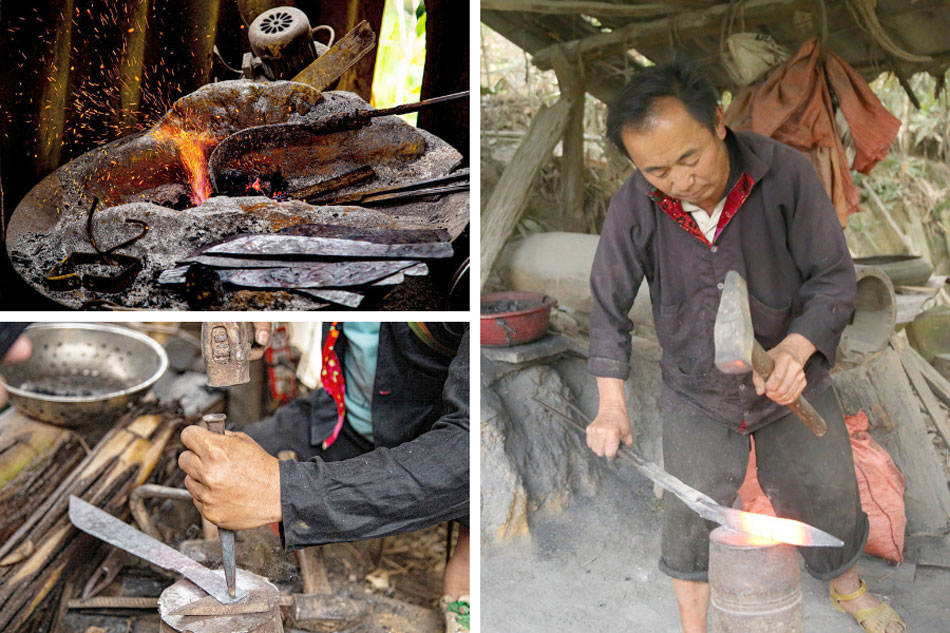
The culture of the Hmong people is clearly reflected in their spiritual values, religious life, rituals, customs, and traditional crafts. Among these, the Hmong blacksmithing craft is quite famous and well-known. In each Hmong village, there are many skilled artisans still practicing the craft. Products created by Hmong blacksmithing are durable, hard but not brittle, flexible yet sharp. To create a good product, Hmong artisans must go through many steps: preparing and gathering raw materials; then cutting iron and steel; followed by forging, tempering, grinding, attaching handles, and making sheaths for knives. In addition, Hmong blacksmiths have applied science and technology to some stages to save effort, such as using electric motors to blow air, and some grinding and filing processes. Agricultural tools made using traditional Hmong methods have become famous throughout the country for their durability, strength, and sharpness. Anyone visiting Dien Bien - Northwest Vietnam hopes to buy a farming tool, especially a forged knife made by the Mong people.

Currently, Muong Phang Commune in Dien Bien Phu City has three villages inhabited by the Mong ethnic group. Many Mong families here still maintain the traditional blacksmithing craft, both for personal use and for the market, producing a wide variety of products such as knives, sickles, and shovels. These products are handcrafted, from cutting the iron and steel, shaping, hammer handles, and making the handles. In particular, their forged knives have become well-known among consumers for many years. To preserve the traditional blacksmithing craft of the Mong people, in 2023, the Department of Culture and Information of Dien Bien Phu City, in coordination with the People's Committee of Muong Phang Commune, organized a training course on traditional Mong blacksmithing in Long Hay village. Mr. Lo Van Hop, Chairman of the People's Committee of Muong Phang commune, said: "The commune has coordinated with various levels and sectors to organize a blacksmithing training course for 15 students. The course was taught by blacksmiths from Muong Phang commune, including Mr. Cu Van Long, who taught the steps to making knives, sickles, shovels, etc., from cutting and shaping iron to heating, tempering, and grinding. At the end of the training course, 100% of the students completed the course and met the requirements."

Mr. Cứ A Nếnh, Secretary of the Party Branch of Lọng Háy village and also the son and student of artisan Cứ Văn Lộng, has been taught the craft by his father for several years. He has become familiar with the sound of hammers and anvils, and the blazing bellows of the forge. The knives he forges are gradually catching up with those of his father and teacher. However, the products his family makes sell very slowly, mostly to people in the Mường Phăng commune area and not yet to tourists, even though it is not far from the Điện Biên Phủ Campaign Command Post historical site. Mr. Cứ A Nếnh confided: “My father always told me to preserve the traditional blacksmithing craft passed down from our ancestors, not to let it disappear. But now, the products we make sell slowly, few people order them. My father is also getting old, and he's not fluent in standard Vietnamese, so it's difficult for him to take the goods to the market or to historical sites to sell them. I have many other jobs, so I can't help him with this either. Perhaps in the near future, I'll have to find a market for our family's blacksmithing products. With a stable market, the blacksmith's workshop can keep the fire burning all year round…”
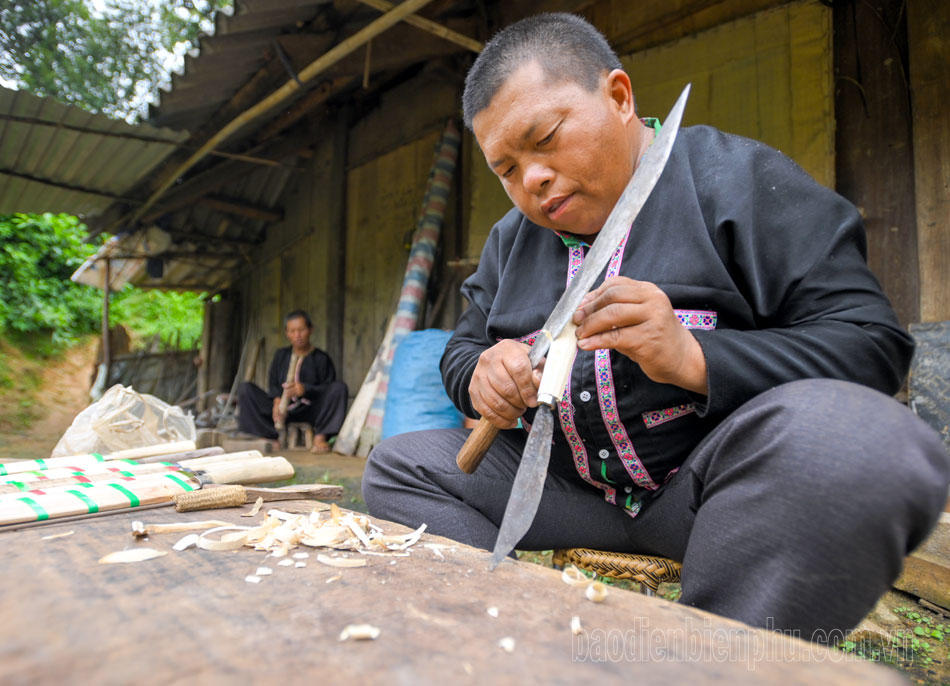
According to the Department of Culture, Sports and Tourism, due to traditional customs and the meticulousness and care involved in blacksmithing, coupled with the high cost of each Hmong forged product compared to similar products, Hmong agricultural tools have not yet found a foothold in the market. This has led to the risk of the traditional Hmong blacksmithing craft disappearing, with many skilled blacksmiths switching to modern casting and forging technologies. Furthermore, the secrets of the craft are passed down only to descendants, not to outsiders. Therefore, when the artisans are gone and successors are not interested in this arduous profession, its decline is understandable.
Recognizing this as a heritage in urgent need of preservation to prevent its disappearance amidst the dynamics of contemporary life, the Department of Culture, Sports and Tourism researched and prepared a dossier proposing its inclusion in the national list of intangible cultural heritage of special interest to the province. In June 2023, the blacksmithing craft of the Mong people in Dien Bien province was recognized by the Ministry of Culture, Sports and Tourism as a national intangible cultural heritage under Decision No. 1406/QD-BVHTTDL. Along with this, the Provincial People's Committee also issued a series of projects on the preservation and development of the culture of ethnic groups in Dien Bien province in conjunction with socio-economic development for the period 2021-2025, with a vision to 2030. Plans for the preservation and promotion of intangible cultural heritage recognized by UNESCO and included in the National List of Intangible Cultural Heritage by the Ministry of Culture, Sports and Tourism, giai đoạn 2022 - 2025; Plans and directives for the implementation of the Project "Preservation and promotion of the fine traditional cultural values of ethnic minorities associated with tourism development" under the National Target Program for Economic Development of Ethnic Minority and Mountainous Regions, giai đoạn 2021 - 2025.

Through the objectives, tasks, and solutions of the Projects and Plans aimed at preserving and developing traditional cultural values, the province honors the fine traditional cultural values of the ethnic groups in the area. In addition, the province organizes a cultural festival of ethnic groups every two years with many activities, including demonstrations and experiences of traditional crafts. Currently, the activities of the festival are integrated into the series of activities of the Hoa Ban Festival, attracting localities to participate and introduce their unique cultural heritage. Furthermore, the province continues to implement the awarding of the titles "People's Artisan" and "Outstanding Artisan" in the field of intangible cultural heritage in accordance with regulations, especially in the traditional blacksmithing craft. This includes proactively advising and implementing the process of compiling lists, holding community meetings, completing dossiers, and motivating and encouraging artisans to enhance their role and responsibility in preserving and promoting the heritage values of blacksmithing in their communities. The province is also promoting the core role of those who understand and practice the various stages of blacksmithing well, encouraging them to continue passing on those skills to the younger generation…
Through various effective solutions, the Hmong blacksmithing craft is currently being maintained and is gradually developing again. However, to further promote the value of this traditional craft, it is necessary for all levels of government and local authorities to provide support in finding more markets and increasing the value of traditional Hmong blacksmithing products. This will create motivation and encourage families and clans to strengthen the teaching of the craft to the younger generation, thus better maintaining the inheritance between generations, and thereby preserving and promoting the cultural heritage more effectively.
Source: https://baodienbienphu.com.vn/tin-uc/van-hoa/216453/giu-lua-nghe-ren-truyen-thong
![[Image] Prime Minister Pham Minh Chinh presides over the second meeting of the Government's Steering Committee on macroeconomic management and administration.](/_next/image?url=https%3A%2F%2Fvphoto.vietnam.vn%2Fthumb%2F1200x675%2Fvietnam%2Fresource%2FIMAGE%2F2026%2F01%2F26%2F1769402831322_ndo_br_dsc-3583-jpg.webp&w=3840&q=75)


![[Photo] General Secretary To Lam presides over the welcoming ceremony for General Secretary and President of Laos Thongloun Sisoulith](/_next/image?url=https%3A%2F%2Fvphoto.vietnam.vn%2Fthumb%2F1200x675%2Fvietnam%2Fresource%2FIMAGE%2F2026%2F01%2F26%2F1769398330249_ndo_br_1-jpg.webp&w=3840&q=75)
![[Photo] General Secretary To Lam working with Ambassadors and Heads of Vietnamese representative offices abroad attending the 14th National Congress of the Party](/_next/image?url=https%3A%2F%2Fvphoto.vietnam.vn%2Fthumb%2F1200x675%2Fvietnam%2Fresource%2FIMAGE%2F2026%2F01%2F25%2F1769334314499_image.jpeg&w=3840&q=75)





Comment (0)