

In Dong Thap, the Import-Export Department ( Ministry of Industry and Trade ) recently held a conference to summarize the 2025 durian harvest season, with nearly 100 delegates in attendance. The most prominent issue raised was the inconsistent quality of the fruit, leading to the risk of technical violations such as cadmium residue, yellow dye (O), overuse of fertilizers, and uncontrolled cultivation practices. Violating shipments resulted in warnings and temporary suspension of customs clearance for businesses, directly impacting the growing region and the overall reputation of the industry.
With China – the market accounting for over 90% of Vietnam's durian exports – tightening its control over quality, quarantine, and food safety requirements, even a small mistake could have a chain reaction.
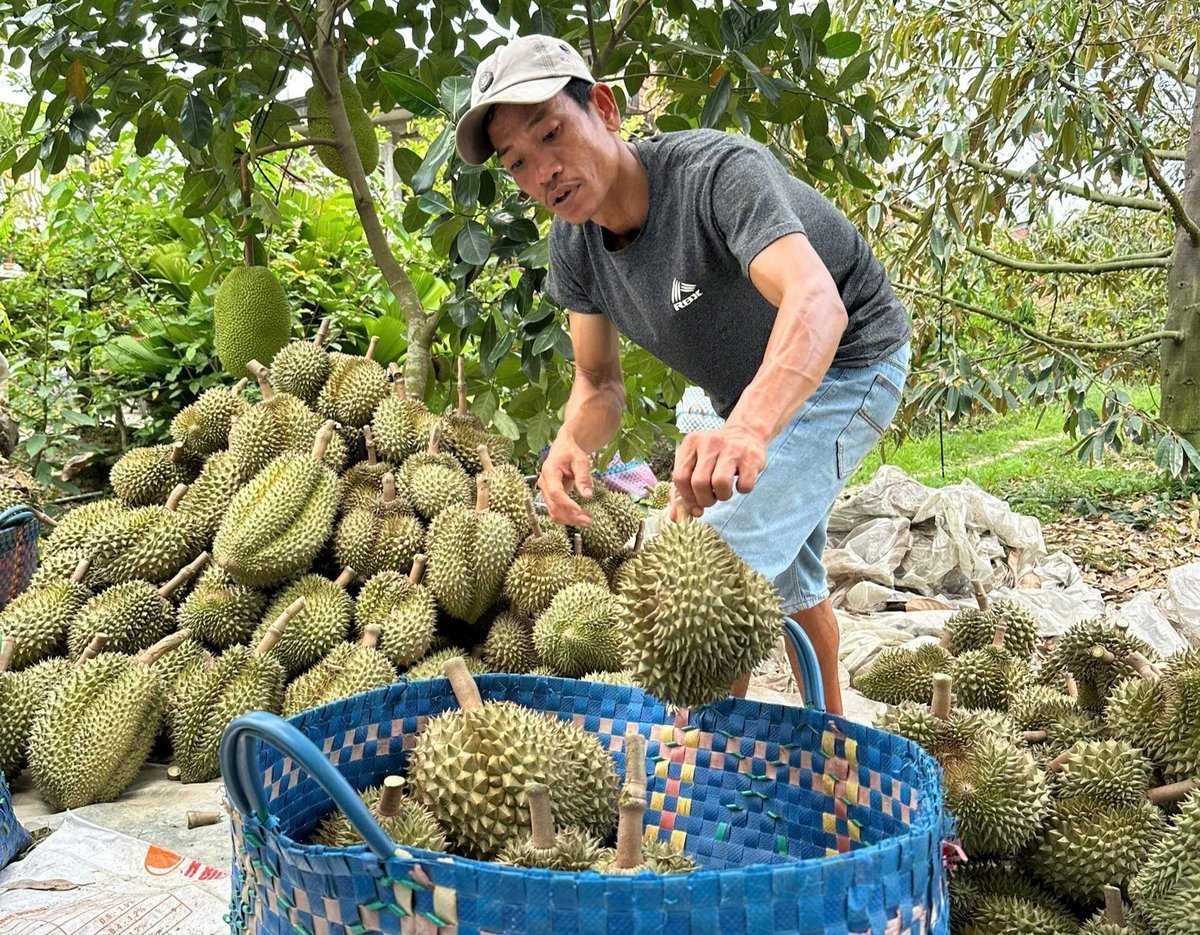
Durian harvesting in Dong Thap province. Photo: Minh Dam.
Mr. Tran Quoc Toan, Deputy Director of the Import-Export Department, warned that the rate of durian cultivation expansion is exceeding management capacity. Many growing areas are developing spontaneously, without regard to soil conditions, water sources, or infrastructure, increasing the risk of violating food safety standards. "An exported durian fruit not only represents a single orchard but also the national prestige," he emphasized.
Mr. Tran Duc Hoa Cuong, Director of Hoa Cuong Agricultural Investment Joint Stock Company (Ho Chi Minh City), said that the company wants to directly link with farmers to build raw material areas but still faces many obstacles, especially in the management of planting area codes.
A worrying issue is the practice of collecting grade C and D fruits – those only intended for processing and export fresh – which reduces the quality of shipments and increases the risk of stricter inspections by importing countries. According to Ms. Ngo Tuong Vy, Director of Chanh Thu Fruit Import-Export Group Joint Stock Company, out of nearly 380 affiliated packing companies, only over 100 have been granted codes. “Where will about 70% of the substandard raw materials go? If we don’t reorganize the supply chain, farmers will be put in a difficult position,” she emphasized.
Post-harvest processing is also a major bottleneck. Packaging capacity is currently uneven, cold storage is inconsistent, and testing is limited. Meanwhile, deep processing, a solution to reduce pressure on fresh exports, is still developing slowly in many provinces of the Mekong Delta.
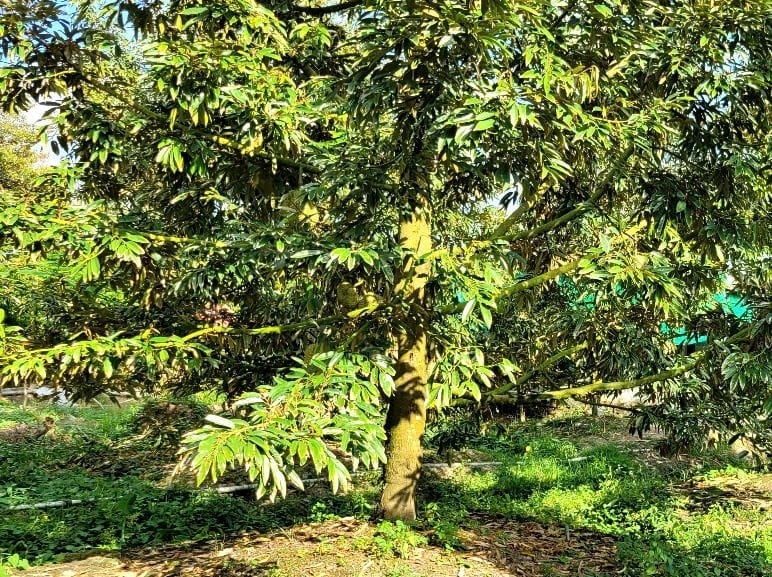
To improve quality and overcome bottlenecks in the durian industry, proper preparation is needed right from the cultivation stage. Photo: Minh Đảm.
In response to this situation, representatives from the Ministry of Industry and Trade proposed four main groups of solutions: standardizing codes for growing areas and packaging facilities; strictly controlling the expansion of durian cultivation, especially spontaneous expansion; upgrading testing laboratories to meet standards; and promoting deep processing to expand markets beyond China. "Quality is the 'passport' for Vietnamese durian to go further," affirmed Mr. Tran Quoc Toan.
Dong Thap currently has over 34,300 hectares of durian orchards, with a production of approximately 506,000 tons. The province has 377 growing areas with 489 codes, of which 393 are for export. According to Mr. Tran Thanh Tam, Head of the Dong Thap Department of Crop Production and Plant Protection, planting mint to treat cadmium is ineffective because this plant cannot survive under durian trees. Therefore, farmers need to apply fertilizer according to recommendations and increase the use of organic fertilizers.
In the first nine months of 2025, Chinese consumers spent $6.146 billion on durian, with Vietnamese durian holding the second largest market share (after Thailand) with a production volume of 620,000 tons and a value of $2.29 billion. Besides China, high-value markets such as the US, Australia, South Korea, and Europe are also opening up. If quality bottlenecks are addressed, Vietnamese durian can fully compete with Thailand, the Philippines, and Malaysia. This will build a strong brand and bring sustainable benefits to growers and businesses.
Source: https://nongnghiepmoitruong.vn/go-diem-nghen-chat-luong-sau-rieng-d784914.html
![[Photo] Prime Minister Pham Minh Chinh receives the Chinese Ambassador to Vietnam](https://vphoto.vietnam.vn/thumb/1200x675/vietnam/resource/IMAGE/2026/04/05/1775397481797_ndo_br_dsc-5512-jpg.webp)











![OCOP during Tet season: [Article 4] Elevating local products](https://vphoto.vietnam.vn/thumb/402x226/vietnam/resource/IMAGE/2026/01/29/1769652810578_2935-z6982071462129_649e82db06fb2f2ea701388b1f5f5b0b-173322_176-185229-202804_457.jpeg)














































Comment (0)