

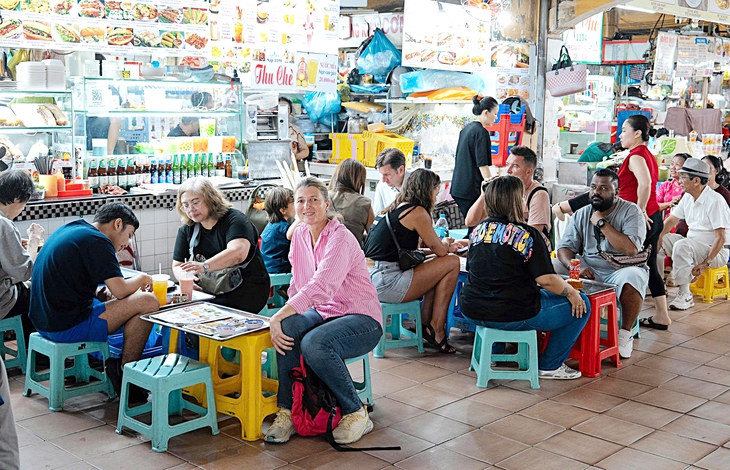
Foreign tourists experience nighttime food at Ben Thanh Market - Photo: HUU HANH
At the seminar "Developing the Nighttime Economy - A Driving Force for Ho Chi Minh City's Growth," organized by Tuoi Tre newspaper in collaboration with the Ho Chi Minh City Culinary Association on the afternoon of March 25th, many experts and businesses suggested various solutions to promote the development of the city's nighttime economy. According to experts, developing the nighttime economy can contribute to extending the length of stay for tourists and increasing nighttime spending...
Breaking down barriers and linking the night-time economy with modern cities.
"The policy of developing the night-time economy has been consistently guided from the central to local levels. However, when it comes to practical implementation, the biggest 'bottleneck' lies in the organizational aspect," Mr. Nguyen Nguyen Phuong, Deputy Director of the Ho Chi Minh City Department of Industry and Trade, frankly shared.
Accordingly, the obstacle lies in the fact that the city has not clearly identified the agency that will act as the "commander-in-chief," responsible for coordinating all nighttime economic activities throughout the area. Furthermore, although many projects and programs have been developed, the number of successfully implemented models remains quite limited. This is not due to a lack of ideas or social resources, but rather to "bottlenecks" in mechanisms, policies, and the legal framework.
The legal regulatory system has not clearly distinguished between daytime and nighttime economic activities. Specific sectors of the nighttime economy, such as food and beverage services, entertainment, and especially the serving of alcoholic drinks, are still governed by general regulations designed for daytime operations. This leads to many difficulties in the licensing process.
"The lack of a suitable legal framework is preventing the successful implementation of many promising models of the night-time economy," Mr. Phuong said.
According to Associate Professor Dr. Dinh Tien Minh - Head of the Marketing Department at UEH Business School (University of Economics Ho Chi Minh City), Ho Chi Minh City has many advantages for exploiting the night-time economy. This is because it is the largest economic, commercial, service, and tourism center in the country. It possesses a vibrant urban lifestyle, high purchasing power, and a great demand for entertainment. Along with rich cultural, artistic, and culinary resources, it has strong demand from both tourists and urban residents.
However, the reality shows that Ho Chi Minh City's night-time economy is still developing in a fragmented manner, with monotonous products, inconsistent planning, a lack of dedicated spaces, and a lack of linkage between functions. Risks related to security and order, noise, waste, the potential for social vices and counterfeit goods still exist, while the control mechanisms are incomplete... There is a lack of a dedicated coordinating body, insufficient inter-sectoral coordination, and inconsistent understanding, which tends to be control-oriented and limits creativity.
"If we only view the night economy as simply staying open later to sell more goods, the approach will be very narrow. Therefore, we need to see the night economy as an urban experiential ecosystem, encompassing: spatial planning, experiential design, security, nighttime transportation, environmental management, cultural activities, and urban brand appeal," suggested Associate Professor Dr. Dinh Tien Minh.
Transform culture into a value that can be measured in money.
Mr. Vo Viet Hoa, Director of the International Tourism Division at Saigontourist Travel Service Company Limited, believes that the night-time economy is no longer an optional addition, but rather the "missing link" in the current tourism product structure. Night-time economic products must reflect the unique identity of Ho Chi Minh City, rather than simply repeating the models of other cities in the region.
Therefore, according to Mr. Hoa, it is necessary to develop two product groups in parallel, including: the high-end group (for business travelers and MICE clients with high demands for quality and experience), and the mass market group (exploiting street food, sidewalk spaces... characteristic elements of Ho Chi Minh City).
"A comprehensive master plan for the night-time economy must be developed soon, focusing on transportation, connectivity between destinations, and safety. When development spaces are organized into clusters with reasonable linkages, it will facilitate the formation of seamless night tours, extending the length of stay and increasing tourist spending," Mr. Hoa said.
According to Mr. Tran Le Nguyen Khang, Deputy Head of SATRA Retail System Management, developing the night-time economy means extending the "consumption lifecycle" of tourists within a day. Linking with travel businesses to create integrated product packages combining sightseeing, dining, and shopping will promote and create an inter-sectoral value chain.
"The night-time economy should not be limited to the physical space but should expand to e-commerce and online spaces. For these models to operate effectively, close coordination is needed between businesses, the tourism industry, and management agencies, especially in ensuring infrastructure, security, and operating conditions," Mr. Khang affirmed.
Meanwhile, Mr. Luu Nhat Tuan, Vice Chairman of the Ho Chi Minh City Culinary Association, argued that the key issue is not a lack of ideas or resources, but rather the lack of a sufficiently clear overall design to guide the entire development process. Therefore, a strong inter-sectoral coordination mechanism is needed soon, and even a specialized steering committee on the night-time economy should be established to connect sectors such as tourism, cuisine, culture, and entertainment.
"When there is a unified and sufficiently strong coordinating body, new resources can operate synchronously. It is important to establish a common strategic framework, clearly defining roles and appropriate operating mechanisms," Mr. Tuan said, suggesting that concentrated night-time economic zones should be planned according to an "all-in-one" model, integrating food, performing arts, shopping, and entertainment. This could be implemented by selecting a few areas for pilot testing, measurement, and adjustment.
The people must benefit greatly.
According to Mr. Nguyen Quoc Ky, Chairman of the Vietnam Culinary Culture Association and Chairman of the Board of Directors of Vietravel, it is time to reconsider and reassess the entire philosophy of developing the night-time economy as well as the overall economy of Ho Chi Minh City.
Accordingly, Ho Chi Minh City needs to clearly define its "cultural identity," instead of adopting a scattered and unfocused approach. A clear distinction between daytime and nighttime economies is necessary for effective development. Simultaneously, three pillars of its "manifesto" should be established: interaction, movement, and openness. It is crucial to promote openness, flexibility, diversity, practicality, rich experiences, and connectivity. When the nighttime economy develops effectively, the people of Ho Chi Minh City will be the direct beneficiaries.
"We must transform culture into economic value," Mr. Ky said, arguing that the city needs to develop a multi-axis economy, strengthen inter-regional connectivity, and form a large-scale urban tourism ecosystem. The focus should be on high-quality products, selling experiences rather than just services.
Ms. Nguyen Thi Thanh Thao, Head of the Tourism Resource Planning and Development Department of the Ho Chi Minh City Department of Tourism, said that the agency is developing a tourism development plan for the city until 2030, which requires expansion beyond the central core area after the merger of Ba Ria - Vung Tau and Binh Duong provinces.
In 2026, the department will conduct a survey on the spending patterns of domestic and international tourists visiting Ho Chi Minh City, helping businesses to orient their development.
"When developing the night-time economy, focusing solely on specific models or investment is insufficient, because the crucial foundation remains the local community. We need to avoid negative impacts and ensure that the people benefit," Ms. Thao said.
Source: https://tuoitre.vn/go-nut-that-thuc-day-kinh-te-dem-20260326080921094.htm
![[Photo] General Secretary and President To Lam presides over a working session with the Central Policy and Strategy Committee on the development of the materials industry.](https://vphoto.vietnam.vn/thumb/1200x675/vietnam/resource/IMAGE/2026/05/21/1779359935432_a3-bnd-3129-1412-jpg.webp)



![[Photo] National Assembly Chairman Tran Thanh Man working with the Standing Committee of the Law and Justice Committee](https://vphoto.vietnam.vn/thumb/1200x675/vietnam/resource/IMAGE/2026/05/21/1779378929214_ndo_br_1-4610-jpg.webp)






![[Infographic] Stock market on May 21st: VN-Index falls 16.34 points, market liquidity decreases.](https://vphoto.vietnam.vn/thumb/402x226/vietnam/resource/IMAGE/2026/05/21/1779379204295_screenshot-2026-05-21-220948-jpg.webp)

























































Comment (0)