

On April 1st, Nguyen Xuan Dai, Director of the Hanoi Department of Agriculture and Environment, inspected the 2025 spring crop production situation in Me Linh district.
According to Nguyen Xuan Dai, Director of the Hanoi Department of Agriculture and Environment, the city aims for economic growth of over 8% in 2025, with the agricultural sector targeted at 3.1%. "Right from the moment the target was assigned, the agricultural sector developed a plan, outlined solution groups, and assigned tasks to each area, striving to achieve a 3.5% growth target for the agricultural sector in 2025," Mr. Dai emphasized.
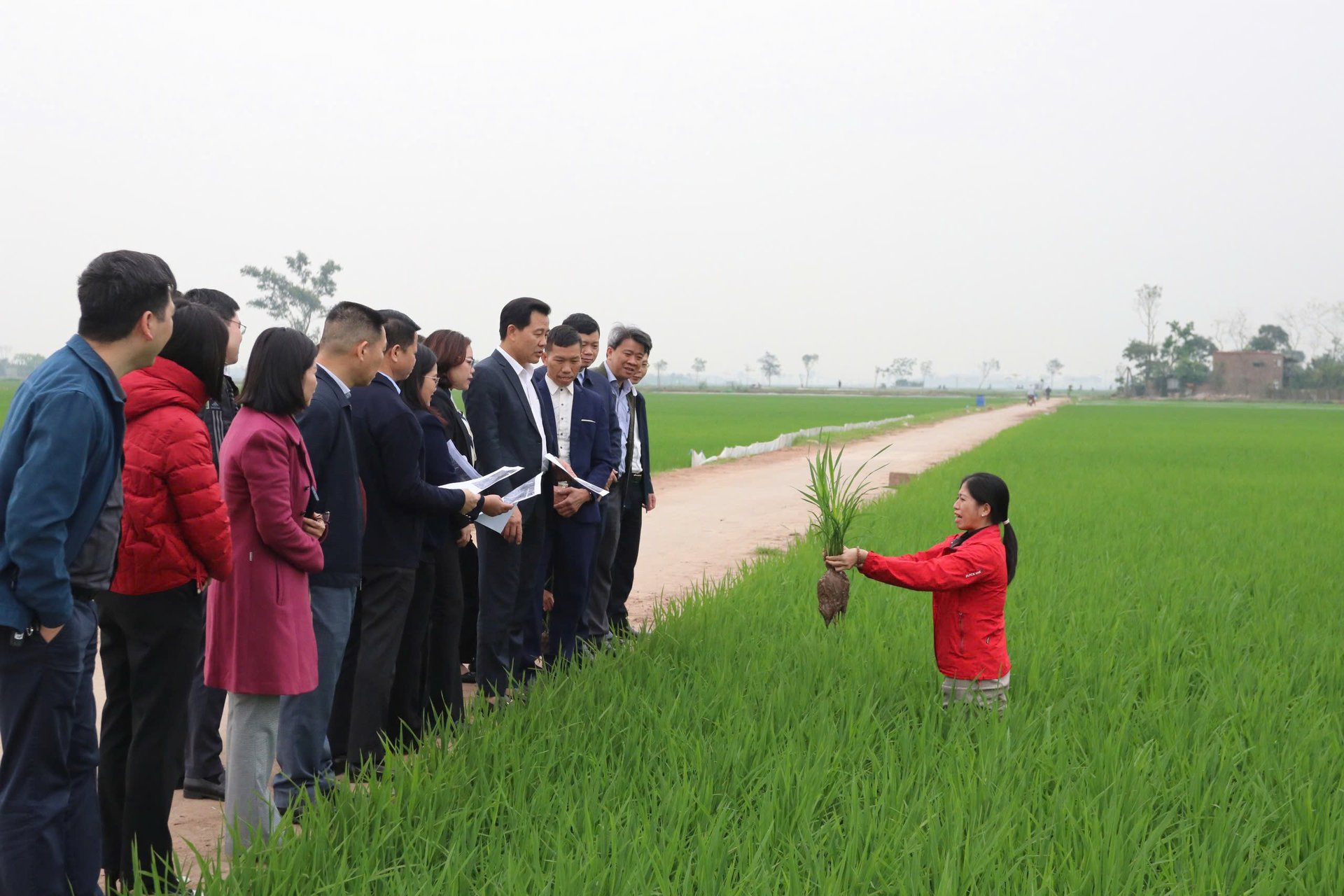
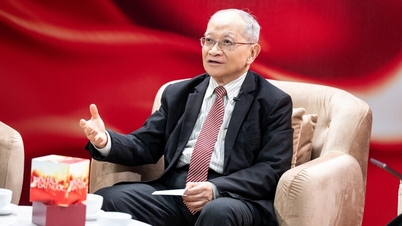
Director of the Hanoi Department of Agriculture and Environment, Nguyen Xuan Dai, and his delegation inspect the 2025 spring crop production situation in Me Linh district. Photo: Hoai Tho.
To achieve this, Hanoi is implementing various solutions to promote agricultural growth, aiming for economic growth exceeding 8% by 2025 and reaching double-digit growth in subsequent years. The focus is on accelerating mechanization, adopting advanced farming models, restructuring production, and implementing effective support policies for farmers.
Since 2022, Me Linh district has applied comprehensive mechanization in rice production, from land preparation, sowing, spraying, to harvesting, covering a total area of nearly 1,000 hectares. Currently, in Thanh Lam commune alone, the mechanization rate reaches approximately 90%. Notably, the model of machine transplanting combined with the improved rice cultivation system (SRI) towards organic farming, reducing emissions, was implemented for the first time by the agricultural sector on a scale of 50 hectares in Lien Mac commune. This is considered a significant turning point in the efforts to mechanize rice production in Hanoi.
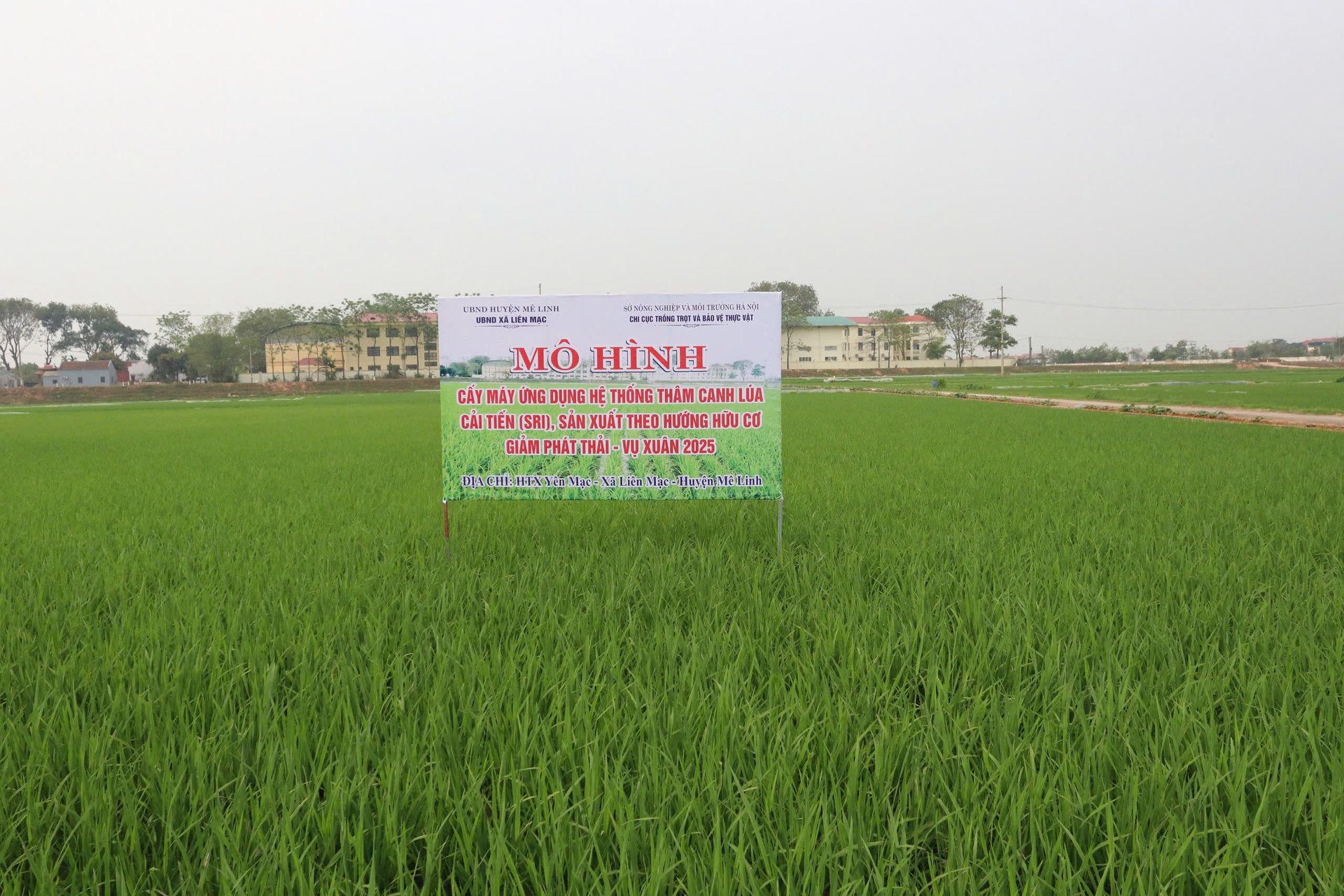
The model of machine transplanting, applying the improved rice cultivation system (SRI) towards organic farming and reduced emissions, was first implemented by the agricultural sector on a scale of 50 hectares in Lien Mac commune. Photo: Hoai Tho.
According to Ms. Luu Thi Hang, Head of the Hanoi Department of Crop Production and Plant Protection, the SRI (System of Rice Intensification) farming method has now been applied to approximately 70% of the city's rice-growing area. The spring crop of 2025 will also be the first year the Department collaborates with Me Linh district to introduce rice transplanters into SRI rice production, following organic and low-emission practices.
At the city level, Hanoi is expanding the area where this model is applied, striving to have 80% of its rice cultivation area using the SRI method by 2030. Currently, Hanoi's rice production area is approximately 160,000 hectares, with the proportion of high-quality rice expected to increase from 62% to over 80%.

Farmer Luu Ba Tiep, in his first year applying the machine-transplanting model using the improved rice cultivation system (SRI), is anticipating a high-value rice harvest. Photo: Hoai Tho.
"Furthermore, in line with the government's direction, Hanoi also aims to reduce greenhouse gas emissions. Applying the SRI model not only helps reduce rice production costs by approximately 7-8 million VND/hectare but also increases productivity by 18-20% and saves 2% of irrigation water, contributing to the protection of water resources and the environment," the Director of the Hanoi Department of Agriculture and Environment further emphasized.
To promote the application of advanced farming models, Hanoi has implemented a series of strong support policies for farmers. Specifically, the city supports 50% of the cost of purchasing machinery and equipment for rice production mechanization; supports 50% of the cost of seeds, fertilizers, and labor for models such as SRI; drafts a resolution with 12 key contents on supporting agriculture, farmers, and rural areas; and supports 100% of the cost of purchasing pesticide containers and collecting packaging waste, aiming to treat 80% of the area in Me Linh district by 2025.
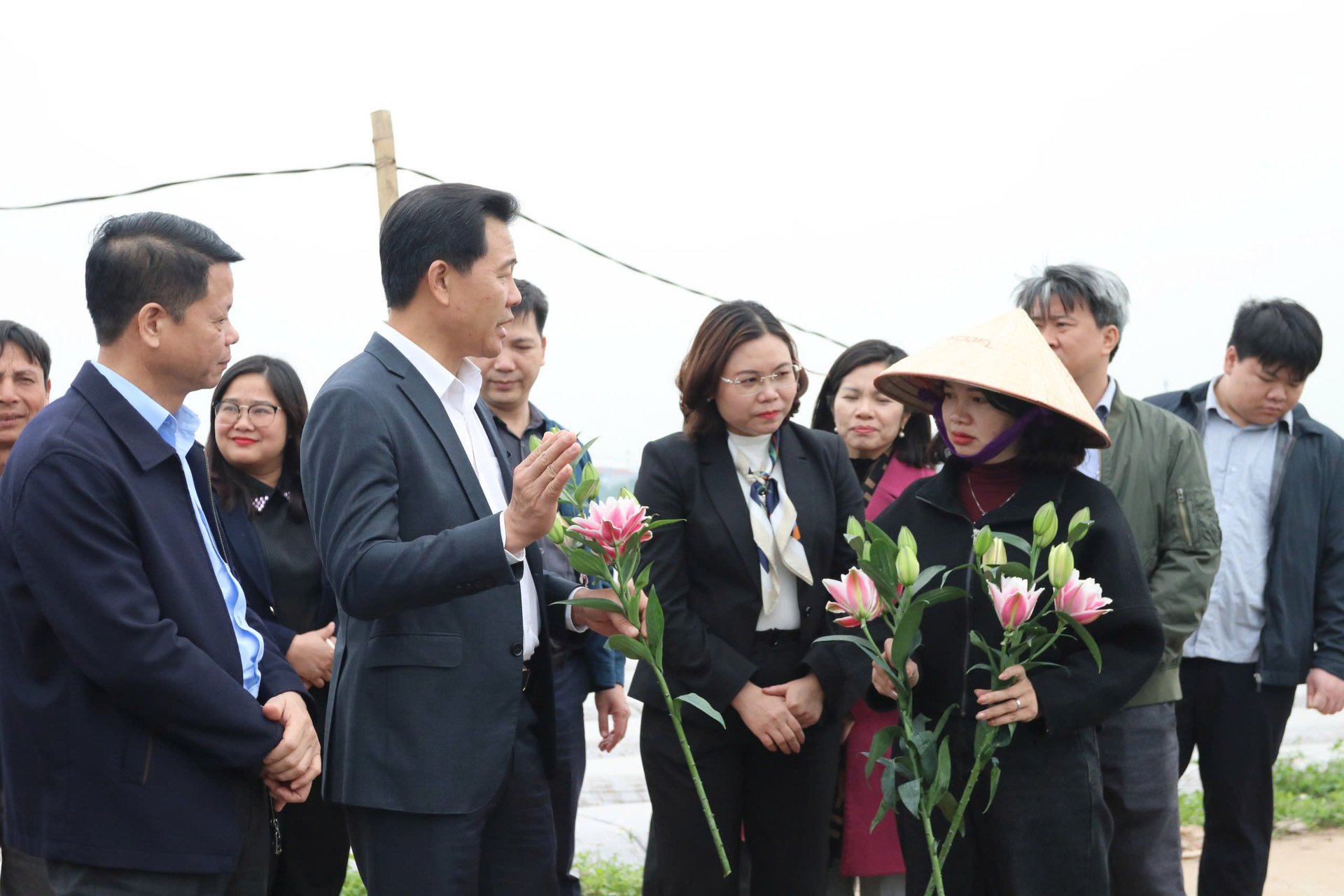
In Tu Lap commune (Me Linh district), the delegation visited the lily garden of Flower Fansipan Company. Spanning 20 hectares, this is one of the largest high-tech lily cultivation models in Hanoi. Photo: Hoai Tho.
According to Ms. Luu Thi Hang, Head of the Hanoi Department of Crop Production and Plant Protection, the unit has advised the Department of Agriculture and Environment to submit to the Hanoi People's Committee a plan for sustainable agricultural development for the period 2023-2030. The focus of this plan is on improving farmers' knowledge and skills, expanding the area applying advanced production models, and implementing carbon credit support programs for environmentally friendly models.
With the determination of all levels and sectors, along with the enthusiastic response of farmers, Hanoi expects to achieve significant progress in sustainable agricultural development, ensuring economic growth while effectively protecting the environment.
Source: https://nongnghiep.vn/ha-noi-phan-dau-80-dien-tich-lua-ap-dung-sri-d745968.html

![[Photo] National Assembly Chairman Tran Thanh Man working with the Standing Committee of the Law and Justice Committee](https://vphoto.vietnam.vn/thumb/1200x675/vietnam/resource/IMAGE/2026/05/21/1779378929214_ndo_br_1-4610-jpg.webp)


![[Photo] General Secretary and President To Lam presides over a working session with the Central Policy and Strategy Committee on the development of the materials industry.](https://vphoto.vietnam.vn/thumb/1200x675/vietnam/resource/IMAGE/2026/05/21/1779359935432_a3-bnd-3129-1412-jpg.webp)






















































Comment (0)