A strong rollout after years of sluggishness.
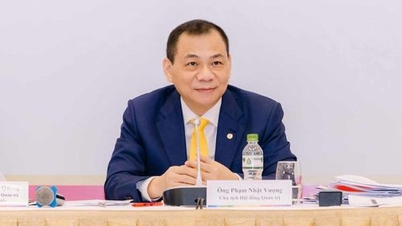
It took nearly 15 years to complete and operate the Cat Linh - Ha Dong and Nhon - Hanoi Station elevated metro lines. However, Hanoi has now made a spectacular "acceleration" by becoming the first locality in the country to simultaneously start construction on 5 new metro lines with a scale of up to 1.3 trillion VND (equivalent to 50 billion USD). These lines are part of Hanoi's plan to develop a network of 18 urban railway lines, playing a key role in the framework infrastructure system that will lead urban development. The consortium of contractors including Vinhomes Joint Stock Company and VinSpeed High-Speed Railway Investment and Development Joint Stock Company ( thuộc Vingroup Group) is the EPC general contractor for these projects.

The metro has gradually changed the commuting habits of Hanoi residents.
PHOTO: TUAN MINH
At the groundbreaking ceremony, Chairman of the Hanoi People's Committee Vu Dai Thang stated that according to the Capital City Master Plan with a 100-year vision, the city has identified development based on a multi-polar, multi-center model, forming new growth poles connected by a modern and synchronized infrastructure system. In this model, the urban railway system is identified as a strategic framework infrastructure, playing a driving role in the modern public transport system and serving as an important tool for reorganizing urban development space.
In fact, after initial concerns about operation, revenue, and profitability, the Hanoi metro system, with its two existing urban railway lines (Cat Linh - Ha Dong and Nho Son - Hanoi Station), has been operating smoothly with rapidly increasing passenger numbers. According to Mr. Le Bang An, General Director of Hanoi Metro, in 2025, passenger transport volume is expected to reach over 20.68 million passengers, exceeding the plan by 7.13%. Notably, revenue from tickets is projected to exceed 143 billion VND, surpassing the assigned plan by 29.09%, contributing to a reduction of over 31 billion VND in subsidies from the state budget…
This provides a practical basis for demonstrating the effectiveness and urgent need to accelerate the expansion of the capital's metro network. The Master Plan for the Capital City with a 100-year vision, approved earlier this year, set a target of 1,200 km of metro citywide. Although this is a long-term plan, Hanoi's rapid progress this year shows that this goal is entirely achievable.
Wherever the metro goes, urban development follows.
Notably, for the first time, the planning identifies the metro not only as a means of public transportation, but also as a redesign of Hanoi's urban space with the goal: wherever the metro goes, urban development follows. Experience from many countries with highly developed metro networks such as Japan and South Korea shows that railway lines not only solve traffic problems but also promote urban development according to the TOD model - centering public transportation systems such as metro and BRT (Bus Rapid Transit). The synchronized development of the metro and the chain of TOD urban areas along the route will effectively utilize land resources, strengthen regional connectivity, and gradually realize the multi-polar, multi-center urban model as outlined in the capital's planning.
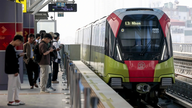



Nhon - Hanoi Station metro line
Photo: Tuan Minh
According to the Hanoi Metro Management Board (MRB), each station should not only be a transit point but also become an integrated center capable of attracting people, developing high-quality office and residential areas, and a comprehensive service ecosystem. Transport for Development (TOD) will generate revenue and support system operation. Furthermore, implementing the TOD model requires close coordination between the state and the private sector, sharing resources and benefits. In other words, there is a breakthrough shift in thinking from "building metros to serve the city" to the TOD model of "building cities around metros." This will be the foundation for forming a multi-centered urban structure, reducing pressure on the central core and creating space for new growth poles.
According to Associate Professor Dr. Nguyen Hong Thai, Vice President of the Vietnam Railway Transport Economics Association, the metro is not just a transportation project but also a tool for restructuring urban space and shaping a new development model for the capital. For many years, the historical inner city has faced immense pressure in terms of population, traffic, infrastructure, and the environment. In fact, Hanoi is implementing a series of projects to relocate residents and move educational, medical, and production facilities out of the city center. The simultaneous commencement of construction on five major metro lines is a golden opportunity to realize the urban space reconstruction process of the capital, as the metro will not only expand urban space but also redistribute the population, jobs, and economic activities.
People will choose to live near the train station.
Five new metro lines are expected to be completed by 2030, seamlessly connecting with lines 3 and 5 currently under construction, gradually forming an integrated public transport network throughout the city. Associate Professor Dr. Nguyen Hong Thai believes the most important benefit of the metro system is the change in traffic culture and the way urban space is organized.

Hanoi is in the process of urban reconstruction, relocating residents away from the city center.
Photo: Tuan Minh


Currently, Hanoi residents still primarily rely on motorbikes and private vehicles. As the metro network is developed and integrated according to the TOD (Transit-Oriented Development) model, people will gradually shift to a multimodal transportation model, with the metro playing a backbone role, connecting with buses, public bicycles, shuttle services, and other forms of shared transportation.
"Urban areas, commercial centers, offices, and services will no longer revolve around the central core as they do now, but will develop around train stations. People will then choose their homes, workplaces, and daily activities based on accessibility to public transportation, similar to Tokyo, Seoul, or Singapore. The metro system will not only change the way people travel but also contribute to the formation of a more modern, green, and sustainable urban lifestyle," shared Associate Professor Dr. Nguyen Hong Thai.
On the other hand, the greatest value of urban rail lies in its network connectivity. Therefore, Mr. Thai believes that during implementation, the plan needs to be reviewed to add transfer stations and connecting corridors between lines, including underground spaces or rapid transfer methods. In addition, it is necessary to ensure synchronous connectivity between the metro and buses, BRT, Park & Ride parking lots, public bicycles, etc. At the same time, it is necessary to build an interconnected electronic ticketing system, a shared data platform, and an integrated control center to provide maximum convenience for passengers.
"The success of the metro system lies not in the number of kilometers of track built, but in its ability to create a seamless network. Only when the metro lines operate as a unified 'circulatory system' can Hanoi maximize investment efficiency, create momentum for urban development, and gradually form a civilized, modern capital city on par with major cities in the region and around the world," Associate Professor Dr. Nguyen Hong Thai emphasized.
Source: https://thanhnien.vn/ha-noi-tang-toc-metro-dai-phau-khong-gian-do-thi-185260623221939849.htm



![[Photo] Prime Minister Le Minh Hung presides over the thematic session on promoting science and technology development and innovation.](https://vphoto.vietnam.vn/thumb/1200x675/vietnam/resource/IMAGE/2026/06/23/1782207872934_ndo_br_dsc-1724-jpg.webp)