

Students who receive a reprimand will only receive a maximum grade of "fair".
One of the two new education policies effective from June is the Circular on Student Affairs (applicable from June 30), replacing numerous separate decisions and circulars related to student affairs for vocational schools, colleges, and universities from 2007 until before June 30, 2026.
This circular applies to higher education institutions, vocational education institutions; secondary school students, college and university students.

Students' performance will now be evaluated on a 5-level scale, eliminating the previous "poor" rating system.
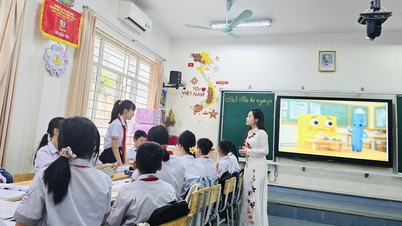
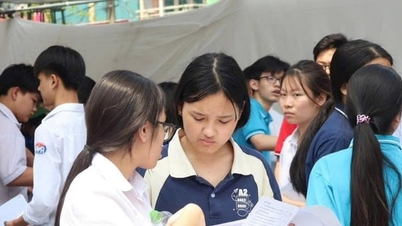
PHOTO: MY QUYEN
While Circular 16 of 2016 assessed students' training results at six levels: excellent, good, fair, average, weak, and poor, the new regulations divide it into five categories: excellent (90 to 100 points), good (80 to under 90 points), fair (70 to under 80 points), average (50 to under 70 points), and weak (below 50 points).
Students' academic performance will be used to consider and award academic scholarships, consider awards for the academic year and the entire course, and their performance score will be directly reflected on their academic transcript at the end of the course.
Regarding disciplinary action, the regulations outline four levels. Level 1 applies to violations with minor harm, confined to a single class, resulting in a reprimand.
Level 2 violations are those of a significant nature, magnitude, and harmful impact, affecting multiple classes or departments, causing negative public opinion inside or outside the school, and resulting in a warning.
Level 3 violations are of a very serious nature, scale, and harmful nature, with an impact extending beyond the school premises, causing public outrage, and affecting the school's reputation; these violations will result in temporary suspension from studies.
Level 4 violations are of an exceptionally serious nature, scale, and harmful nature, impacting the entire society, causing widespread public outrage, and significantly affecting the school's reputation. This level carries the highest disciplinary penalty: expulsion.
Students who receive a reprimand will have a maximum conduct rating of "fair" (below 80 points); if they receive a warning or higher, their maximum rating will be "average" (below 70 points).
Students who receive a suspension from their studies will not have their conduct evaluated during the suspension period; those who receive expulsion from the university will not have their conduct evaluated.
A preparatory university school is a specialized school.
Circular 36, which promulgates the Regulations on the Organization and Operation of University Preparatory Schools, came into effect on June 7th, replacing the 2011 circulars and the 2013 amendments. It introduces many new points compared to previous regulations.
Specifically, while Circular 24 of 2011 stipulated that preparatory universities for pharmacy were established for children of ethnic minorities and children of ethnic minority families permanently residing in areas with particularly difficult socio -economic conditions, aiming to contribute to training personnel for these regions, Circular 36 stipulates that the function of preparatory universities is to implement the Party and State's ethnic policy in improving the quality of human resources for ethnic minority and mountainous regions, and areas with particularly difficult socio-economic conditions.
The new circular requires pre-university schools to implement the pre-university preparatory course program issued by the Ministry of Education and Training. Thus, the pre-university program now includes computer science as an additional subject.
In addition, there are regulations regarding specific educational activities, including education on ethnic cultures, career guidance, and experiential learning. Schools are required to develop plans and content for these activities (both inside and outside the school grounds) to preserve cultural identity and enhance students' soft skills.
Thus, while Circular 24 of 2011 primarily operated pre-university schools as centers for exam preparation/knowledge enrichment for transitional studies, Circular 36 of 2026 elevated these schools to comprehensive specialized education centers, simultaneously compensating for knowledge gaps, nurturing national culture, and developing life skills and digital transformation for students in disadvantaged areas.
Source: https://thanhnien.vn/hai-chinh-sach-giao-duc-moi-co-hieu-luc-tu-thang-6-185260530114622808.htm




![[Image] A brilliant symphony and explosive power in the skies of Da Nang.](https://vphoto.vietnam.vn/thumb/1200x675/vietnam/resource/IMAGE/2026/05/31/1780196945787_anh-man-hinh-2026-05-31-luc-10-08-51.png)















![[Video] Sunset at Lap An Lagoon – Where the sun sets over the fishing nets](https://vphoto.vietnam.vn/thumb/340x192/vietnam/resource/IMAGE/2026/05/31/1780192137701_beach-landscape-sea-water-nature-grass-745871-pxhere-com.jpeg)




































































Comment (0)