


Artists Luu Hong Quang (standing) and Luu Duc Anh interact and perform at the Vietnam Literature Museum. Photo: Nguyen Dinh Toan
Luu Hong Quang (born in 1990, currently teaching at the New Zealand Conservatory of Music) and Luu Duc Anh (born in 1993, the youngest lecturer at the Vietnam National Academy of Music since 2018) were among the artists who performed on the Bösendorfer VC280 grand piano and shared their stories about pursuing music since childhood and their future aspirations.
Reporter (R): Born into a family with a musical tradition, your passion for music must have led you to start practicing piano at the tender age of six or seven. And did you want to pursue a professional career from that point on?
Artist Luu Duc Anh: To be honest, I think that most people who study music from a young age do so because of their parents' guidance. Fortunately, my parents and my first teachers all had the same idea: they didn't know if we could pursue a professional career, but studying had to be serious and structured. Therefore, my early music studies weren't very focused; I was quite playful. It wasn't until high school that I gradually realized I wanted to pursue a professional music career. And from then on, music became "in my blood" without me even realizing it!
Artist Luu Hong Quang: I'll tell you a slightly humorous story. Back then, during the day, both my brother and I had to go to school, and we only practiced our instruments in the evenings. And after practice, our father would check on us very strictly. I remember there was a good TV drama on VTV around 9 PM. My brother and I played rock-paper-scissors to decide who could practice first, and we "bargained" that whoever practiced first would get to watch it first.
Talent alone cannot be judged immediately, but what is more important than talent is unconditional love. If you were to ask a child under 10 years old studying music, they probably wouldn't be mature enough to clearly say that they "love" it so much that they choose to study it. But the fundamental foundation in art – like classical music or some other fields – is a system of techniques and theories that must be thoroughly understood before they can be applied. Those who came before understand this and have a broader perspective to guide the training of the next generation: If you want to mature, you need years for students to internalize these skills and practice them as a way of life, only then can you know and predict what they will be like five or ten years from now…
PV: So, to pursue such a long-term goal, what could be considered the fundamental principle of "establishing a habit"? Or is "painting" a picture of future successes from competitions also a... draw?
Artist Luu Duc Anh: Discipline is certainly the first necessity, but in the past, it was easier to force a child to follow academic discipline than it is now. Nowadays, children have access to so many things. I teach regularly, so I understand that if you want to force students to follow the same routine as I did in the past, it won't work.
But personally, I believe that on the "highway of music," without genuine discipline, you'll only get a short distance. And how to apply that discipline in a way that transforms into a "self-discipline" for the children is something I've discussed with many parents, making it a key secret to long-term success.
Artist Luu Hong Quang: As Duc Anh just said, that "ticket of discipline" is for us to cross "long bridges" on the path of music. Success in competitions is also like bridges, boats, or gates—means to get closer to music. To reach your desired goal quickly, you need to use these means. But most importantly, you need to define your aspirations. If we consider competitions as a game, there are two types of games. One is a game where you want to win, with a final goal, and no need to continue. The second type is a game where you play to continue playing and never stop. It's a game infinite in space and time, with no real stopping point... That's true love of music!
Interviewer: Lưu Đức Anh, you were a student abroad and achieved early success in music (university in Belgium and postgraduate studies in Sweden, winning a special award in France in 2017), but why did you return to Vietnam to teach officially starting in 2018?
Artist Luu Duc Anh: When I first went to study abroad, I was very inspired because I could hear classical music everywhere I went. However, during my years of study, I still maintained my return to Vietnam to perform frequently, and gradually I realized that there were many favorable spaces in my homeland for what I wanted to do. And in 2018, I decided to return to Vietnam to carry out many projects alongside performing and teaching.
Most recently, we organized the first Vietnam International Piano Competition and Festival (VIPCF 2025) last year, attracting hundreds of contestants from many countries around the world . The program was honored to have the sponsorship of the Vietnam Symphony Orchestra; the Fryderyk Chopin Institute (Poland) and Bosendorfer (Austria). The Bösendorfer VC280 grand piano that you just heard us and Mr. Hong Quang perform at the Conservatory on May 8th, is worth over 10 billion VND and was donated by the renowned Bösendorfer company last year to support the competition. They support our ideal path under the motto "Professional Stage - Connecting Together". The second competition will be held in 2027.
Many people think that a musician who grew up in Europe will have an advantage, but I don't think so. I believe that I am who I am today because of my circumstances, environment, and all the factors of my country and family that I experienced from a young age.
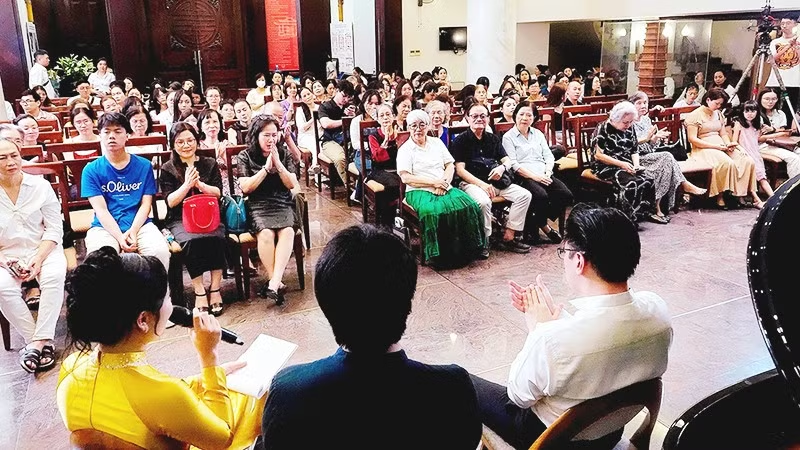
Many writers and readers interacted with and asked questions to the two artists. Photo: NGUYEN DINH TOAN
PV: Lưu Hồng Quang, what are the differences between domestic and foreign teaching practices, based on your current teaching experience?
Artist Luu Hong Quang: I used to teach in Australia, and now I teach in New Zealand, a different environment. However, music remains the same everywhere – notes, harmony, technique, and written words. The difference lies in the interaction between people, and perhaps domestically, this is a strength – there's a common denominator: a fairly uniform training system, many young artists and professors with a solid foundation in technique and academics. This is the basis for building even higher.
However, due to those strict rules in schools, the flexibility of individual personalities is somewhat difficult to find. Abroad, for example in Australia and New Zealand, where I've spent many years, the appreciation and approach to music is more natural and relaxed. They don't have a system below university level; students who like it can self-study for certificates or learn from excellent teachers at conservatories. Whether they go to university and pursue a career in music is up to them.
I have to admit that summer camp classes in Vietnam are great; the children are very well-behaved, type quickly, don't argue, and never ask questions. Children abroad are completely different; they ask so many questions. At first, the students asked so many questions that it gave me a headache. But then I thought about it again and remembered the insightful quote from physicist Einstein (1879-1955): If we don't explain something in a very simple way, we may not fully understand it.
The numerous questions from young people abroad are objective; I'm not judging one side as better than the other. Like "chopsticks in pairs," learning music requires a balance of free inspiration and discipline. And when it comes to discipline, Asian countries are "powerhouses in discipline." I quote Professor Dang Thai Son when commenting on the discipline of Korean and Japanese students in the elementary and secondary levels: "These people play music so meticulously, it couldn't be any more precise." But to "elevate" an artist, if there's no inspiration to express it, then there's nothing to ask about or care about... I think these two "streams of thought" are two different approaches, each with its own strengths and weaknesses, reflecting the styles of Asia and Europe...
Interviewer: Thank you, both artists!
According to Nhandan.vn
Source: https://baoangiang.com.vn/-tam-ve-ky-luat-dua-ta-qua-nhung-cay-cau-dai-a487320.html




![[Image] Nearly 125,000 Hanoi students completed the Literature exam for the 10th grade entrance exam.](https://vphoto.vietnam.vn/thumb/1200x675/vietnam/resource/IMAGE/2026/05/30/1780117233041_ndo_br_thiet-ke-chua-co-ten-2-png.webp)





















































































Comment (0)