


The above is an explanation from the "Dictionary of Vietnamese Proverbs" (Nguyen Duc Duong - Ho Chi Minh City General Publishing House - 2010). Did the author mistakenly associate "stone monuments may wear away in a hundred years, but spoken words remain intact for a thousand years" with "stone monuments"?
In fact, the "stone fortress" here symbolizes the building and strengthening of forces to protect the foundation of a dynasty, a regime, or a nation. But no matter how strong the army, how high the walls, or how deep the moats, if it does not win the hearts of the people, does not have the support of the people and the will of Heaven, then that dynasty or nation will not only find it difficult to stand firm, but will also quickly collapse, giving way to a new dynasty, or even losing its entire territory to a foreign power.
Perhaps the Vietnamese proverb in question summarizes a historical lesson from more than half a millennium ago.
- Ho Quy Ly had everything in his hands, a beautiful country, a powerful army, high walls, deep moats... But "Because of the Ho family's troublesome politics/ Leaving resentment in the people's hearts" (1) When the Ming dynasty threatened to invade, Left Prime Minister Ho Nguyen Truong had already expressed his concern to the Emperor Ho Quy Ly: "I am not afraid of fighting, I am only afraid that the people's hearts will not follow!"
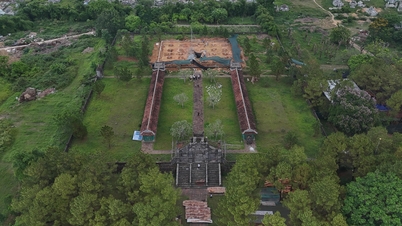
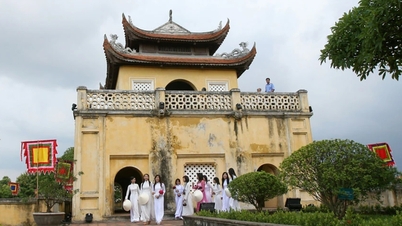
Ho Nguyen Truong erected iron chains across the river, building a defensive line stretching hundreds of miles, determined to resist the invaders... But then all those fortifications and defensive lines crumbled one after another before the overwhelming attack of the Ming army. The Ho family abandoned the capital, gradually retreating to Thanh Hoa. The retired emperor Ho Quy Ly, Emperor Ho Han Thuong, and the Left Prime Minister Ho Nguyen Truong... dared not/were unable to defend the city. The Ho family abandoned their entire Dai Ngu kingdom, abandoning the unique and imposing Tay Do citadel... fleeing to the Nghe An and Ha Tinh regions. But then the Ming invaders caught up. The retired emperor Ho Quy Ly was captured and taken to Jinling, the Ming capital, and then all the Ho brothers and descendants were also captured alive one after another.
- Le Loi raised the banner of rebellion when the country had fallen into the hands of the enemy: “Just as the banner of rebellion was raised/ At the time when the enemy army was strong/... Talented men like morning stars/ Talented people like autumn leaves.../ When Linh Son ran out of provisions for several weeks/ When Khoi Huyen had not a single army...”(2). But Le Loi had the favor of heaven and the people. Throughout the western region of Thanh Hoa - Nghe An , there was no place where the footprints of the Lam Son rebels were not preserved without legends about the skillful protection of the gods and the ingenuity of the people, helping Le Loi and his army escape death many times from the relentless pursuit of the Ming invaders. Especially, when Le Loi was besieged at Trinh Cao, Le Lai risked his life to save the lord, pretending to be the Lord of Lam Son, leading 500 suicide soldiers to storm the enemy camp, fighting fiercely to open a way for the commander Le Loi and his army to escape.
"The soldiers were united in filial devotion," enduring ten years of hardship and suffering, Le Loi and his army advanced northward from Nghe An and Thanh Hoa, successively breaking through fortifications, besieging cities, and capturing camps, sweeping the Ming invaders from the country and reclaiming the beautiful land of Dai Viet.
Among the dictionaries, we found that the Dictionary of Vietnamese Idioms and Proverbs (by the Vu Dung - Vu Thuy Anh - Vu Quang Hao group) correctly explains: "A stone fortress is no match for a human heart: When everyone is united and fights with one heart and mind, they are stronger than having a solid fortress."
This historical lesson remains valuable for all time.
Hoang Tuan Cong (Contributor)
(1), (2) Excerpt from the Proclamation of Victory over the Wu.
Source: https://baothanhhoa.vn/ve-cau-tuc-ngu-nbsp-thanh-da-khong-bang-da-nguoi-289341.htm



![[Image] Nearly 125,000 Hanoi students completed the Literature exam for the 10th grade entrance exam.](https://vphoto.vietnam.vn/thumb/1200x675/vietnam/resource/IMAGE/2026/05/30/1780117233041_ndo_br_thiet-ke-chua-co-ten-2-png.webp)



























































































Comment (0)