

Military news update, January 22nd: South Korea is developing the Hyunmoo V surface-to-surface ballistic missile (SSBM) with the goal of countering potential adversaries and launching a preemptive strike.
The US is integrating an anti-UAV air defense module; South Korea is developing a ballistic missile capable of carrying an 8-ton warhead… these are the headlines in today's world military news.
The US integrates a new anti-UAV air defense module.
According to Army Recognition magazine, the US military is considering integrating a new British short-range air defense system with weapons systems from the Configurable Warfare Platform (RIwP).
Specifically, the American company Moog introduced two combat vehicles based on the RIwP platform at the Defense IQ 2025 conference in Farnborough, England. Both systems could be candidates for the British Army's ground-based air defense program, in which the force seeks an effective system to counter small unmanned aerial vehicles (UAVs).
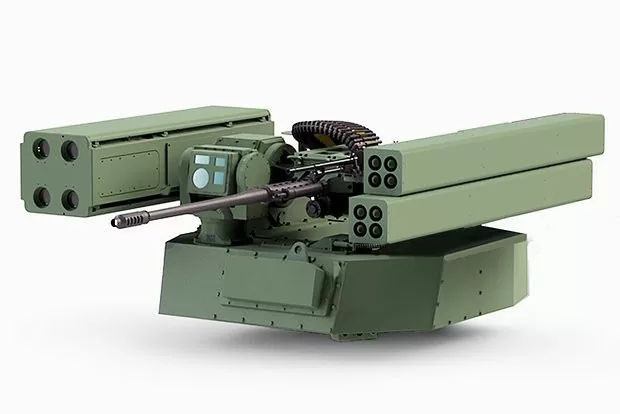 |
| The US is considering acquiring a British anti-aircraft and anti-UAV module. (Photo: Defense News) |
The first version of the system was mounted on a three-axle Supacat HMT chassis. This lightly armored vehicle could reach speeds of up to 120 km/h. The second chassis was built on the Dingo 3 armored vehicle, which is mine-resistant.
The modular RIwP platform integrates various weapons systems into a single system. The weapon system showcased in the UK carries Starstreak surface-to-air missiles, an M230 LF 30 mm automatic cannon, and a parallel machine gun.
In October 2024, at a U.S. Army Association exhibition and conference, a high-energy beam anti-drone system was introduced on the hull of the armored aircraft carrier Stryker, featuring laser cannons, automatic cannons, and 70mm APKWS II guided missiles.
The US Navy is upgrading its littoral combat ships to counter UAVs.
The U.S. Navy announced that the Freedom-class Littoral Combat Ship (LCS) USS Indianapolis has been upgraded to equip itself with AGM-114L Longbow Hellfire radar-guided missiles. These missiles are designed to destroy drones, a task that has become particularly important in light of recent conflicts in the Middle East.
The decision to upgrade the warships' weaponry stems from the increasing number of drone and missile attacks on U.S. forces in the region. Since the start of the Israeli-Gaza conflict in October 2023, U.S. and allied bases have suffered numerous attacks. Additionally, drone and missile attacks from Yemen, including those targeting U.S. ships in the Red Sea, have also posed a serious problem.
 |
| The US is seeking solutions to integrate low-cost anti-UAV measures into the LCS. Photo: Topwar |
Previously, the U.S. Navy typically used traditional missile defense systems or fighter jets to intercept UAVs and missiles targeting military and commercial vessels. However, such measures require significant financial resources.
The cost of intercepting a target using the SM-2, SM-3, or SM-6 missile defense systems used in the Middle East can reach $2-4 million, with approximately 200 of these missiles produced in the past year. Meanwhile, the use of the AGM-114L Longbow Hellfire, costing around $200,000 per missile, significantly reduces costs while maintaining high effectiveness.
The modernization process of the littoral combat ship was carried out directly during its deployment in the Red Sea. Previously, in September 2024, the Freedom, along with two Arleigh Burke-class destroyers, participated in repelling missile and drone attacks launched by the Houthi forces of Yemen.
Colonel Matthew Lehman, Director of the LCS Mission Modules program, noted the importance of upgrading anti-UAV systems in the face of increasing threats. He stated that developments within the U.S. Fifth Fleet's area of responsibility underscore the need to modernize the fleet to effectively address new challenges.
South Korea is developing a ballistic missile capable of carrying an 8-ton warhead.
According to the military news site Defense News, South Korea has developed a powerful new Hyunmoo V surface-to-surface ballistic missile (SSBM). The transport-elevator-launcher system for the Hyunmoo V ballistic missile was showcased at the 76th South Korean Armed Forces Day ceremony in 2024. While the missile itself has not been officially released, this has raised several questions.
South Korea's new ballistic missile is capable of striking targets at distances of up to 3,000 km. It can carry an 8-ton conventional warhead, making it the heaviest non-nuclear warhead ever fitted to a ballistic missile.
This missile is designed to destroy military infrastructure located deep underground, including missile silos, command bunkers, and critical underground facilities.
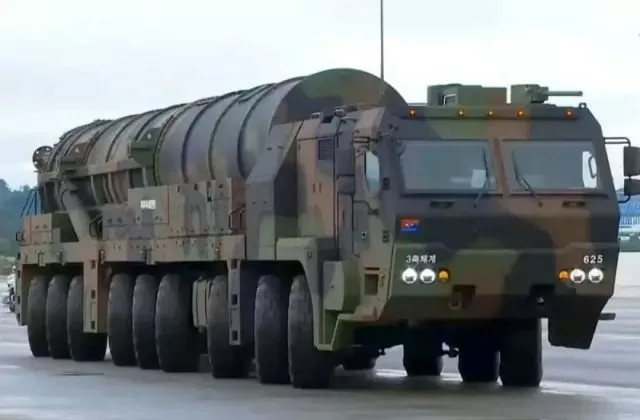 |
| The transport-erection-launch platform for the Hyunmoo V ballistic missile. Photo: Topwar |
The missile development underscores South Korea's desire to bolster its defense capabilities after the U.S. lifted restrictions on ballistic missile range in 2021 that had previously limited Seoul's ability to develop longer-range, more powerful ballistic missiles. The new missile is expected to enter service with the South Korean military in the near future and will become a crucial component of its strategic deterrence system.
The missile is equipped with a two-stage solid-fuel propulsion system capable of rapid acceleration and a short transition time. In the final stage, the missile warhead can reach speeds close to Mach 10, making it much more difficult for enemy missile defense systems to intercept. The missile is mounted on a Kia Motors K901 off-road vehicle chassis, increasing its maneuverability and operational flexibility.
The Hyunmoo V's guidance system is based on advanced inertial and satellite guidance, providing high accuracy even over long distances. This level of accuracy allows South Korea to strike targets far from its territory or in preemptive strikes.
Source: https://congthuong.vn/ban-tin-quan-su-221-han-quoc-dang-phat-trien-ten-lua-dan-dao-sieu-khung-370733.html













































































































Comment (0)