

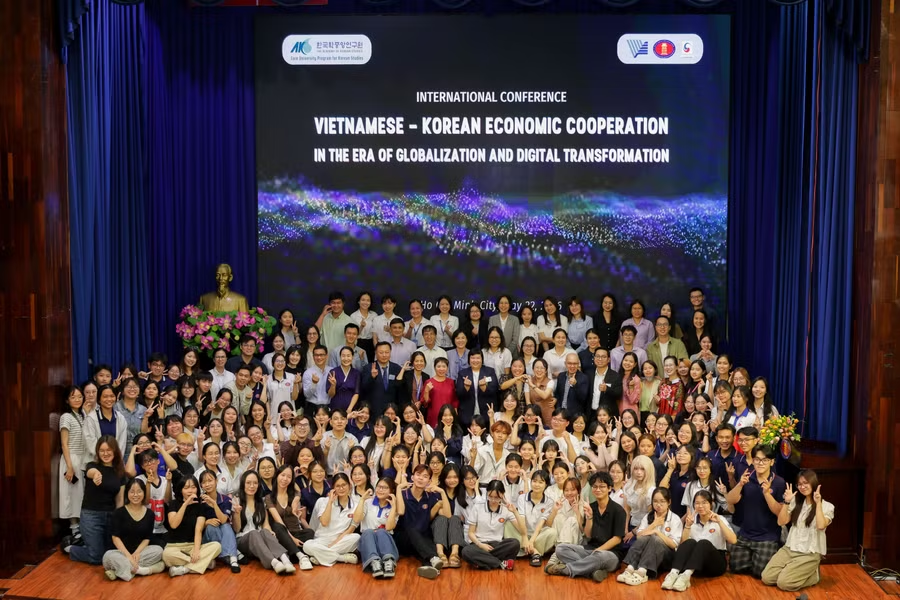
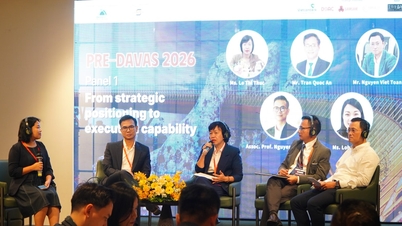
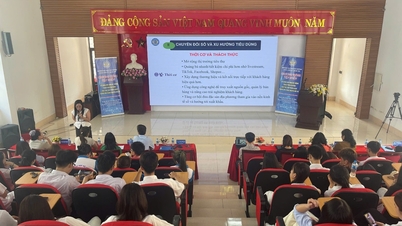
Against the backdrop of digital transformation and globalization reshaping international relations, the University of Social Sciences and Humanities (Vietnam National University Ho Chi Minh City) is organizing the international scientific conference "Vietnam-Korea Economic Cooperation in the Era of Globalization and Digital Transformation".
The workshop brought together representatives from diplomatic agencies, academia, and businesses from Vietnam, South Korea, and many countries in the region such as Thailand, the Philippines, and Indonesia.
In her opening remarks, Professor Ngo Thi Phuong Lan, the school's principal, stated that after Vietnam and South Korea upgraded their relationship to a Comprehensive Strategic Partnership in 2022, bilateral economic cooperation has developed strongly in both scale and depth.
According to Ms. Lan, bilateral trade between the two countries is projected to reach $89.5 billion in 2025, while South Korea will continue to hold the position of the largest foreign direct investor in Vietnam.
In particular, this foundation has been continuously strengthened through historic state visits, most recently the visit to South Korea by General Secretary and President To Lam (August 2025) and the visit to Vietnam by the President of South Korea (April 2026).
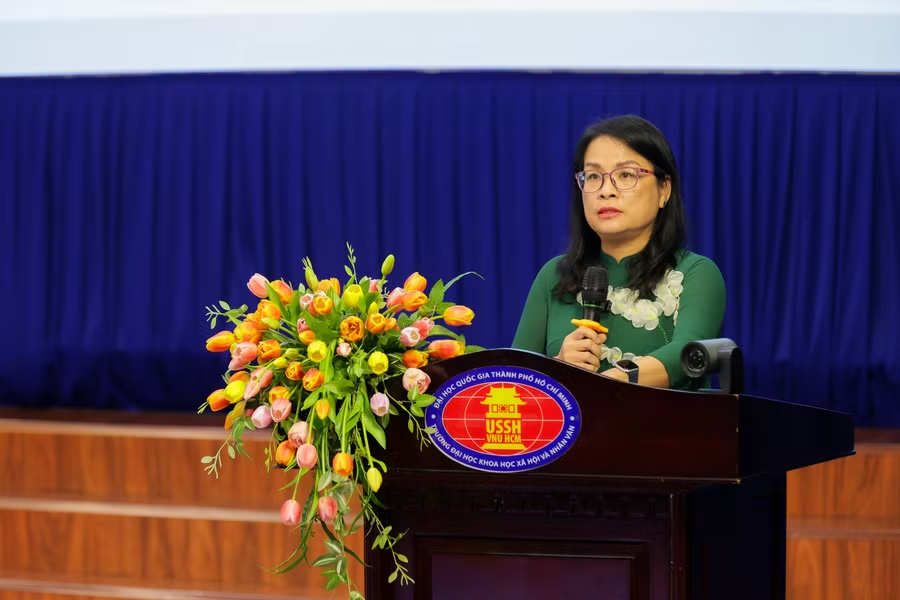
The Rector of the University of Social Sciences and Humanities in Ho Chi Minh City emphasized that in the digital age, economic cooperation is not only measured by trade or investment indicators, but also depends on the quality of human connections, interdisciplinary capabilities, and cultural understanding.
"We shouldn't just discuss dry economic growth indicators, but rather recognize language, culture, and interdisciplinary understanding as endogenous resources, serving as the core foundation for all trade activities and the building of a future for both sides," Professor Ngo Thi Phuong Lan stated.
According to school leaders, this is also why Korean Studies is no longer limited to language or traditional culture, but is strongly shifting towards the fields of economics, technology, and digital management.
This orientation is evident in the fact that the Department of Korean Studies has pioneered the implementation of an interdisciplinary bachelor's program in Korean Business and Commerce since 2023, in collaboration with the University of Economics and Law (Vietnam National University Ho Chi Minh City).
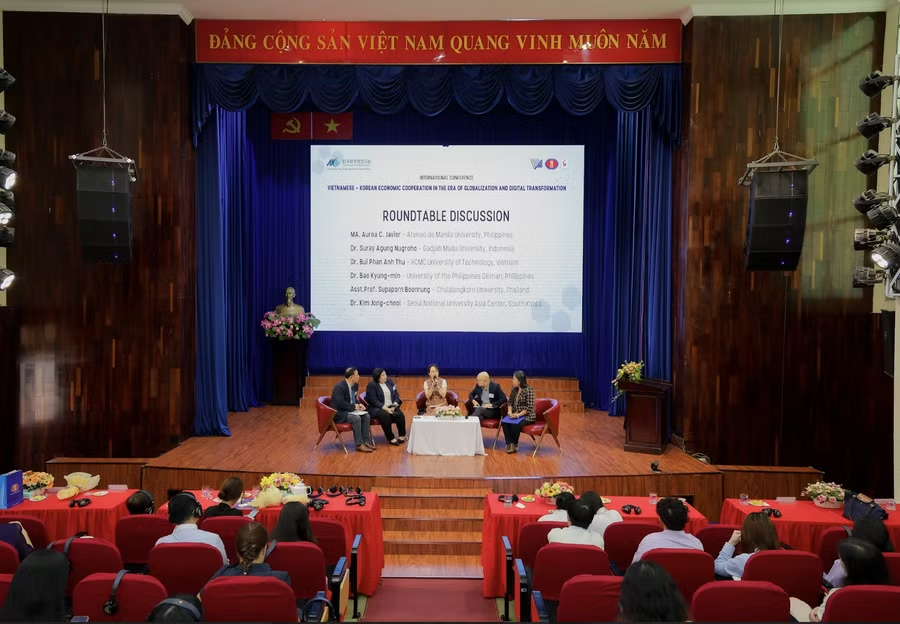
Highly appreciating the interdisciplinary training orientation of the University of Social Sciences and Humanities in Ho Chi Minh City, Mr. Jung Jung Tae - Consul General of South Korea in Ho Chi Minh City, said that fields such as artificial intelligence (AI), semiconductors, green energy, and digital transformation are becoming decisive factors in national competitiveness.
Therefore, connecting academia with practical needs is a pressing requirement.
In his introductory report titled "Vietnam-Korea Relations in the Digital Age and Global Restructuring," Ambassador Vu Ho, Vietnam's Ambassador Extraordinary and Plenipotentiary to South Korea, noted that the world is currently undergoing dramatic changes under the impact of technology, supply chains, green energy, and geopolitics.
The ambassador stated that the Vietnam-Korea relationship is shifting from cooperation for development to jointly building the future.
The two countries have a clear strategic complementarity, with South Korea possessing strengths in technology, R&D, and management, while Vietnam has a young market, a large workforce, and a strategic location in Southeast Asia.
Mr. Vu Ho suggested that future areas of cooperation should focus on AI, semiconductors, green technology, cybersecurity, and innovation.
However, for cooperation to deepen, both sides need to focus on substantive technology transfer, developing high-quality human resources, and building a shared innovation ecosystem.
Also at the conference, Professor Phan Thi Thu Hien, a senior lecturer in the Faculty of Cultural Studies and former Head of the Department of Korean Studies, presented a paper on the Seongsu-dong "pop-up sanctuary" model in Seoul from the perspective of experiential economics and urban innovation.
The report offers many insights for developing cultural and creative spaces in Vietnam in the context of a rapidly developing digital economy.
The workshop is one of the key activities marking the 5th year of implementing the Key University Project on Korean Studies in Vietnam, sponsored by the Central Institute for Korean Studies.
Source: https://giaoducthoidai.vn/viet-nam-han-quoc-thuc-day-hop-tac-thoi-dai-so-post778833.html

![[Image] Hanoi's urban life under the challenge of a "scorching hot" environment](https://vphoto.vietnam.vn/thumb/1200x675/vietnam/resource/IMAGE/2026/05/25/1779706979265_nang-nong-t5-2026-minh-duy-7-4636-jpg.webp)
![[Image] Close-up view of the interchange connecting the two expressways and Long Thanh Airport.](https://vphoto.vietnam.vn/thumb/1200x675/vietnam/resource/IMAGE/2026/05/25/1779703378210_ndo_br_z7863716673926-224453a31600126cce10622af6290afd-4549-jpg.webp)






































































Comment (0)