Her life story is a journey of unwavering determination, from the Vinh Linh battlefront to the Independence Palace, a symbol of the courageous spirit of Vietnamese revolutionary journalists.
We only have one life to live…
The history of revolutionary journalism in Vietnam is written with the blood, sweat, and tears of those who held cameras on the front lines. Among those proud names, war correspondent, director, and writer Xuan Phuong stands out as a special witness to a century of great upheaval.
Leaving school at the age of 16 to join the resistance, from a military doctor, she bravely chose a dangerous path to become a chronicler of the brutal realities of war. The life of this woman from the ancient capital of Hue, born in 1929, is a testament to the dedication of a generation of artists and soldiers with the indomitable spirit of Vietnam.
Before embarking on her career in wartime journalism, Ms. Xuan Phuong was living a peaceful life. After the victory at Dien Bien Phu in 1954, she studied medicine, worked as an interpreter and nurse serving international delegations at the Committee for Cultural Relations with Foreign Countries. With her high level of expertise and fluency in French, she worked in a comfortable environment.
However, a major turning point came for her in 1967, when President Ho Chi Minh assigned her the task of accompanying and acting as an interpreter for the film crew of two world-renowned revolutionary filmmakers, Joris Ivens and Marceline Loridan, to the Vinh Linh front line in Quang Tri to make the documentary film " The 17th Parallel - People's War".
Two months enduring American bombing in the dark, suffocating tunnels amidst fierce fighting completely changed the young female doctor's worldview. Witnessing the indomitable spirit of the people of Vinh Linh and the sacrifices of her colleagues, she was enlightened with a new ideal.
Recalling those life-or-death days together, Ms. Xuan Phuong recounted the fateful advice of legendary director Joris Ivens: “In mid-1967 , you are in desperate need of interpreters and doctors. But even more urgently, you need a team of war correspondents to document firsthand the tenacious fighting spirit in defending every inch of Vietnamese land. I hope Phuong will bravely venture into a profession that, although fraught with danger, is something your country desperately needs at this time.”
Those heartfelt words from her first film teacher haunted her dreams for many nights, prompting her to make a pivotal decision.
Back at the clinic, she vividly recalled the days when she was buried under bombs, yet still peacefully drifted into a deep sleep in the dark tunnels. “I was 38 years old then, the mother of three young children, having endured so much hardship before finally enjoying a little peace. Leaving the luxurious, comfortable clinic with its high salary to return to my apprenticeship as a reporter, earning only as much as a street sweeper, and venturing into such danger.”
Rumors circulated that I had been disciplined, fired, or that I was insane. But I was haunted by Mr. Ivens' words that I had the potential to be a war correspondent. My heart told me that I only have one life to live, so I should live it to the fullest,” Ms. Xuan Phuong recalled.
Footage obtained through bloodshed.
Becoming a war correspondent for the Liberation Film Studio, she braved the most brutal battlefields. To obtain historical footage denouncing the war, she faced death countless times. She was buried under rubble twice by bombs, and once had shards of glass embedded in her face at Hien Luong Bridge.
Those brutal life-or-death experiences left an unforgettable impression on her, becoming valuable source of realism that made her later recollections more authentic and deeply moving for viewers and readers.
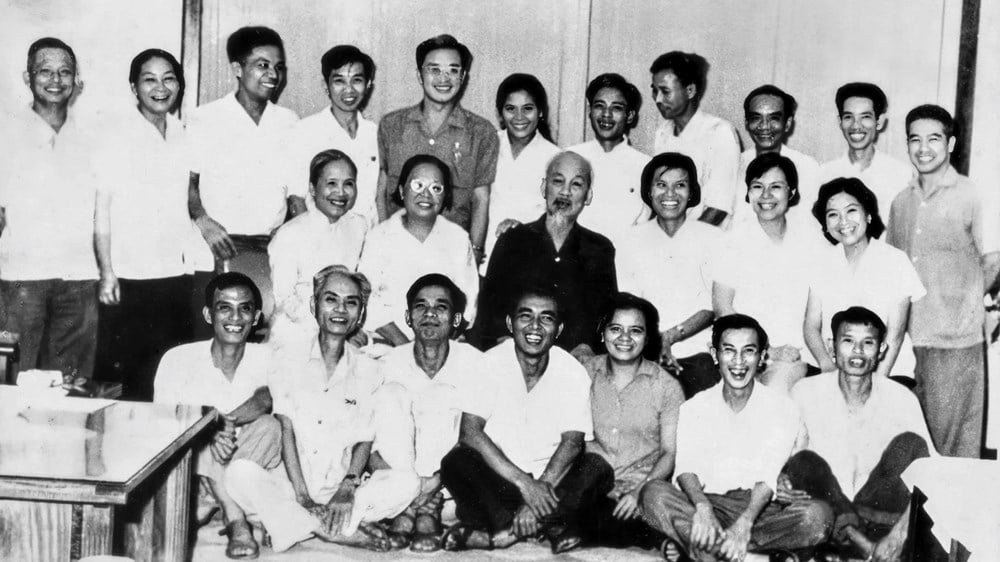
Throughout her career as a journalist and filmmaker, Ms. Xuan Phuong was fortunate enough to witness and record historical moments. In 1968, while filming President Ho Chi Minh receiving heroes and exemplary workers with director Joris Ivens' film crew, Ms. Phuong had a special experience. During filming, President Ho Chi Minh was wearing a hat with a brim, which partially obscured his face. Director Ivens suggested that she ask him to remove his hat for a better shot.
Although initially hesitant, she eventually mustered the courage. She recounted, "I bravely ran in, and Uncle Ho turned around and asked, 'What is it, child?' I replied, 'Uncle, your hat is very beautiful, but your hair is even more beautiful.' Hearing this, Uncle Ho smiled kindly and said, 'This journalist is quite something,' then he took the hat and put it on her head."
On March 20, 1975, amidst the overwhelming news of victories from the southern front, Ms. Xuan Phuong proactively requested a used car, but unfortunately, it had run out of gas. Determined not to miss this historic moment, she boldly knocked on the door of Mr. Phan Tu Quang's house (then the head of the Petroleum Department under the Ministry of National Defense) in the middle of the night to ask for fuel.
The very next day, her film crew set off, closely following the rapid progress of the Ho Chi Minh Campaign, traversing newly liberated areas from Hue, Da Nang, and Nha Trang, heading straight towards Saigon.
On the morning of May 1st, Ms. Phuong set foot in the Independence Palace, the very place where the Saigon government had declared its surrender just the day before, and was able to record invaluable documentary footage about the country's context during this historic transition period.
On the first night after the reunification of the country, standing by the window of the Caravelle Hotel and looking down at the dimly lit streets, she was overwhelmed with an indescribable emotion. In the quiet stillness of the city, she realized that for the first time after so many years of wartime struggle, the ears of a war correspondent no longer heard the sound of gunfire, heralding the arrival of a truly peaceful and independent era in her homeland.

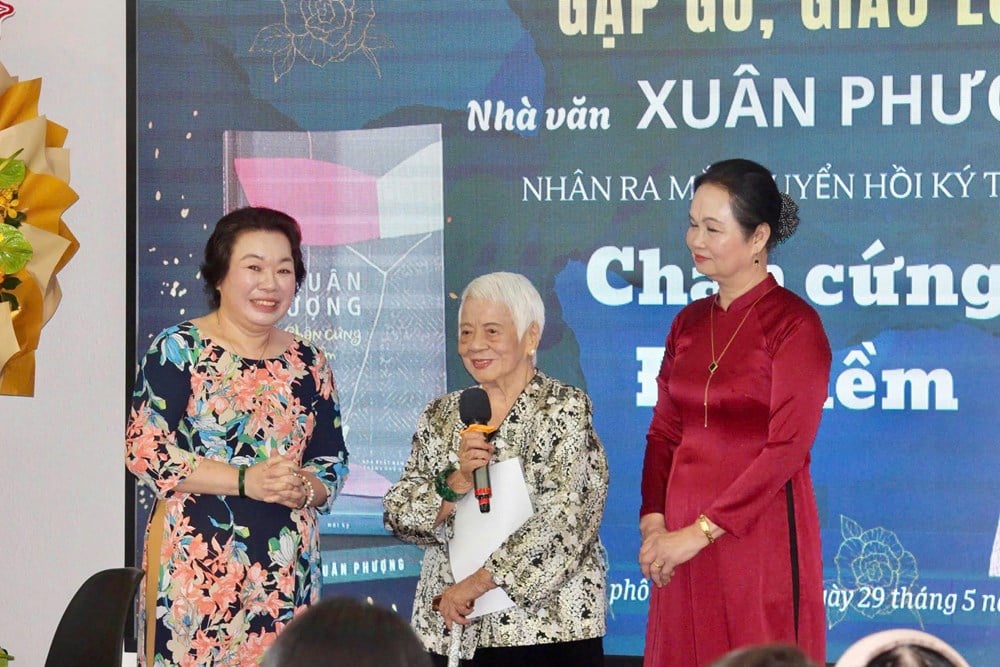
Director and writer Xuan Phuong launches her memoir "Strong and Unyielding".
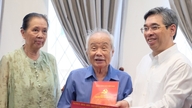

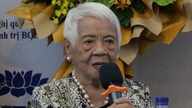
After the war, her documentary film "When the Gunfire Has Just Ceased" received an honorable mention at the Leipzig International Film Festival. Many of her other works, such as "Vietnam and the Bicycle," "When Smiles Return," "Two Words: Homeland," "I Write a Song of Rebirth," etc., continue to be invaluable films about a time of bloodshed.
Having passed the age of 90, when most people have chosen to retire, the former war correspondent embarks on a new journey on the blank page. She always reflects: "Having chosen the profession of writing, happiness and hardship go hand in hand at any age. Facing a blank page, trying to write words exactly as one intends is incredibly difficult, let alone for someone over ninety years old."
The sweet fruit of that tireless work ethic is the birth of *Gánh gánh... gồng gồng...* , a work that won the Vietnam Writers Association Literature Prize in 2020 and has been reprinted 14 times, much to the admiration of many generations of readers. At the age of 97, this iron woman continues to release her third memoir, * Chân cứng đá mềm *.
The work not only portrays the journey of a patriotic female intellectual, but also realistically recreates the awkward and challenging early days of entering the field of war documentary filmmaking, along with the extraordinary efforts to "persevere" after making that bold career change.
Describing herself as an aging director yet a young writer, Ms. Xuan Phuong maintains an optimistic spirit with a clear life motto: "Remember when needed, don't dwell on the past when not needed." On the occasion of Vietnam's Revolutionary Press Day, her story serves as a powerful source of inspiration, evoking a spirit of resilience, dedication, and a desire to serve the country for today's generations.
Source: https://baovanhoa.vn/bao-chi/hanh-trinh-chan-cung-da-mem-238883.html
![[Image] Schools organize meetings and introduce teaching models to students admitted to grade 10.](https://vphoto.vietnam.vn/thumb/1200x675/vietnam/resource/IMAGE/2026/06/25/1782368077271_ndo_br_z7970052192242-1ec8daeb77a6eed1a4e9f58c564ddd3e-jpg.webp)
![[Image] Ho Chi Minh City: Ma Lang area, Chicken-Rice Market about to change its appearance](https://vphoto.vietnam.vn/thumb/1200x675/vietnam/resource/IMAGE/2026/06/25/1782377698627_ndo_br_m1-jpg.webp)
![[Photo] General Secretary and President To Lam receives Palestinian Ambassador Saadi Salama](https://vphoto.vietnam.vn/thumb/1200x675/vietnam/resource/IMAGE/2026/06/25/1782365384740_a1-bnd-9423-8322-jpg.webp)