

Rural-urban gap
In just a few years, IELTS, originally designed as a tool to assess academic English proficiency for studying abroad and immigration, has transformed into a "golden ticket" in Vietnamese university admissions.
The staggering growth figures have astonished many: the National Economics University received up to 25,000 applications, the Banking Academy over 13,000, and many other schools saw a 3-4 fold increase in just one exam season.
Le Hoang Phong, founder and academic director of Your-E Education and Training Organization, believes that, on the surface, this is a positive development: a generation of students eager for integration, responsive parents, and universities seeking more transparent selection methods. However, beneath the surface lie underlying tensions and troubling questions about inequality, the risk of large-scale "foreign currency outflow," and, above all, the autonomy of Vietnamese education.
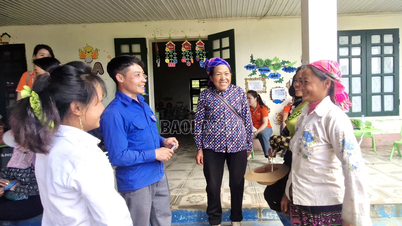
In Hanoi , while students and their families in rural and remote areas are saving up a few million to tens of millions of VND to invest in the "golden ticket" of the IELTS certificate in the next few years, many students in large cities have the means to access this certificate.
For example, NTD, an 11th-grade student at a prestigious specialized high school in Hanoi, has her parents investing in her studies with a British teacher specializing in IELTS preparation. The family is willing to spend nearly 100 million VND per 6-month course, averaging over 1.3 million VND per session.
Take NVD, a student who just got accepted into the 10th grade specialized Biology class in Hanoi. Four years ago, her family hired a teacher who was a student studying in Europe to tutor her English one-on-one. Now, with the resources available and having just been accepted into the 10th grade, instead of going to a cheaper tutoring center with other students, she still chooses to study at the 2 million VND per lesson fee.
Conversely, in a suburban district of Hanoi, H., an orphan living with her 82-year-old grandmother, studied diligently for a year thanks to a free IELTS scholarship. Her mock test results showed she could achieve a 6.0, a dream score. But when the official exam came, she didn't enter the examination room because the 4.64 million VND fee was an amount her family could barely afford to spend in three months.
In another case, in Cao Lanh district, Dong Thap province, T., the child of a hired laborer, learned about IELTS through online videos. The nearest center is more than 50 km away. Each round-trip bus fare costs her mother half a day's wages.
For students like H. and T., the "IELTS door" never truly opened. These aren't just individual stories. This is structural inequality, where access to opportunity is constrained by affordability. In an education system that values equity, this is a warning sign.
Is absolute fairness possible?
Speaking with a reporter from Tien Phong newspaper, Mr. Nguyen Tran Binh An, a prospective master's candidate in Applied Linguistics at the University of York (UK), assessed that adding points to the IELTS score inadvertently creates a "double advantage" for students from affluent backgrounds.
Mr. An believes that using IELTS certificates for university admissions inadvertently creates a significant advantage for students from affluent families compared to those from less privileged backgrounds. From the outset, these students benefit from better learning conditions, from better facilities and teacher quality to supplementary classes and quality learning materials. Thanks to this superior access, affluent students often achieve higher grades in their academic transcripts and university entrance exams for the required subjects, creating a favorable foundation for university admissions.
According to Mr. An, the policy of adding points to IELTS scores further highlights this disparity in economic conditions. Many well-off families have exposed their children to English from a young age through intensive English classes and abundant, well-structured English resources, and as they grow older, they continue to invest in their children's IELTS preparation at high-quality centers.
The cost of obtaining an IELTS certificate is considerable: a single IELTS lesson currently costs an average of 150,000–200,000 VND, and to progress from a level of 3.5-4.0 (the exit level for students after completing secondary school, equivalent to A2) to 7.0–7.5 (the competitive IELTS score) requires approximately 700-800 hours of guided study (according to Cambridge English), equivalent to 250-300 lessons (after deducting self-study time and school time), costing around 40-45 million VND, not including exam fees and retakes. For many families, this is an unaffordable expense.
Speaking with reporters, Mr. Nguyen Dinh Do, Principal of Thanh Nhan High School in Ho Chi Minh City, said that in recent years, learning IELTS has not only been a focus of attention for parents and students but also a priority for the school.
At our school alone, an average of about 50% of high school graduates obtain an IELTS certificate with scores ranging from 6.5 to 8.0, which serves as a "lifeline" for many students when applying to top universities, especially in the health and engineering fields.
According to Mr. Do, many universities currently have policies to add points or convert scores for students with IELTS certificates or other foreign language certificates, so the school has identified this as an advantage for students applying to universities with English as a subject combination.
Regarding the issue of academic imbalance and inequality between urban and rural/remote students, Mr. Do believes this view is not entirely accurate. Firstly, the imbalance is a concern; the school's IELTS preparation is scientifically structured, with both teachers and students recognizing it as a supplementary subject to boost university admissions and enhance knowledge. Furthermore, studying for and taking the IELTS exam is a long process, not something that happens overnight. At Thanh Nhan School, this preparation is prioritized for students in grades 10 and 11, leaving students in grade 12 with virtually no time to study and prepare for the IELTS.
Regarding the issue of inequality between urban and rural/remote areas, Mr. Do believes that this problem exists to some extent, but a more objective perspective reveals a greater degree of fairness. He agrees that students in rural areas lack the economic resources and environment to study and prepare for the IELTS exam, but with effort, they can still learn through various methods, including reference materials and online resources such as free and paid software and applications. He also points out that students in rural and remote areas have traditionally received regional bonus points, so adding extra points to their IELTS scores would help create a more balanced admissions process.
Sharing the same view, Mr. Nguyen Dang Khoa, Principal of Trung Vuong High School, Ho Chi Minh City, also believes that the policy of converting and adding IELTS/foreign language certificate points for candidates in the admissions process before implementation has certainly been thoroughly analyzed and evaluated. Absolute fairness among candidates is difficult, but overall, this is necessary to select suitable candidates for each major and each school.

Even those with SAT 1500 and IELTS 8.5 were left speechless by the English graduation exam.

IELTS score conversion rates for over 70 universities in 2025: Some universities have converted a 6.0 to a 10.

The English graduation exam is as difficult as the IELTS: Students are crying out in despair, what do experts say?

Ho Chi Minh City University of Science is converting foreign language certificates for the first time.

How will the Academy of Finance convert IELTS certificates in 2025?
Source: https://tienphong.vn/hao-quang-ielts-cuoc-dua-bat-binh-dang-trong-nen-giao-duc-post1770628.tpo


![[Image] Hanoi Police officially crowned champions of V-League 2025/2026](https://vphoto.vietnam.vn/thumb/1200x675/vietnam/resource/IMAGE/2026/05/31/1780244769054_ndo_br_039d561b692be875b13a-jpg.webp)
![[Photo] The General Secretary, President and his wife begin their state visit to the Philippines.](https://vphoto.vietnam.vn/thumb/1200x675/vietnam/resource/IMAGE/2026/05/31/1780230559452_anh-man-hinh-2026-05-31-luc-19-28-11.png)
![[Photo] Admire the coral "masterpiece" amidst the million-year-old heritage of Dak Lak province.](https://vphoto.vietnam.vn/thumb/1200x675/vietnam/resource/IMAGE/2026/05/31/1780221235105_anh-man-hinh-2026-05-31-luc-16-53-27.png)
![[Photo] Solemn bathing ceremony and Buddha procession in Hue](https://vphoto.vietnam.vn/thumb/1200x675/vietnam/resource/IMAGE/2026/05/31/1780228263543_1-jpg.webp)


















![[Video] Sunset at Lap An Lagoon – Where the sun sets over the fishing nets](https://vphoto.vietnam.vn/thumb/340x192/vietnam/resource/IMAGE/2026/05/31/1780192137701_beach-landscape-sea-water-nature-grass-745871-pxhere-com.jpeg)
































































Comment (0)