

SGGP
Following several large-scale protests, the first of their kind in South Korean history, the Ministry of Education introduced a series of new policies to protect teachers' legal rights against bullying from parents and students. However, these policies have failed to meet the teachers' earlier demands and appear to do more harm than good.
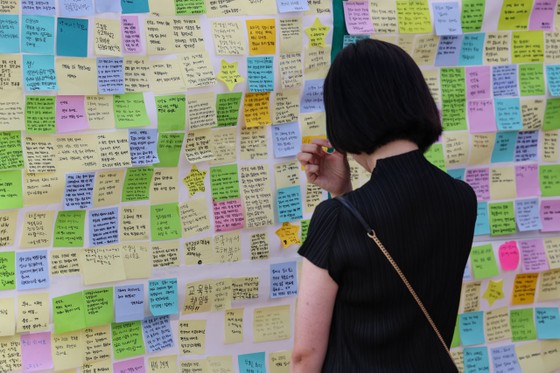 |
| Commemorating a primary school teacher who committed suicide due to academic pressure. Photo: Yonhap |
Caught between a rock and a hard place.
The latest protest by approximately 100,000 South Korean teachers, also a demonstration to commemorate a young female colleague who recently committed suicide, took place on September 4th, marking a historic moment in the nation's education sector. The demonstration was the final straw after a series of teacher suicides stemming from extreme stress caused by insults from parents and students.
Threats, slander (through unsolicited phone calls at any time of day), or even physical attacks (like throwing pens at teachers) have been commonplace for a long time. Prior to September 4th, the South Korean Ministry of Education introduced new policies to protect teachers' legal rights by granting them more control over their classrooms. Accordingly, teachers have the right to ask disruptive students to leave the classroom, confiscate their phones, and require parents to make appointments in advance if they wish to meet with the teacher. In cases of threats or attacks, teachers are permitted to use force to restrain unruly students.
However, according to the Korea Herald, the new policy also allows students or parents to evaluate teachers' teaching methods with the principal, instead of directly filing complaints with the teachers. According to lawyer Kim Ji-yeon of Young Lawyers for a Better Future, the scope of the new policy is too vague and still fails to prevent excessive parental interference, as parents are also empowered to intervene. This only encourages overbearing parents to abuse their power.
Even though teachers have the right and obligation to discipline unruly students, the principal can still request that the teacher mitigate the punishment for such a student. Faced with this immense pressure and feeling a lack of basic respect, many teachers, despite the Ministry of Education's efforts to protect their rights, choose to resign permanently because they cannot tolerate the insults from students and parents.
Change the definition
School bullying has been a serious problem in South Korea for decades. Analysts suggest that parents and students have exploited the legal and administrative system, specifically the Child Welfare Act of 2014 (which prohibits any form of physical punishment against children), to bully teachers. This act does not allow teachers to intervene in cases of student fights. Even yelling can be classified as "emotional abuse," leading to the teacher's dismissal.
Since 2018, hundreds of teachers have committed suicide, most due to depression stemming from work stress. Last year, 12,000 teachers resigned. Meanwhile, around 10,000 young people of school and university age commit suicide each year. Academic pressure on Korean students is immense; even from kindergarten onwards, anyone who is different or fails to fulfill their obligations becomes a target of bullying. The root of this is South Korea's hyper-competitive society, which views education as the most readily accepted form of social progress.
According to Archyde, in a society where everything depends on academic success, parents often look to teachers. Many believe that the entire South Korean education system needs reform. Vice Prime Minister and Minister of Education Lee Joo-ho stated, “I think it’s time to redesign (the teacher evaluation system) because the conditions for students and teachers have changed so much.”
South Korea has the highest suicide rate among developed countries and the lowest birth rate in the world due to the burden of raising children. Previously, Korean families had five or six children, but now most have only one. Professor Kim Bong-jae of Seoul National University of Education says the cause is increasing inequality. There is still a long way to go, but this issue is a subject of intense debate within South Korean politics.
According to Professor Park Nam-gi of Gwangju National Normal University, the definition of societal success needs to be changed. The South Korean Ministry of Education should invest more financial and human resources if it wants to create a better learning environment. Otherwise, the new measures will once again push teachers to the brink.
Source

















































































Comment (0)