

(NLĐO) - Some objects in the Solar System have unusually tilted orbits, or even rotate in reverse. Scientists have just discovered the reason.
According to Sci-News, a new study indicates that billions of years ago, our solar system was in close proximity to another identical star system.
Much like those fictional scenes where a person encounters an identical doppelganger in a parallel world , a great deal of chaos ensued.
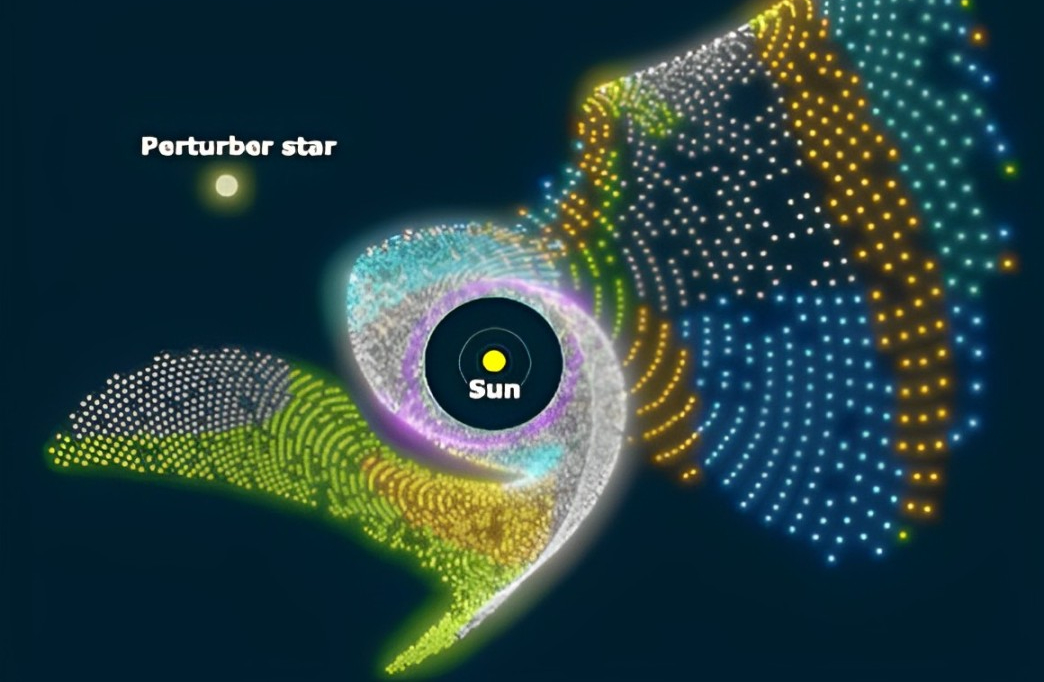
Graphic depicting the Solar System and a star at least 0.8 times its size passing alongside it - Image: Jülich Research Center
A team of authors led by Dr. Susanne Pfalzner from the Jülich Research Center (Germany) studied objects residing in the most distant regions of the Solar System, beyond the orbit of the eighth planet, Neptune.
There are approximately 3,000 known objects beyond Neptune.
Surprisingly, most of them move in eccentric and tilted orbits. Some even rotate in the opposite direction to most other objects in the solar system.
This is an unusual phenomenon because objects of all sizes within a star system, from planets and dwarf planets to asteroids, should theoretically have a certain degree of similarity.
The most likely scenario is that something has affected the orbits of these objects. Because these unusual objects are concentrated in the outer regions of the solar system, researchers believe this disruption is due to something flying too close to us.
A series of simulations were set up, pointing to the most plausible scenario: Billions of years ago, when the solar system was very young, a star with a mass at least 0.8 times its own – capable of carrying planets – flew past at a distance of only 110 astronomical units (AU), or 16.5 billion kilometers.
An AU is equivalent to the distance from the Sun to the Earth. For an entire star system, passing each other at a distance of only 110 AU is extremely close.
But it would have to be close enough to cause some objects to have their orbits disrupted to the point where they move almost perpendicular to the orbits of the planets.
Some objects, such as 2008 KV42 and 2011 KT19, even rotate in the opposite direction to the planets.
The close flyby of this star system, very similar to our own, also propelled some objects beyond Neptune toward planets.
As a result, some of the outermost planets have acquired additional moons, most of which are distorted, have distant, tilted, and eccentric orbits.
This may explain why the outer planets of our solar system often have two different types of moons: one type similar to Earth's moons, and the second type being the unusual moons mentioned above.
At least 140 million sun-like stars in our Milky Way galaxy have suffered a similar fate.
Source: https://nld.com.vn/he-mat-troi-dao-lon-vi-dung-do-the-gioi-song-song-196240912093917716.htm





































































































Comment (0)