

During the 2025 dry season, Lao Chai commune faced extreme weather conditions with 26 consecutive days without rain, raising the forest fire warning to a dangerous level. In response to this pressure, the local authorities not only relied on government agencies but also strongly activated community-based forest protection mechanisms. Commitment agreements and village regulations, agreed upon by the people, became an effective shield, keeping the forests safe.
Lao Chai is an area with a large forest area of over 9,000 hectares, of which natural forest accounts for more than 7,000 hectares. With a forest cover rate of 54.9%, the lives of the people here are closely linked to the forest through economic models under the canopy such as cardamom (139 hectares) and hawthorn trees (over 800 hectares).

However, this unique characteristic also creates significant pressure in forest fire prevention and control. According to statistics, the commune currently has about 30 hectares of cultivated land interspersed with or right at the edge of the forest. During the dry season, even a small mistake in using fire or burning undergrowth can have serious consequences.
In 2025, the situation became even more tense when, right from the start of the season, the commune recorded a streak of 26 consecutive days without rain. The prolonged dry weather caused the vegetation to become parched, raising the forest fire risk forecast in Lao Chai to level IV – the most dangerous level. Given this reality, the challenge for the local authorities was how to control the fire sources, with a limited number of forest rangers and a highly fragmented terrain.
To solve this problem, Lao Chải commune chose to rely on the people, transforming legal regulations into specific, easily understandable clauses in the village's customs and conventions.
According to Mr. Hoang Van Chien, a forest ranger in Lao Chai commune, the key to this approach is creating internal regulations with a community focus. The content of the village regulations on forest protection is contributed and developed by the people themselves, so when applied, the villagers take it very seriously.
"The agreement creates a constant reminder within the village. It fosters a positive mindset within the community, making people consider forest conservation a shared responsibility, not just the responsibility of forest rangers," Mr. Chien emphasized.
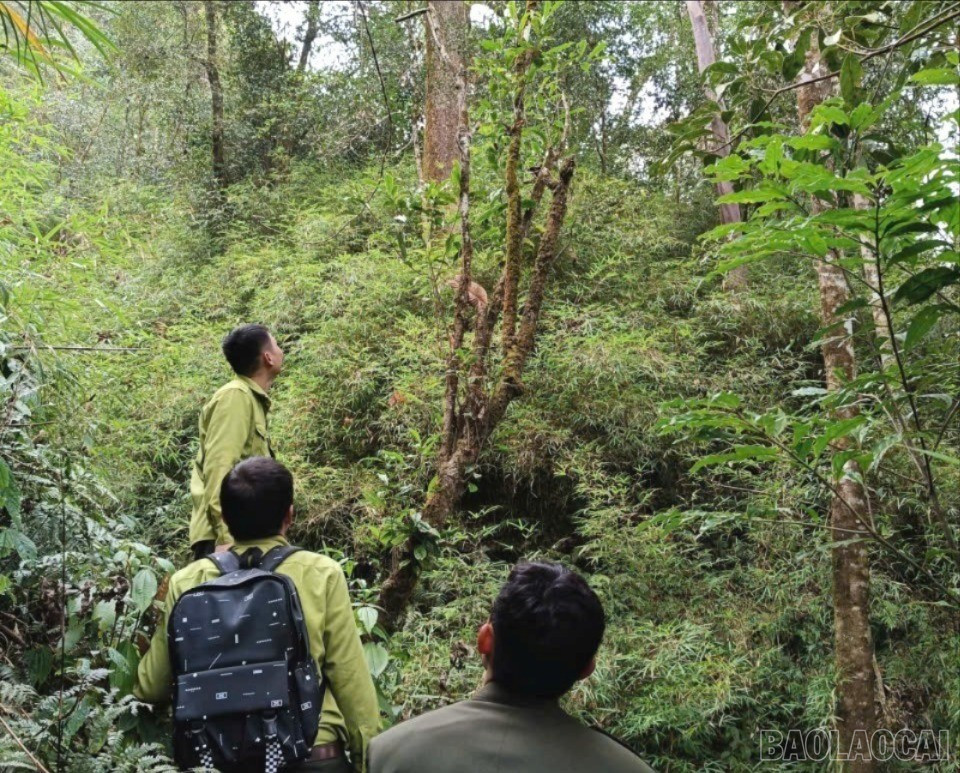
To date, 1,766 households in all 14 villages of Lao Chai have signed commitments to protect the forest.
In Hang Gang village, which manages nearly 470 hectares of forest (including natural protection forests and planted forests), this work is carried out very strictly. Mr. Sung A Rua, the head of Hang Gang village, said: In addition to maintaining fire monitoring and patrols, the village has incorporated strict regulations into its community rules. These include strictly prohibiting illegal burning of forests for farming and forbidding the cutting of trees within the protected forest area. Anyone who violates these rules will be condemned by the community and dealt with according to the agreed-upon regulations.
Not only did they make commitments, Lao Chai commune has also strengthened 14 forest fire prevention and control teams in the villages with 73 members, averaging 7-10 people per village in the rapid response team. During the peak of this year's dry season, these forces coordinated and organized 23 patrol sessions at hotspots.
While there were still 3 small fires in the area in 2024, thanks to effective patrolling and monitoring, Lao Chai commune did not experience any forest fires during the 2024-2025 dry season.
The handling of violations has also been carried out strictly to ensure deterrence. Since the beginning of the year, the commune's People's Committee has handled 3 cases of violations, including illegal logging, collecting 8 million VND for the state budget, and has transferred 4 other cases to the Forest Protection Department for handling. This resolute handling demonstrates that the village's forest protection regulations are not just empty words.

Evaluating the local approach, Ms. Dao Thi Thu Thuy, Secretary of the Party Committee of Lao Chai commune, affirmed: The positive results achieved in the past period are thanks to the synchronized involvement of the entire political system and the consensus of the people.
According to Ms. Thuy, the commune has issued directives closely aligned with the actual situation and mobilized social resources to equip local firefighting tools such as machetes, hoes, and shovels. However, the greatest success is that the people have truly come to view the forest as a common asset that needs to be preserved.
The village regulations in Lao Chai demonstrate that when laws are concretized through familiar conventions and accepted by the community, forest protection becomes more sustainable.
Source: https://baolaocai.vn/hieu-qua-tu-huong-uoc-giu-rung-post889772.html
![[Photo] General Secretary and President To Lam meets with National Assembly delegates from ethnic minorities.](https://vphoto.vietnam.vn/thumb/1200x675/vietnam/resource/IMAGE/2026/04/20/1776696701056_a1-bnd-8331-3342-jpg.webp)




![[Image] National Assembly discusses the implementation of the socio-economic development plan.](https://vphoto.vietnam.vn/thumb/1200x675/vietnam/resource/IMAGE/2026/04/20/1776696707422_ndo_br_img-20260420-185419-jpg.webp)

























































































Comment (0)