

 |
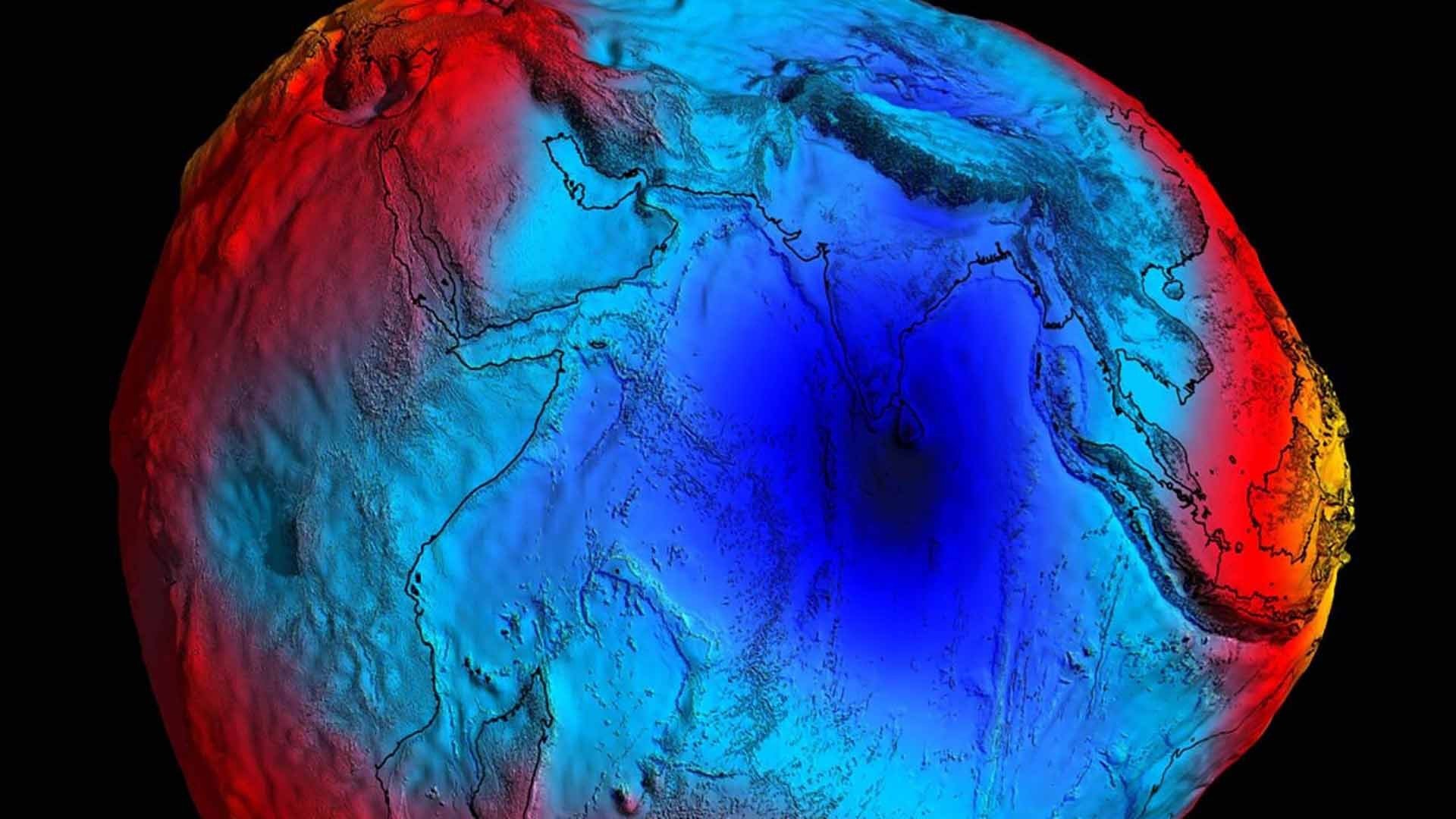
| Sea levels have dropped by approximately 100 meters in a "gravity crater" in the Indian Ocean. (Illustrative image. Source: CNN) |
This mysterious "gravity hole" has puzzled geologists for a long time. But recently, researchers at the Indian Institute of Science in Bengaluru (India) have found an explanation for its formation. It is caused by flows of molten lava (magma) forming from within the Earth.
To reach this conclusion, the research team used computer simulations to recreate the formation of this area 140 million years ago. The team presented their findings in a new study published in the journal Geophysical Research Letters, which mentions an ancient ocean that no longer exists.
Ancient oceans disappear.
People often think of the Earth as a perfect sphere, but the reality is quite different.
Co-author of the study, Attreyee Ghosh, a geophysicist and associate professor at the Centre for Earth Sciences of the Indian Institute of Science, said: “The Earth is basically like a bumpy potato. It’s not a sphere, but an ellipse, because as the planet rotates, the center of it bulges outwards.”
The Earth is not uniform in density and properties; some areas are thicker than others—this significantly affects the Earth's surface and the differing gravitational forces exerted on these points.
Ms. Ghosh explained that, assuming the Earth's surface were completely covered by water, the planet's gravitational field would create bulges and depressions on this imaginary ocean surface. These bulges and depressions on the ocean surface are called geoids. A geoid is the hypothetical shape of the ocean surface under the influence of only the Earth's gravitational interaction and rotation, without other influences such as tides and wind. Geoids have uneven elevations.
The Indian Ocean's "gravity crater"—officially known as the Indian Ocean Geoid—is the lowest and most anomalous point within that geoid. It forms a circular depression beginning just off the southern tip of India and covering approximately 3 million square kilometers. Its existence was first discovered in 1948 by Dutch geophysicist Felix Andries Vening Meinesz during a gravity survey conducted from a ship. Since then, the "gravity crater" has remained a mystery.
"This is the place with the lowest geoid on Earth, and the exact explanation remains unexplained," said Ghosh.
To find the answer, she and her research team used computer models to simulate the area as it was 140 million years ago, aiming to observe the overall geological picture. From that starting point, the team conducted 19 simulations, recreating the movement of tectonic plates and changes in the molten rock layers within the Earth over the past 140 million years.
They compared the shape of the geoid obtained from computer simulations with the actual geoid of the Earth obtained from satellite observations.
The future is uncertain.
The distinguishing factor between these simulation models is the presence of molten lava flows surrounding the low geoid region, along with mantle structure in the vicinity, which are thought to be the cause of the formation of the “gravity crater,” Ghosh explained.
These simulations were run on a computer by the research team with different parameters regarding the density of the lava flow. Notably, in simulations without the plumes of smoke created by the lava flow, the low geoid region did not form.
These lava flows originated from the disappearance of an ancient ocean as the Indian landmass drifted and eventually collided with the Asian continent tens of millions of years ago.
“140 million years ago, the landmass of India was in a completely different location than it is today, and there was an ancient ocean between India and Asia. The landmass of India then began to gradually shift northward, causing that ancient ocean to disappear and the distance between India and Asia to narrow,” she said.
As ancient oceans sank beneath the Earth's mantle, they may have spurred the formation of hot plumes, bringing low-density material closer to the Earth's surface.
According to the research team's calculations, this low geoid region was formed approximately 20 million years ago. It's difficult to say whether it will disappear or shift to another location in the future.
Ms. Ghosh commented: "It all depends on how these anomalies move across the Earth. It could last for a very long time. But it's also possible that the movement of tectonic plates will cause it to disappear within a few hundred million years."
Professor Huw Davies, from the School of Earth and Environmental Sciences at Cardiff University (UK), who was not involved in the study, said this was “very interesting and will encourage further research on this topic.”
According to Dr. Alessandro Forte, a professor of geology at the University of Florida in Gainesville, there is good reason to conduct computer simulations to determine the origin of the low-level geoid in the Indian Ocean. He considers this a significant step forward. “Previous studies only simulated the sinking of cold material within the Earth, not the rising of hot material to the planet’s surface.”
Source


![[Photo] Prime Minister Pham Minh Chinh presides over the conference announcing the establishment of the International Finance Centre in Vietnam.](/_next/image?url=https%3A%2F%2Fvphoto.vietnam.vn%2Fthumb%2F1200x675%2Fvietnam%2Fresource%2FIMAGE%2F2025%2F12%2F21%2F1766309817714_ndo_br_dsc-3400-jpg.webp&w=3840&q=75)
![[Photo] Prime Minister Pham Minh Chinh presides over a meeting on private sector economic development.](/_next/image?url=https%3A%2F%2Fvphoto.vietnam.vn%2Fthumb%2F1200x675%2Fvietnam%2Fresource%2FIMAGE%2F2025%2F12%2F20%2F1766237501876_thiet-ke-chua-co-ten-40-png.webp&w=3840&q=75)


































































































Comment (0)