


Get acquainted with digital citizenship skills.
Digital citizenship skills is a new educational activity, first introduced by Ho Chi Minh City in the 2024-2025 school year. Depending on their specific characteristics, each school has flexibly organized these activities to create interesting and unique lessons, equipping students with the necessary skills in the context of rapidly developing technology and digital transformation.
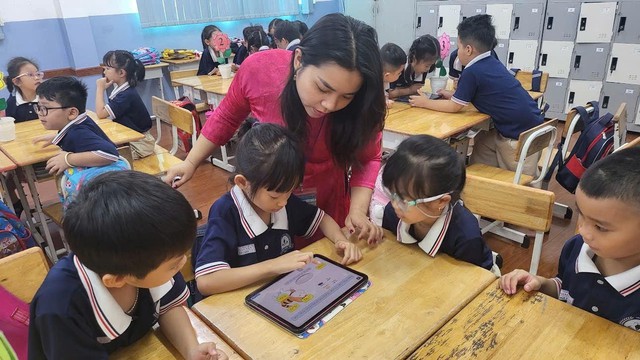
A lesson integrating digital skills education at Phan Van Tri Primary School (District 1, Ho Chi Minh City)
PHOTO: BAO CHAU
In class 1/4 of Phan Van Tri Primary School (District 1, Ho Chi Minh City), teacher Le Thi Kieu Nhi integrated digital citizenship education into the social studies subject with the theme of plants and animals. Accordingly, the teacher prepared e-learning lessons and interactive lessons and uploaded them to the school's digital learning resource library. Students interacted with the self-study exercises at home, using tablets and phones with the support and supervision of their parents. Through this, students developed skills in using computers. After students became familiar with these skills, the teacher incorporated lessons using these devices into the curriculum.
"Talking about digital citizenship skills to elementary school students, especially first graders, might sound like a big deal, but basically, for the early grades, it's just about equipping them with the skills to use a computer mouse and some basic toolbars to draw, interact, and type short answers... For example, in the social studies subject with the topic of plants and animals, when digital citizenship education is integrated, students interact on tablets, find parts of animals, and use artificial intelligence (AI) tools to draw their favorite animals," Ms. Nhi shared.
Mr. Le Hong Thai, Principal of Phan Van Tri Primary School, said that the school incorporates digital citizenship skills education into its curriculum, integrating it with subjects from grade 1 onwards. This is to help teachers become familiar with the process and to help students initially become acquainted with new concepts of digital citizenship skills. In particular, it aims to help parents understand the meaning, purpose, and content of digital citizenship education, thereby fostering their support and participation.
Meanwhile, at Colette Secondary School (District 3), teachers and students created digital technology lessons by using digital platforms and AI to compose music, design e-books, build videos, and create talking signs... based on lessons about planting, caring for, and protecting forests in the 7th grade textbook. Using their subject knowledge, students combined it with technological skills to develop solutions to improve the effectiveness of forest protection and awareness campaigns.
Ms. Duong Thai Tran, a technology teacher at Colette Secondary School, who was in charge of the lesson, said: "The students' products are very diverse, truly digital products that can be shared on many platforms and attract viewers. The products related to music , videos, books, and road signs were flexibly applied by the students using digital applications and AI. When given the opportunity to use digital technology, the students were very enthusiastic and passionate about learning. The important thing is that they know how to select and evaluate to find the most suitable applications…"
According to Ms. Tran, through digital citizenship skills education lessons, teachers hope to guide students to effectively use digital and AI applications to create useful values. From there, a generation of students will be able to apply digital citizenship skills to create useful products in life.
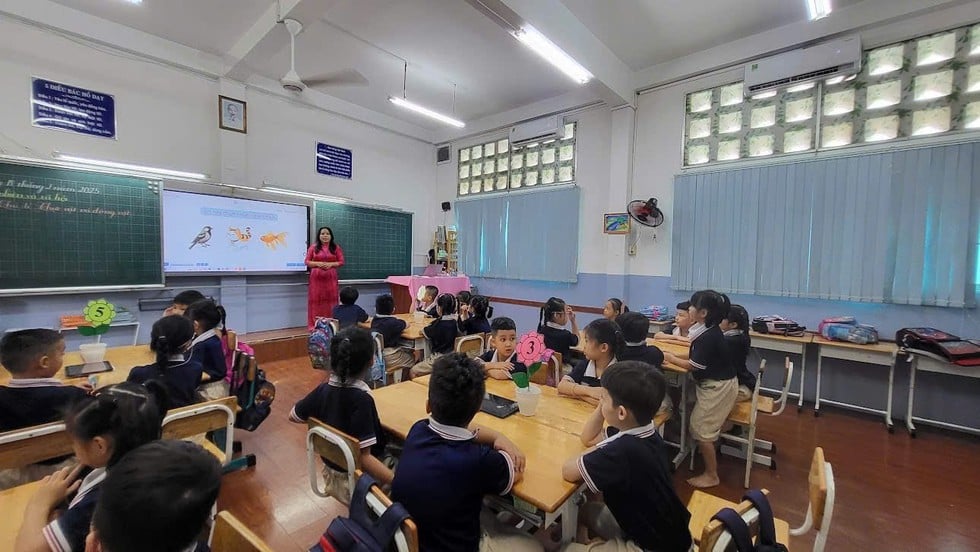
Through digital citizenship skills education lessons, teachers aim to guide students in effectively using digital and AI applications to create useful values.
Photo: Bao Chau
Teachers also need to have digital skills.
According to Ms. Duong Thai Tran, in order for students to choose appropriate AI applications and use technology appropriately and responsibly, teachers need to play the role of suggesting, guiding, and instructing in experiments. To achieve this, teachers must possess digital skills.
Ms. Tran frankly acknowledged that to avoid falling behind in the context of developing digital technology, teachers must constantly learn and improve their skills. For example, they regularly participate in AI training courses for teachers organized by the Department of Education and Training. This helps teachers gain knowledge, skills, and confidence in applying AI in their lessons and supporting students in developing digital skills. Digital products created by students are uploaded by teachers to the school's digital learning resource page, becoming a valuable reference material.
According to Dr. Pham Dang Khoa, Head of the Education and Training Department of District 3, in the context of the rapidly developing technology and AI, education cannot stand aside but plays an increasingly important role in equipping, guiding, and leading students. Therefore, teachers must become digital teachers, understand the use of AI in teaching, and equip students with the ability to use AI effectively in learning… This is the foundation for developing digital citizenship skills in students.
Leaders of the Ho Chi Minh City Department of Education and Training recognize that strengthening digital citizenship skills education in the curriculum is fulfilling the digital transformation task in education that Ho Chi Minh City is striving for, and is also a goal of the 2018 General Education Program to develop the necessary skills for digital citizens.
According to the Department of Education and Training, digital skills education for primary school students is of particular importance, as this is the age when they are most interested in exploring and using technology. Helping students acquire basic skills in using technology safely and correctly will help them avoid online risks and dangers, while also developing multi-dimensional thinking and essential creative skills in the digital age.
The Ho Chi Minh City Department of Education and Training requires schools, under practical circumstances, to develop plans to enhance digital citizenship skills education with appropriate content and duration. Particular attention should be paid to students in grades 1 and 2, while increasing the duration and content for students in grades 3, 4, and 5, focusing on specific themes and knowledge areas.
Create digital school records.
In accordance with the Ho Chi Minh City Department of Education and Training's project "Developing applications of population data, electronic identification and authentication to serve national digital transformation in the period 2022-2025, with a vision to 2030," the city will pilot digital report cards for 132,719 first-grade students in the 2023-2024 school year. From the 2024-2025 school year, implementation will continue for grade 6, while simultaneously digitizing all report card data for primary and secondary school students. In the 2025-2026 school year, digital report cards will be implemented in grade 10, and all report card data for high school students will be digitized.
Accordingly, student data on scores, academic results, and conduct are updated for each subject and grade level to ensure consistency and integrity. After the database is completed, Ho Chi Minh City's digital student record management system will be connected to the Ministry of Education and Training's digital student record management system and the overall education sector database.
Digital school records have the same legal validity as paper records and can be used in place of paper records in administrative procedures related to students' academic activities.
If necessary, a digital transcript can be printed out, certified by the educational institution that issued the transcript, or copied from an electronic document as prescribed, and will have the same legal validity as a paper transcript.
A new feature of Ho Chi Minh City's implementation of digital student records is the software used to track and evaluate students. For primary school, this includes a summary and evaluation table of educational results; for secondary school, it includes a digitized student tracking and evaluation logbook stored in a digital environment. This data collection includes information about students, grades, and academic results. Teachers digitally sign each class they are responsible for, and this data has legal validity across all levels…
Source: https://thanhnien.vn/hoc-lam-cong-dan-so-tu-lop-1-185250502222622111.htm























![[Photo] A large number of people offer incense and visit the Ho Chi Minh Memorial Church.](https://vphoto.vietnam.vn/thumb/1200x675/vietnam/resource/IMAGE/2026/02/21/1771668099014_ndo_br_12-resize-7721-jpg.webp)



























































Comment (0)