

The application of artificial intelligence (AI) in learning is becoming increasingly popular among students. Almost all students use AI and ChatGPT, but how can we prevent its misuse and the use of AI for "cheating" in their studies and assignments?
Students from 5th to 12th grade all use ChatGPT to study literature.
Nguyen Thi Phuong Thao, a second-year student majoring in primary education at Ho Chi Minh City University of Education, said that while tutoring two fifth-grade students, she was surprised to receive two essays that were almost identical. Both described Phu Quoc Island, with striking similarities in structure, expression, and imagery. Upon inquiry, she discovered that both had used ChatGPT for assistance.
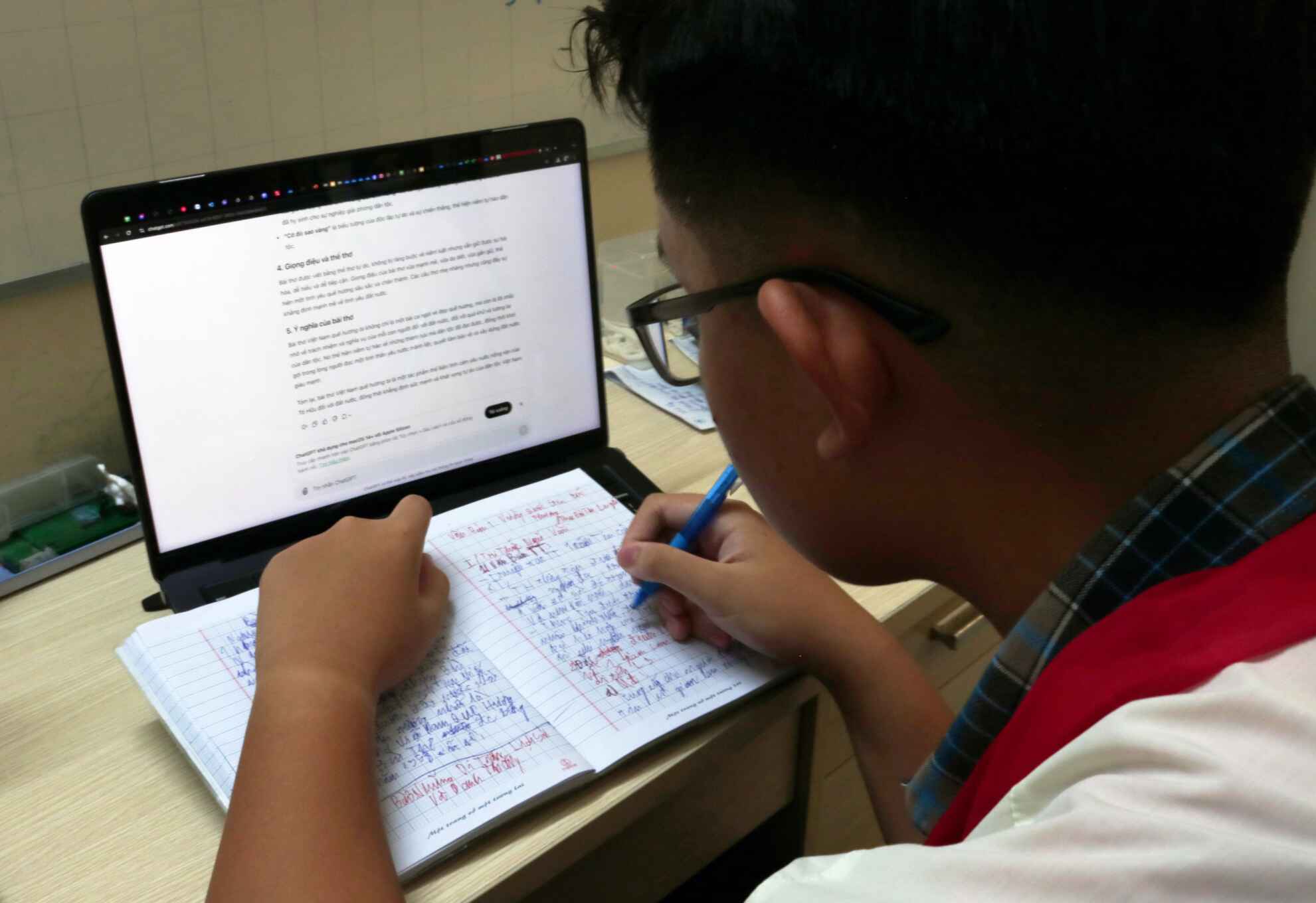
Many students use ChatGPT during revision, math practice, and literature studies.
PHOTO: UYEN PHUONG LE
Also using AI to help with essay writing, PHN, an 8th-grade student at Chi Lang Secondary School (District 4, Ho Chi Minh City), once copied an entire essay describing a trip to the ancient capital of Hue from ChatGPT. The reason was, "The teacher asked us to describe a scene in Hue, but no one in the class had ever been to Hue, so I couldn't do it and had to confess to the teacher that I had used ChatGPT to write the essay."
Nguyen Minh Hung, a 12th-grade student and member of the gifted literature team at Nguyen Thi Minh Khai High School, District 3, Ho Chi Minh City, admitted to using ChatGPT to find references and evidence. "Because I needed to research many works outside the curriculum, I asked ChatGPT to summarize long books that I didn't have time to read, for example, Victor Hugo's Les Misérables," the student shared.
According to Hung's assessment, ChatGPT has the ability to summarize works in depth and closely match the original text, especially foreign works, because it has access to many English and French sources. This helps you acquire knowledge more easily than manually searching on Google.
How do students in the GPT group write essays and solve math problems?
To "test" ChatGPT, we entered a recent midterm exam question from a 10th-grade literature class at Mac Dinh Chi High School in Ho Chi Minh City: "Write an argumentative essay discussing the superficial lifestyle of today's youth." The AI generated a 612-word essay in less than 10 seconds. The essay had a complete introduction, body, and conclusion with fairly coherent arguments, including: explaining the concept of "superficial lifestyle," analyzing the consequences of this lifestyle, and proposing solutions from both objective and subjective perspectives.
Similarly, with mathematics, we entered a question from the 12th grade midterm math exam at Trung Vuong High School, District 1, Ho Chi Minh City, and asked ChatGPT to solve it. The answer and solution guide appeared instantly. This was a real-world problem about producing school equipment to maximize profit. ChatGPT outlined each step: setting up the equation and calculating the derivative. The AI application even explained why we should choose 50 as the solution instead of -16.67.
However, ChatGPT doesn't always provide the correct solution. Nguyen Le Khoi Viet, a 9th-grade student at Tang Bat Ho Secondary School, District 4, recounted using ChatGPT to solve a reading comprehension exercise but failing to get any points. Specifically, when asked about the reasoning operations in a text excerpt, ChatGPT answered "explain, illustrate, and compare." The student copied ChatGPT's answer, but it was incorrect because the operation "illustrate" was missing; the correct term should be "prove."
Nguyen Vu Hong An, a student in class 11A15 at Trung Vuong High School, District 1 (Ho Chi Minh City), recalled an instance where she filled in answers following ChatGPT's instructions, resulting in a score of less than 5 points in chemistry. "The AI's answers all included explanations, but the information was incorrect. Even with the same question, if asked twice, the AI could still give two different answers," Hong An explained.
Nguyen Minh Hung, a student at Nguyen Thi Minh Khai High School, believes that students should not rely too heavily on technology. "AI is only accurate for popular and familiar works, authors, and topics. For lesser-known works, AI can easily provide inaccurate information, so it's necessary to verify the information before accepting it," Hung explained.
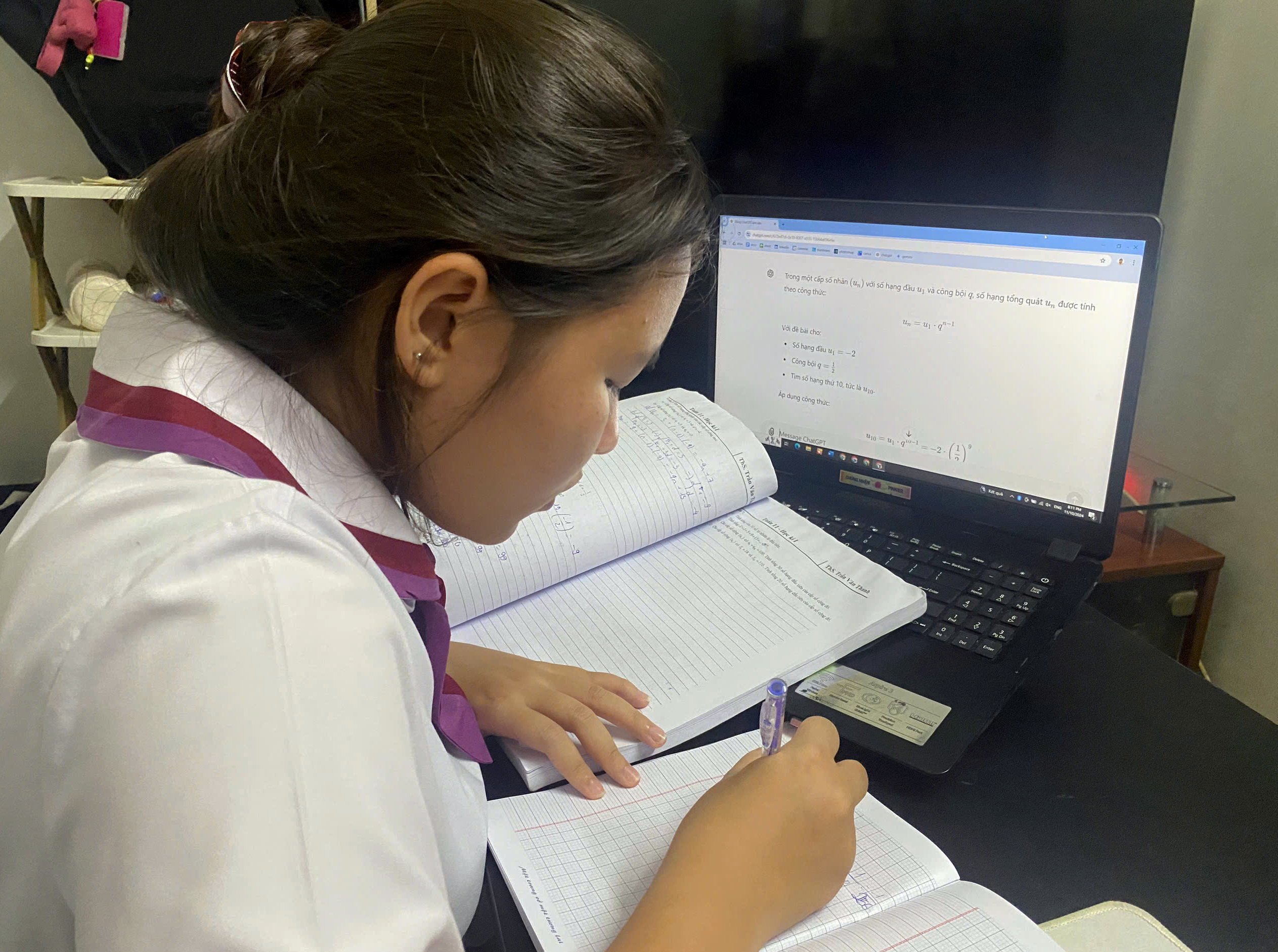
Using AI for learning is becoming increasingly popular among middle and high school students.
PHOTO: UYEN PHUONG LE
USING AI IS LIKE A "DOUBLE-EDGED SWORD"
Duong Duy Khang, a student at Ho Chi Minh City University of Law and a tutor at eTeacher, teaching math, physics, chemistry, and biology, acknowledges that middle and high school students currently frequently use ChatGPT during their studies and exam preparation.
"When teaching, to verify whether students solved problems on their own or used AI, I ask them to explain the problem-solving process in more detail. Why did they do this step? Why did they use this formula instead of another?" Khang shared his experience.
"ChatGPT doesn't always produce accurate results. In my opinion, it can be a good learning tool if students grasp the knowledge and understand the methods. For some science problems, ChatGPT can also show students what information to pay attention to and which formulas to use, making the review process easier. However, if students only know how to 'paste' the problem and copy the answer, then the 'double-edged sword' of ChatGPT will hurt them. Students become dependent on it, gradually becoming lazy in their thinking, and losing their ability to think creatively," Duy Khang commented.
Many students also believe that they shouldn't become overly reliant on AI if they want to develop their learning in a more sustainable way. Ngo Gia Huy, a 12th-grade student at Nguyen Huu Huan High School in Thu Duc City (Ho Chi Minh City), said he uses ChatGPT to check the results of his math, physics, and chemistry homework. If he can't figure out a solution, he asks ChatGPT to explain the method step-by-step.
Similarly, Tran Hoang Gia Han, an 11th-grade student at Luong The Vinh High School, District 1, said that ChatGPT can be used to learn physics and chemistry. According to Han, ChatGPT provides a good theoretical foundation along with specific examples. For instance, when studying electromagnetic waves, you can ask ChatGPT for examples of Wi-Fi, GPS, radio, etc., and you will receive specific explanations. However, this technology is not suitable for advanced exercises because the solutions are difficult to understand and lack accuracy.
In another case, Le Vo Gia Hoa, a 12th-grade student at Nguyen Thi Minh Khai High School, used AI to create presentation content for history, geography, economics , and law. For this male student, AI helped him create detailed outlines and even provided tools to generate professional presentation slides. However, he didn't use the pre-made slides but instead referenced the content and redesigned them himself because the AI-generated slides were quite mechanical and lacked impact.
Thai Thanh Tam, a student majoring in natural science education at Saigon University and a tutor at eTeacher, teaches math to 8th-grade students. He believes ChatGPT can support students in systematizing theoretical knowledge in various subjects, saving them time from having to synthesize and search on other channels. However, Tam requires students not to preview the AI solutions before each lesson; instead, the teacher and student must first thoroughly understand the knowledge. After solving the problems, students can check their answers on ChatGPT, expanding on different approaches. Only then will students truly acquire their own knowledge without "borrowing" from others.
"High-achieving students who pass entrance exams to top universities are not dependent on technology."
Ms. Nguyen Thi Tra My, a retired math teacher from Nguyen Huu Huan High School (Thu Duc City), who is currently tutoring 12th-grade students in math, made this observation.
Ms. My cited many of her students who were admitted to universities such as the University of Information Technology, the University of Technology (Vietnam National University Ho Chi Minh City), and the University of Economics Ho Chi Minh City… all of whom shared a common trait: “They could access problems online to solve them themselves, discuss them with friends, and find multiple solutions, rather than relying on AI for help. The teacher poses problems to guide students in finding solutions, suggesting key points to help them find answers, rather than solving the problems for them.” And the goal of these students when attending math tutoring classes is to find a community to study together, with a teacher to guide them through each stage of their preparation, preventing them from getting sidetracked.
Notably, Ms. My stated that many of her students, who excelled in mathematics, also achieved high scores in the high school graduation literature exam, and none of them relied on ChatGPT. She explained: "Students read a lot of newspapers, follow domestic and international news, and when writing essays, they know how to relate to real-world situations, express their own perspectives and viewpoints, giving their essays a personal touch and unique emotions – something that machines cannot replicate."
Thuy Hang
Source: https://thanhnien.vn/hoc-sinh-nho-ai-chatgpt-de-hoc-bai-185241114202030595.htm


![[Photo] General Secretary and President To Lam meets with National Assembly delegates from ethnic minorities.](https://vphoto.vietnam.vn/thumb/1200x675/vietnam/resource/IMAGE/2026/04/20/1776696701056_a1-bnd-8331-3342-jpg.webp)
![[Image] National Assembly discusses the implementation of the socio-economic development plan.](https://vphoto.vietnam.vn/thumb/1200x675/vietnam/resource/IMAGE/2026/04/20/1776696707422_ndo_br_img-20260420-185419-jpg.webp)












































































Comment (0)