

December joy
Although not a staple crop, shallots in Vo Thuan village have brought hope to many households over the years. Capable of thriving in less productive land, shallots can utilize large areas of previously abandoned hilly terrain.
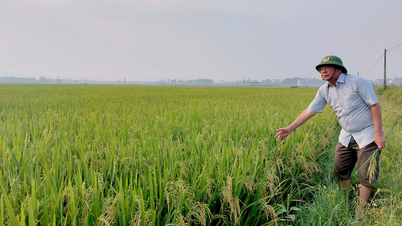
"We also planted cassava and peanuts, but the most effective crop is shallots, especially during Tet (Lunar New Year), when demand is high and prices remain stable," shared Mr. Duong Minh Ky from Vo Thuan 3 village.
 |
| The shallot fields of Vo Thuan 3 village, Hoan Lao commune, during harvest season - Photo: NM |
Mr. Ky's family cultivates 2 sao (approximately 2,000 square meters) of shallots. After deducting expenses, he says the profit ranges from 7 to 10 million VND per sao, depending on market prices. Shallots are quite "easy to grow" and are a characteristic dish during Tet (Lunar New Year), so the market demand is relatively stable, rarely experiencing unsold stock or price drops. Thanks to this, for many years, shallots have consistently contributed to a steady income, giving farmers peace of mind and warming the atmosphere during the twelfth lunar month.
The scallions, nestled gently on the hillside, are harvested quickly and efficiently thanks to the collaborative efforts of many households. Skillfully shaking off the soil and cutting the roots with homemade tools, Mrs. Nguyen Thi Thien explains that instead of hiring laborers at a cost of around 300,000 VND per person per day, the villagers take turns helping each other. After finishing one field, they move on to another, rotating through the process, saving costs and strengthening community bonds.
 |
| Families take turns harvesting shallots together - Photo: NM |
With creativity and diligence, the entire field was harvested in a neat, even, and uniform manner. The soft brown soil was also ready for the next crop. It wasn't just a bountiful harvest, but also a sense of sharing and camaraderie among the farmers working together in the same field.
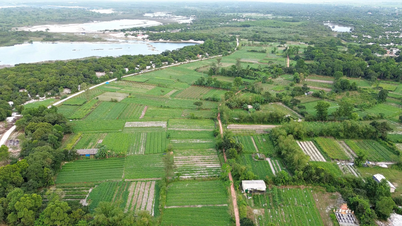
Thanks to the practical benefits this small plant brings, the villages in Vo Thuan alone have developed nearly 30 hectares of shallot cultivation. The hillsides that previously yielded poor results in growing other crops are now covered in the green of shallots, creating a concentrated production area that facilitates care and consumption.
According to Ms. Duong Thi Hong Man, Head of the Women's Association of Vo Thuan 2 village, shallots are one of the crops chosen by the village and commune in the recent years' orientation towards restructuring crop patterns. In reality, this direction is suitable for the local soil and climate conditions; the investment costs are not too high, and the economic efficiency is relatively stable.
The taste of home
Leaving the sun-drenched fields, the pickled shallots follow people to their small kitchens. As Tet approaches, in her sun-drenched courtyard, Mrs. Ngo Thi Lan, from residential group 3, Dong Hai, Dong Hoi ward, is still diligently drying and pickling shallots.
Ms. Lan said that she makes pickled shallots year-round, but the days leading up to Tet (Lunar New Year) are the busiest. After purchasing the shallots, they are sorted, the roots are cut off, the skin is peeled, washed clean, and then sun-dried before being pickled. Each step requires meticulous attention to detail to ensure the shallots retain their white color, crispness, and characteristic mild spiciness.
"The busiest time is the days leading up to Tet (Lunar New Year), we work non-stop, but it's fun because we get so many orders," she said with a cheerful smile.
Pickled shallots are a familiar dish, so almost every household buys them. Many people even order them to bring from the North to the South and send to relatives abroad.
"Someone told me that every time they open a jar of pickled onions and eat a piece of crispy, spicy pickled onion, they feel like their hometown is very close," Mrs. Lan shared.
 |
| The journey of shallots from sun-drenched fields to the Tet feast table - Photo: NM |
Ms. Nguyen Thi Thuy Trang, currently living in the Federal Republic of Germany, said that every year among the gifts her family sends her is a jar of pickled shallots from her hometown.
"You can still buy a lot of Asian food here, but the taste of our pickled onions is unique. Every time I open a jar of pickled onions, it feels like Tet (Vietnamese New Year) is coming back, and my homesickness is somewhat eased," she shared.
Pickled shallots, though simple, are particularly harmonious when served with fatty pork and sticky rice cakes, adding richness to the Tet holiday meal. For many families, the spring feast may change over time, but the jar of pickled shallots is present every year. Without that spicy, sour, and sweet flavor, Tet seems to lack a bit of completeness.
From sun-drenched countryside fields to small kitchens and distant lands, the journey of the shallot is not just about its economic value, but also carries with it affection and memories, so that wherever you are, you can still find a part of your homeland in its familiar taste.
Diep Dong
Source: https://baoquangtri.vn/xa-hoi/202602/huong-kieu-ngay-xuan-4f940f2/


![[Image] Bridges and roads connecting the eastern part of Ho Chi Minh City](https://vphoto.vietnam.vn/thumb/1200x675/vietnam/resource/IMAGE/2026/04/16/1776328595108_ndo_br_bh-vt5-jpg.webp)














































































Comment (0)