

According to a source familiar with the matter, cited by Tasnim news agency on Monday (May 18), Pakistan will forward Iran's new proposal to Washington. The source said the proposal focuses on negotiation steps and confidence-building measures from the US side.
Sources indicate that Washington had previously sent Tehran a 14-point response to Iran's initial proposal. After revisions, Iran subsequently submitted a new proposal through Pakistan.
"Following the recent pattern of exchanging messages, Iran has once again sent a 14-point document through Pakistani mediation after making revisions," the source said.
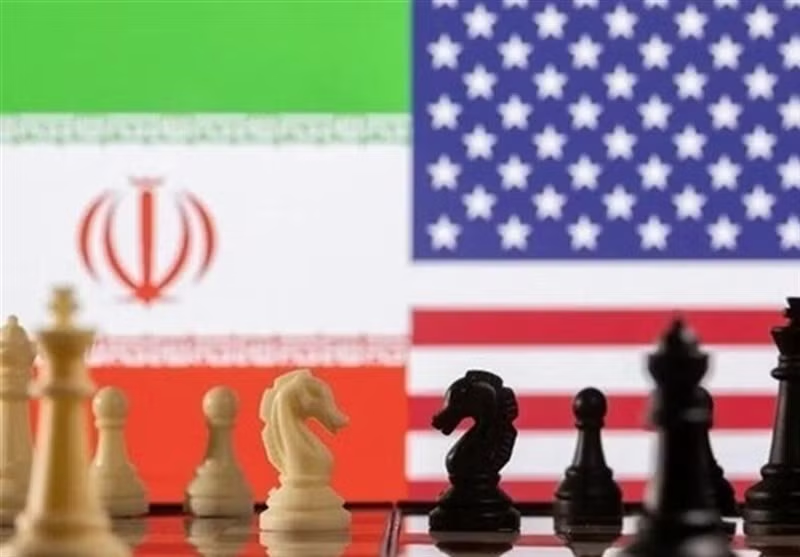
According to Tasnim , the US has reportedly agreed to consider temporarily easing some oil sanctions during negotiations. However, this information has not yet been officially confirmed by either the US or Pakistan.
This development occurred just hours after US President Donald Trump issued a strong warning to Iran on the social media platform Truth Social.
"For Iran, time is running out, and they had better act quickly or there will be nothing left. Time is of the essence," Trump wrote on the social media platform Truth Social.
The deadlock surrounding nuclear issues and the Strait of Hormuz.
The Washington Post previously reported that 14 points were being discussed by both sides with the aim of laying the groundwork for a broader treaty in the future.
The U.S. wants Iran to stop enriching uranium and reopen the Strait of Hormuz in exchange for easing sanctions. Washington's negotiations are currently being led by special envoys Steve Witkoff and Jared Kushner.
US President Trump has repeatedly demanded that Tehran hand over its stockpile of 60% enriched uranium, which he calls "nuclear dust." According to experts, 60% enriched uranium is only a relatively short technical step away from the 90% threshold that makes it usable for nuclear weapons.
Special envoy Steve Witkoff once stated that the amount of 60% enriched uranium Iran possesses could be enough to build 11 nuclear warheads if it were further enriched to weapons-grade levels.
However, Iran has so far rejected demands to hand over its uranium stockpile. Many sources suggest that much of this material lies deep within nuclear facilities that were severely damaged after US airstrikes.
According to US President Trump, Washington is currently closely monitoring these locations using satellites and has considered various military options, including the possibility of deploying ground forces to recover the uranium.
On April 10, Iran sent a response to the US proposal to end the war, but it was subsequently rejected by US President Donald Trump, who called the document "completely unacceptable."
Tehran insists that at this stage, negotiations should focus solely on ending hostilities in the region, while other issues such as the nuclear program will be discussed later.
A Pakistani source told Reuters that Islamabad had handed the U.S. the latest revised version of the agreement from Iran to advance the reconciliation process. However, the source warned that Washington and Tehran "don't have much time left" to narrow their differences.
Iranian Foreign Ministry spokesman Esmaeil Baghaei said Tehran had received "a series of points for adjustment and consideration" from the Pakistani mediator.
Source: https://tienphong.vn/iran-gui-de-xuat-14-diem-moi-cho-my-post1844413.tpo



























































































Comment (0)