

Create new momentum
The Mekong Delta is witnessing significant shifts in the national power greening roadmap. In Can Tho City, the implementation of the Phu Cuong 1A and 1B wind power plant complex (including a 220kV substation, with a total investment of over 9,100 billion VND) and the No. 4 wind power plant project (350MW capacity, valued at 14,500 billion VND) in coastal areas of Lai Hoa, Vinh Phuoc, and Khanh Hoa communes are practical steps. On a regional scale, these projects contribute to concretizing the vision of the National Power Development Plan for the period 2021-2030, with consideration to 2050 (Revised Power Plan VIII), creating further impetus for the development of energy infrastructure throughout the region.
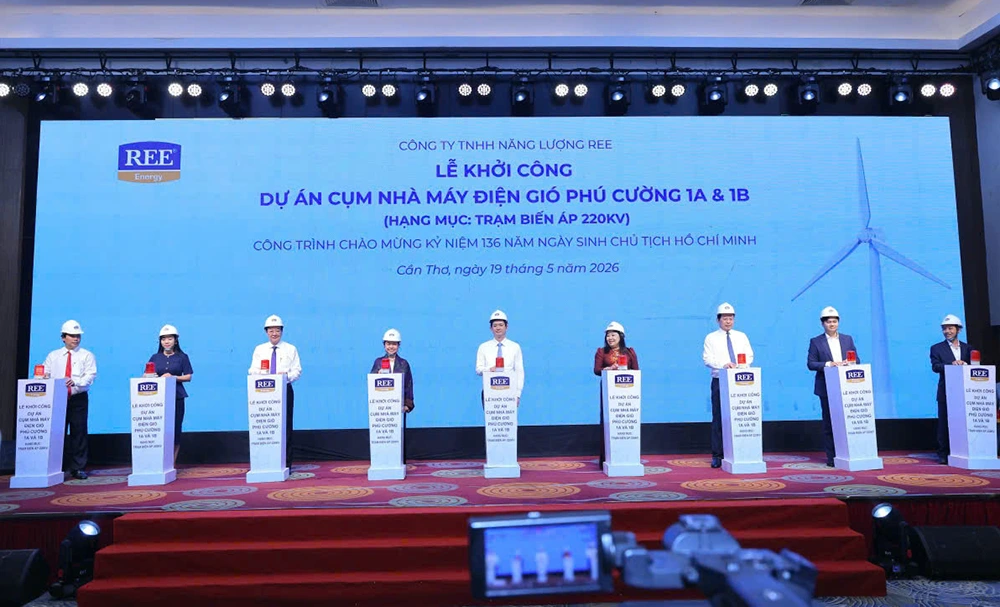
Delegates perform the groundbreaking ceremony for the Phu Cuong 1A and 1B wind power plant complex project in Can Tho City. Photo: My Hoa
According to the revised Power Development Plan VIII, renewable energy is targeted to account for 28-36% of the total power generation capacity by 2030 and aims for 74-75% by 2050. In this strategy, the Mekong Delta plays a key role as one of the renewable energy industrial centers of the region and the nation. The recent activation of coastal wind power projects in Can Tho City, with a total investment of over 23,000 billion VND, reflects the local government's concrete efforts to realize this common goal.
Wind power development in Can Tho City is closely linked to the optimal utilization of space, geography, and policies. With approximately 72km of coastline, Can Tho has access to an estimated offshore wind power potential of 10,000-30,000MW. This potential is becoming a bright spot attracting investors. To date, according to the planning roadmap until 2030, Can Tho has approved 56 power generation projects with a total capacity of over 9,154MW, including 30 wind power projects with a scale of approximately 2,785MW. On-site progress is being accelerated in clear stages: the city has granted investment approval for 20 wind power projects (total capacity of 1,428MW), of which 9 plants are already in commercial operation (396MW), 3 projects are under construction (142MW), and 8 projects are completing construction procedures (890MW). In addition, there are plans to select investors for 10 new wind power projects (approximately 1,357 MW).
In the Mekong Delta, the trend of developing integrated clean offshore energy centers is entirely consistent with the orientation of private sector economic development and ensuring national energy security. For example, Vinh Long province has a total wind power plan of over 2,500 MW, and REE Group is applying a phased investment method. After bringing the 48 MW V1-4 plant into commercial operation, the company continues to focus on land clearance to implement the V1-3 (phase 2), V1-5, and V1-6 project clusters this year. Ca Mau province maintains 16 commercially operating wind power plants with a capacity of 870.2 MW, while also preparing the groundwork for a green hydrogen and ammonia production project. Dong Thap province manages 32km of coastline along with the Tan Phu Dong 1 and Tan Phu Dong 2 power plants, which have been connected to the grid, and is also promoting the Tan Thanh project (100MW) in 2026. These are testaments to the coastal-oriented mindset of the Mekong Delta region...
Removing bottlenecks for development
Despite its significant potential, the implementation of wind power in the Mekong Delta still faces several challenges. According to a practical experience report from REE Group, when the capacity of new power sources increases by 2,500-3,000 MW, the pressure on the existing transmission grid infrastructure is immense. This requires a mechanism for coordinating and sharing infrastructure among neighboring projects to avoid waste. Furthermore, according to analysis from the Electricity Department (Ministry of Industry and Trade), addressing delays and inconsistencies between national and provincial sectoral planning and land use planning (as stipulated in Government Decree No. 151/2025/ND-CP) or commune-level general planning (as stipulated in Circular No. 16/2025/TT-BXD of the Ministry of Construction ) still requires timely intervention from local authorities to expedite the approval of investment policies.
Despite their enormous potential, many believe that the biggest challenge in effectively unlocking these clean energy sources is resolving the overlapping planning layers and land procedures. Therefore, the timely application of Government Resolution No. 66.3/2025/NQ-CP dated September 12, 2025, on resolving obstacles to the implementation of projects within the period when the national land use planning for the period 2021-2030, with a vision to 2050, has not yet been approved for adjustment, will be key. This resolution allows localities to use land use planning or urban and rural planning as a basis to expedite land clearance, acquisition, and leasing for key industrial projects.
At the same time, the spirit of simplification in Government Resolution No. 290/NQ-CP dated September 19, 2025, at the thematic session on lawmaking, needs to be thoroughly understood. Accordingly, the decision-making process for investment policies should be brought back to its true nature as approval in principle, reducing administrative procedures so that businesses can proactively improve technology at the project planning stage. Only when the bottlenecks in the mechanisms are synchronously removed can wind power from Can Tho and the southwestern coastal strip be seamlessly integrated into the grid, creating a real impetus to boost the region's economy.
HA TRIEU
Source: https://baocantho.com.vn/khai-thac-tiem-nang-dien-gio-duyen-hai-dbscl-a205981.html

![[Photo] General Secretary and President To Lam and the President of the Philippines hold talks.](https://vphoto.vietnam.vn/thumb/1200x675/vietnam/resource/IMAGE/2026/06/01/1780286997787_anh-man-hinh-2026-06-01-luc-11-09-43.png)












































































Comment (0)