

(NLĐO) - Scientists have just discovered the "dark legacy" of the Big Bang: A swarm of monsters billions of times larger than the Sun.
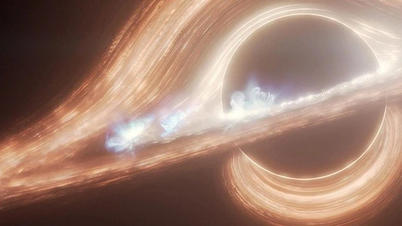
According to SciTech Daily, an international research team led by Stockholm University (Sweden) has found an unimaginable number of "monster black holes" from the early universe. These are the "zombie" forms of the first objects to be born after the Big Bang.
These black holes appear to be perpetual traps in spacetime, forever devouring anything that passes nearby.
They are the largest, monstrous black holes, weighing millions to billions of times more than the Sun, and like hibernating dragons, they will awaken and devour anything unfortunate enough to pass through, then burst into flames like blazing lighthouses.
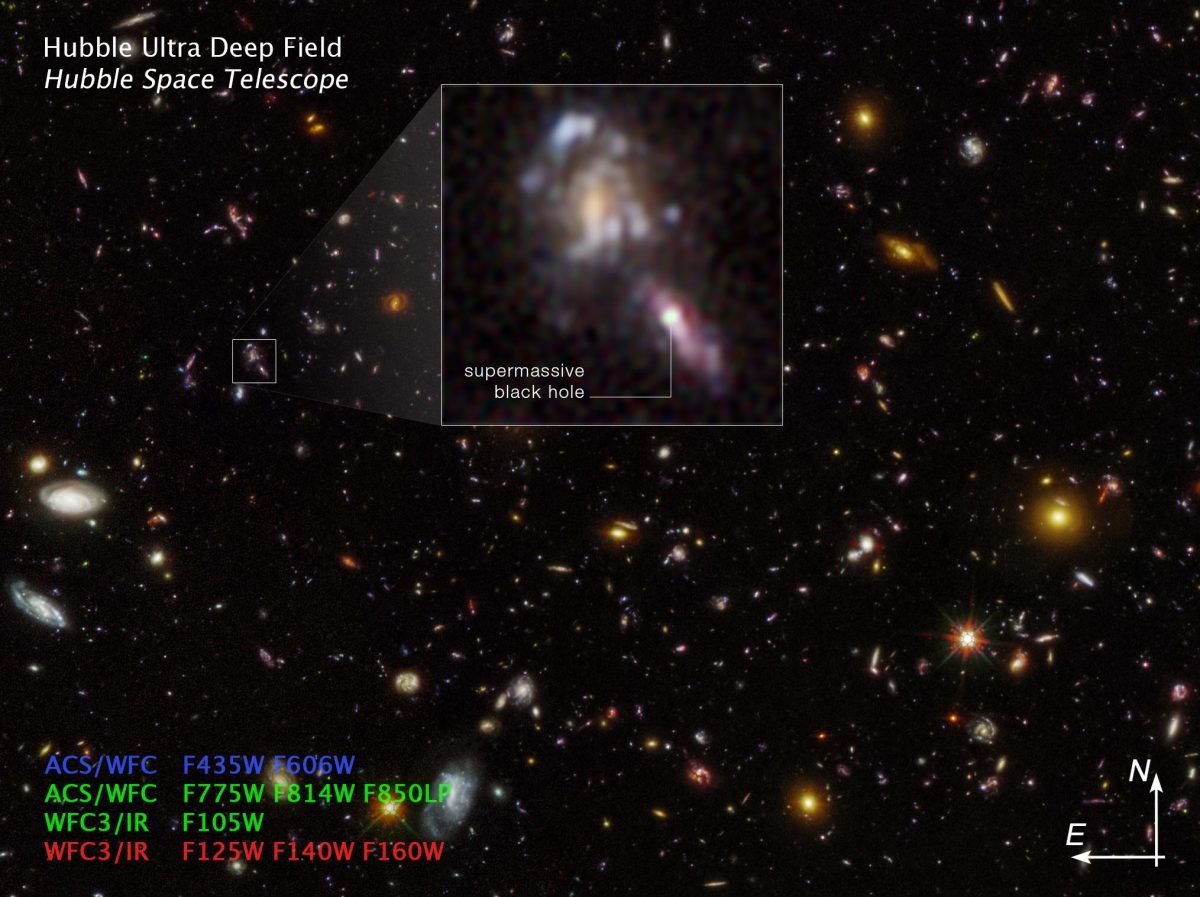
Hubble images reveal clues about some of the primordial monster black holes that existed in the first billion years after the Big Bang - Photo: NASA/ESA
Scientists have previously discussed this type of black hole, which existed during the "Dawn of the Universe," the first billion years after the Big Bang.
They typically exist as active black holes at the center of large, singular galaxies.
"Many of these objects appear to be larger than the initial mass we thought they might have at this point, either because they formed very large objects, or because they grew extremely rapidly," said astronomer Alice Young, co-author of the study.
According to a paper published in the scientific journal The Astrophysical Journal Letters, the authors used years of data from the Hubble telescope to measure changes in the brightness of ancient galaxies, a clear indicator of black holes.
They not only discovered more black holes than expected, but also clues about their origin.
Some of these ancient black holes were likely formed by the collapse of massive, primordial stars in the first billion years after the Big Bang.
These children of the Big Bang – an extremely extreme but purely material type of star from the early universe – could only exist in the very early stages of the universe, because subsequent generations of stars were "contaminated" by the remnants of previous generations of stars.
These supergiant and extreme stars are very short-lived; they quickly merge, explode, and transform into massive primordial black holes within the first few seconds after the Big Bang.
With this new information, more accurate models of galaxy formation can be built, helping humanity to better understand the turbulent past of the "early" universe.
Source: https://nld.com.vn/kham-pha-nhung-dua-con-tu-than-cua-vu-no-big-bang-19624092311260083.htm


![[Photo] The heat at the fireworks display site on the opening night of the Da Nang International Fireworks Festival 2026](https://vphoto.vietnam.vn/thumb/1200x675/vietnam/resource/IMAGE/2026/05/27/1779889741485_ndo_br_z7872039145157-fecaba5112f39e8352544099d7ef4738-5140-jpg.webp)

![[Photo] The courage of new recruits of Brigade 144 on the training ground.](https://vphoto.vietnam.vn/thumb/1200x675/vietnam/resource/IMAGE/2026/05/27/1779881651341_anh-man-hinh-2026-05-27-luc-18-32-52.png)



























































![[Photo] The courage of new recruits of Brigade 144 on the training ground.](https://vphoto.vietnam.vn/thumb/402x226/vietnam/resource/IMAGE/2026/05/27/1779881651341_anh-man-hinh-2026-05-27-luc-18-32-52.png)

































Comment (0)