

According to Techspot, this technology is designed for storage systems that need to last for extremely long periods. Meanwhile, current storage media have a relatively short lifespan: hard drives fail easily, SSDs degrade quickly, and magnetic tapes require periodic rewriting to prevent data loss. Therefore, the emergence of "memory crystals" is expected to completely change how people store information.
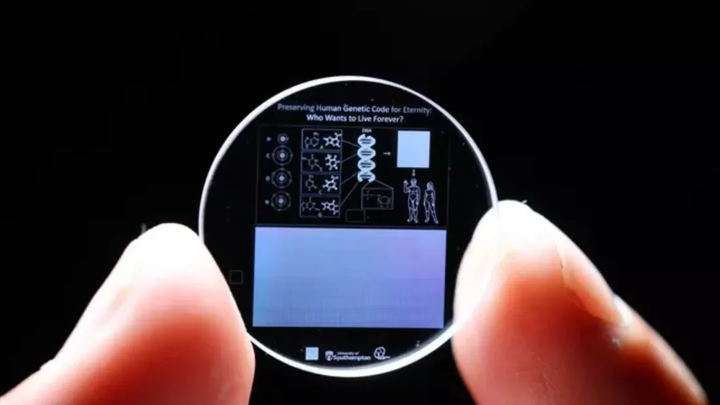
Illustration of a 5D glass disc storing human genetic code - a technology for permanent data preservation. (Source: Techspot)
The UK-based startup SPhotonix, founded in 2024, is commercializing this technology. Essentially, data is etched into a super-durable glass block using ultra-precise lasers capable of impacting the material at an extremely small level. Instead of just being stored on the surface, information is recorded throughout the entire glass block, increasing storage density and durability. Data is encoded using five elements: three spatial dimensions and two optical properties: direction and intensity. As a result, a glass disc the size of a traditional CD/DVD can hold up to 360 TB of data.
The most notable feature is its longevity. Under normal conditions, the data remains readable after billions of years. Glass materials also have the ability to withstand high temperatures, radiation, electromagnetic interference, and wear and tear over time – factors that are the "enemies" of long-term storage.
However, this technology still has limitations. Current write speeds are only about 4 MB/s, and read speeds are around 30 MB/s, much slower than hard drives or SSDs. Therefore, it is suitable for long-term storage of data that is rarely accessed but absolutely must not be lost. SPhotonix aims to increase speeds to 500 MB/s within the next 3–4 years.
Cost is also a major hurdle. The data logger is expected to cost around $30,000, while the reader will cost around $6,000. The company says a portable reader version could launch within the next 18 months.
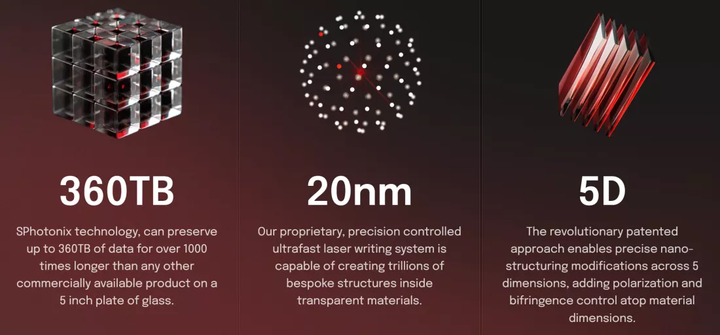
SPhotonix's technology records data using ultrafast lasers and a 5-dimensional nanostructure within transparent glass. (Source: Techspot)
Despite its many shortcomings, this technology has attracted the attention of data centers and research institutions. As the amount of global data increases rapidly, storage costs are growing – not only financially but also in terms of energy and the environment. A storage medium that requires no electricity, no maintenance, and no rewriting after writing is a very attractive solution.
Recently, SPhotonix raised several million dollars to take the technology out of the lab and into real-world testing. The company is targeting applications such as storing scientific data, cultural records, legal documents, and historical data – information that needs to last much longer than the hardware that created it. With a lifespan of up to 13.8 billion years, 5D "memory crystals" are seen as the solution to humanity's sustainable storage problem.
Source: https://vtcnews.vn/tinh-the-nho-5d-cuoc-cach-revolution-luu-tru-du-lieu-sieu-ben-ar993236.html
![[Photo] Prime Minister Pham Minh Chinh receives the Governor of Tochigi Province (Japan)](/_next/image?url=https%3A%2F%2Fvphoto.vietnam.vn%2Fthumb%2F1200x675%2Fvietnam%2Fresource%2FIMAGE%2F2025%2F12%2F16%2F1765892133176_dsc-8082-6425-jpg.webp&w=3840&q=75)

![[Image] Leaked images ahead of the 2025 Community Action Awards gala.](/_next/image?url=https%3A%2F%2Fvphoto.vietnam.vn%2Fthumb%2F1200x675%2Fvietnam%2Fresource%2FIMAGE%2F2025%2F12%2F16%2F1765882828720_ndo_br_thiet-ke-chua-co-ten-45-png.webp&w=3840&q=75)

![[Photo] Prime Minister Pham Minh Chinh receives Lao Minister of Education and Sports Thongsalith Mangnormek](/_next/image?url=https%3A%2F%2Fvphoto.vietnam.vn%2Fthumb%2F1200x675%2Fvietnam%2Fresource%2FIMAGE%2F2025%2F12%2F16%2F1765876834721_dsc-7519-jpg.webp&w=3840&q=75)
![[Live] 2025 Community Action Awards Gala](/_next/image?url=https%3A%2F%2Fvphoto.vietnam.vn%2Fthumb%2F1200x675%2Fvietnam%2Fresource%2FIMAGE%2F2025%2F12%2F16%2F1765899631650_ndo_tr_z7334013144784-9f9fe10a6d63584c85aff40f2957c250-jpg.webp&w=3840&q=75)






















































![[Photo] Prime Minister Pham Minh Chinh attends the Vietnam Economic Forum 2025](https://vphoto.vietnam.vn/thumb/402x226/vietnam/resource/IMAGE/2025/12/16/1765893035503_ndo_br_dsc-8043-jpg.webp)



































Comment (0)