

Composers Hoang Long and Hoang Lan are not only twin brothers but also pursued music together, creating side-by-side for over half a century, sharing a common musical rhythm, becoming an almost unique pair of composers in Vietnamese art.
Born on June 18, 1942, in Vinh Yen, Hoang Long and Hoang Lan's childhood was spent in Son Tay and Hanoi during the turbulent years of war. They grew up in a family that was torn apart early: from the age of 12, the two brothers were separated from their mother when she went to the South. The absence of their mother's embrace and the difficult living conditions forged in the twins a strong inner strength, mutual support, and a world of their own – where music became their enduring spiritual anchor.
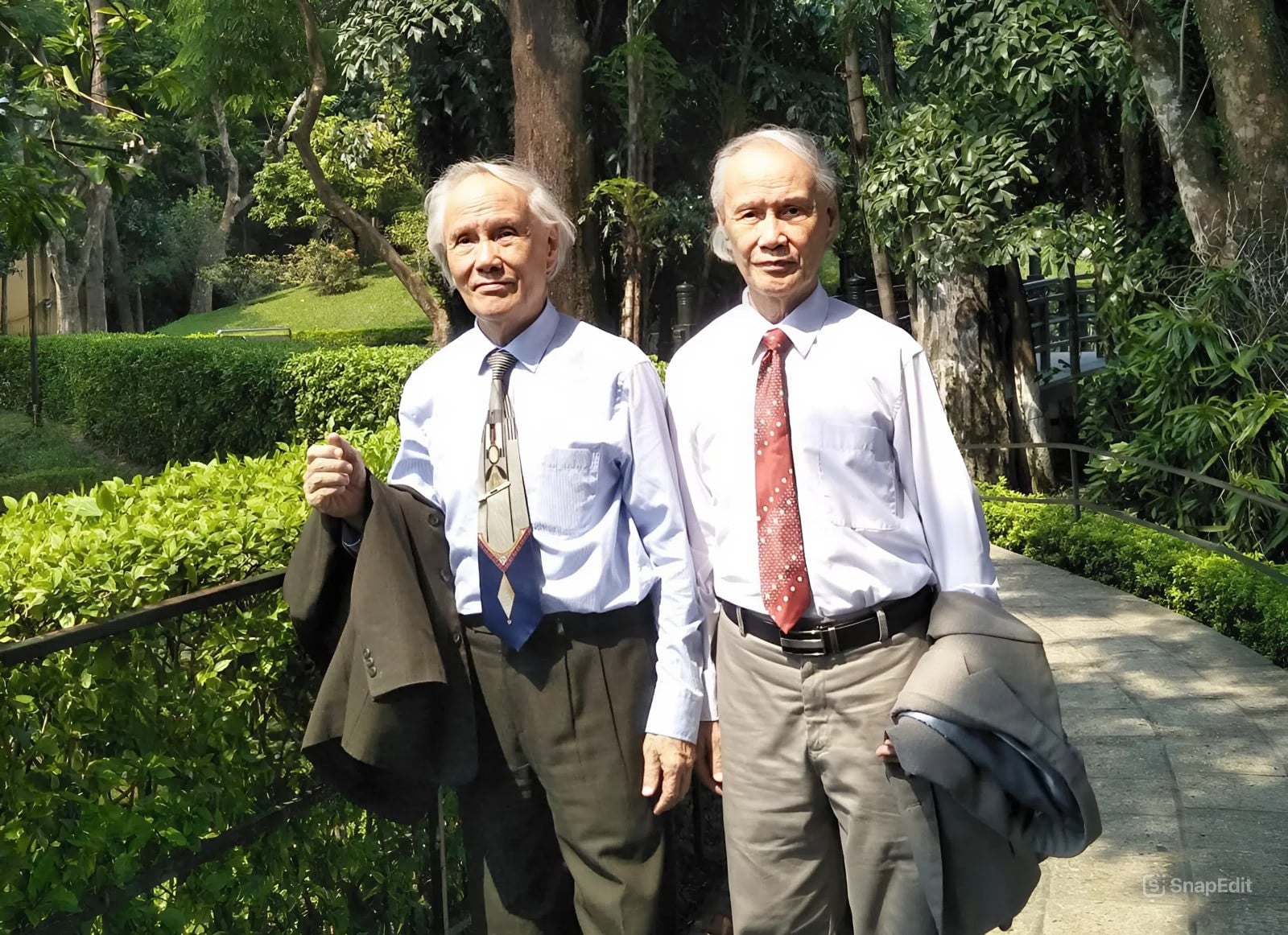
Composers Hoang Long and Hoang Lan.
From the late 1950s, at a very young age, Hoang Long and Hoang Lan showed outstanding musical talent. Their song " Em di tham mien Nam" (I Go to Visit the South) , composed in 1959 when they were just teenagers, quickly spread and became one of the most familiar songs for children. This not only marked the beginning of their songwriting career but also revealed a lasting strength in their profession: children's music – innocent, simple, yet rich in emotion.
What's remarkable about Hoang Long and Hoang Lan is their uncanny resemblance in appearance. Composer Hoang Long told VietNamNet that colleagues often can't tell them apart. But behind that twin look, each possesses a distinct creative style. Hoang Long leans towards clarity and precision, while Hoang Lan is more gentle and pedagogically rich. These differences don't separate them but complement each other, creating a harmonious whole that makes their works both relatable and enduring.
For decades, the two brothers left a profound mark on Vietnamese music, especially in the areas of children's songs, choral music, and music education . The melodies of Hoang Long and Hoang Lan were not pretentious or ostentatious, but gently entered memories, nurturing the souls of generations of Vietnamese children. Their music was associated with schools, children's stages, and educational programs – where songs were not only for listening but also for learning, remembering, and growing with time.
Beyond songwriting, Hoang Long and Hoang Lan have also devoted much of their energy to teaching, research, and music pedagogy. They have taught at various art training institutions, contributing to building a musical foundation for many generations of students. For them, music is not just a personal inspiration but also a social responsibility – the responsibility to pass on lasting values to the future.
Their quiet but enduring dedication was recognized by the State with the 2012 State Award for Literature and Arts. This was not only an honor for individual talent but also a recognition of the twin brothers who have walked the same artistic path, keeping the flame of creativity alive for over half a century.
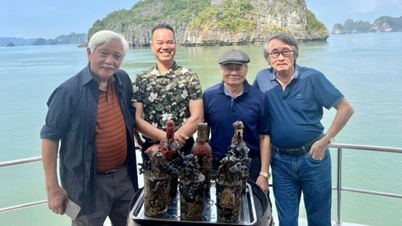
At their advanced age, Hoang Long and Hoang Lan continue to show a special appreciation for their professional memories and musical heritage. In December 2025, the two composers and their families donated many valuable manuscripts, documents, and artifacts related to their creative careers (along with the family of composer Hoang Van) to the National Archives Center III. These old manuscripts, handwritten musical notation, and documents from decades ago were all entrusted with the hope of being preserved, protected, and passed on to future generations.
The moment the twin brothers appeared together at the ceremony to receive the documents was not only significant for preservation but also a highly symbolic image: two individuals who have lived almost an entire musical life are now handing over their professional memories to history. It is the choice of artists who understand the value of time and their responsibility to their spiritual heritage.
What is admirable about Hoang Long and Hoang Lan is that despite their widespread public recognition, they maintain a relatively quiet personal life. Information about their families and children is rarely mentioned in the press. Perhaps, for them, the most important thing is not their flamboyant public presence, but the fact that their music has quietly lived on in the hearts of the public for generations.
Looking back at the more than half-century of creative work by Hoang Long and Hoang Lan, one sees not only their works, awards, and career milestones. What remains most deeply is the image of the twin brothers quietly walking side by side, persistently contributing and leaving behind for Vietnamese music songs that are pure, humane, and rich in educational value. A legacy written not just with musical notes, but with a lifetime of dedication and companionship.
The two composers have a combined total of over 700 songs, mostly for children, with bright, innocent, easy-to-remember, and easily popularized music. Their works are closely associated with the childhood of many generations of Vietnamese people, such as: "I Go to Visit the South" (1959), "The Teacher in the Highlands" (1960), "Coming Home from School " (1961), "Uncle Ho - The One Who Gave Me Everything" (1975), " From the Green Forest, I Come to Visit Uncle Ho's Mausoleum" (1978), " Road and Feet" (poem by Xuan Tuu, 1982), and " Why Does the Cat Wash Its Face?" (1982).
Hong Nhung sings "Uncle Ho - The one who gave me everything" with the children.
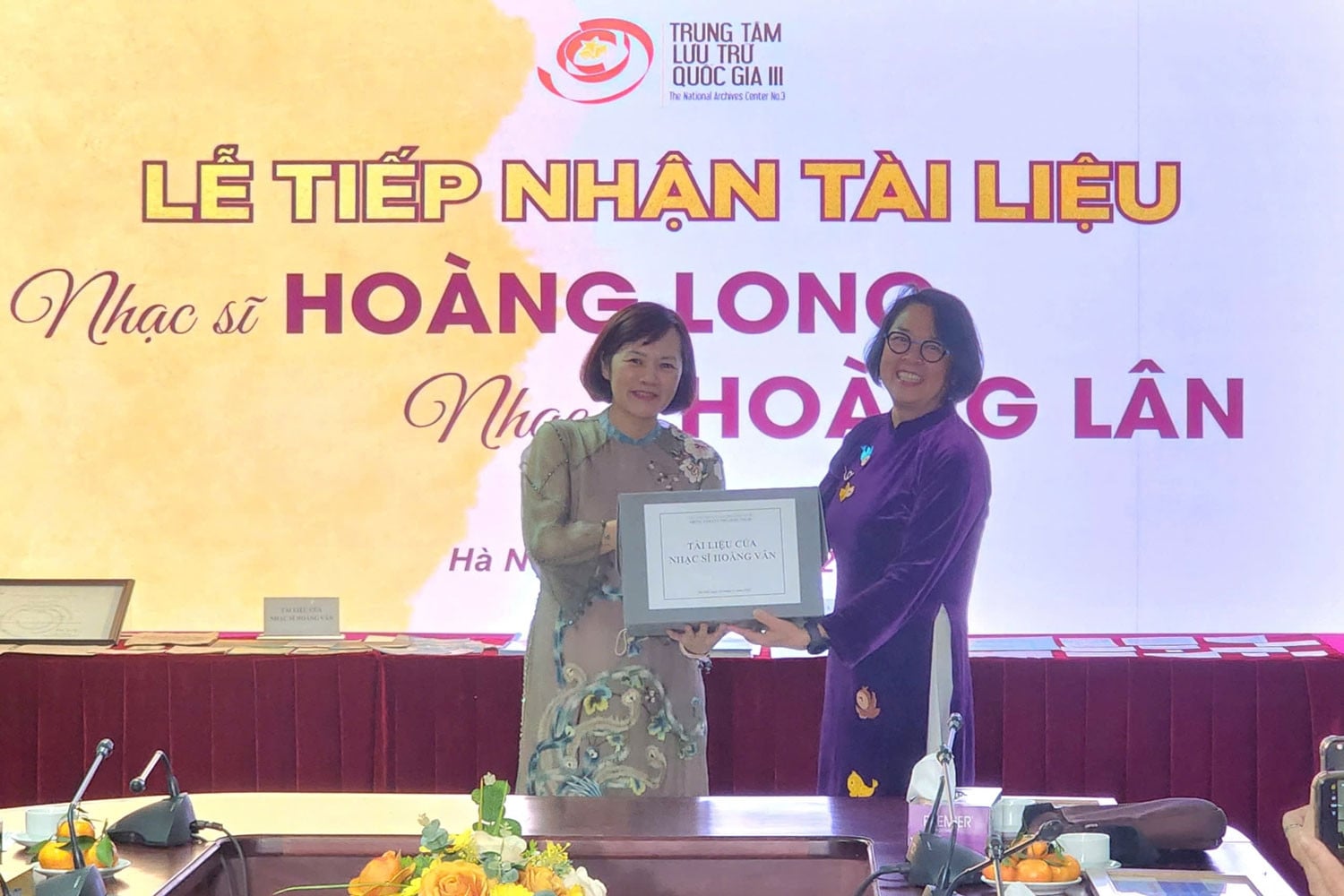
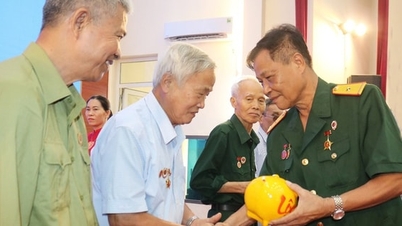
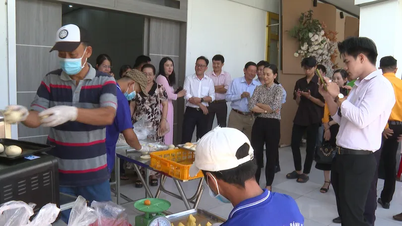
On December 10th, the National Archives Center III held a ceremony to receive the second batch of valuable documents and artifacts related to composer Hoang Van and composers Hoang Long and Hoang Lan.
Source: https://vietnamnet.vn/dieu-dac-biet-ve-hai-anh-em-sinh-doi-la-nhac-si-cung-sang-tac-hon-700-ca-khuc-2472174.html
![[Live] 2025 Community Action Awards Gala](/_next/image?url=https%3A%2F%2Fvphoto.vietnam.vn%2Fthumb%2F1200x675%2Fvietnam%2Fresource%2FIMAGE%2F2025%2F12%2F16%2F1765899631650_ndo_tr_z7334013144784-9f9fe10a6d63584c85aff40f2957c250-jpg.webp&w=3840&q=75)


![[Photo] Prime Minister Pham Minh Chinh receives Lao Minister of Education and Sports Thongsalith Mangnormek](/_next/image?url=https%3A%2F%2Fvphoto.vietnam.vn%2Fthumb%2F1200x675%2Fvietnam%2Fresource%2FIMAGE%2F2025%2F12%2F16%2F1765876834721_dsc-7519-jpg.webp&w=3840&q=75)
![[Image] Leaked images ahead of the 2025 Community Action Awards gala.](/_next/image?url=https%3A%2F%2Fvphoto.vietnam.vn%2Fthumb%2F1200x675%2Fvietnam%2Fresource%2FIMAGE%2F2025%2F12%2F16%2F1765882828720_ndo_br_thiet-ke-chua-co-ten-45-png.webp&w=3840&q=75)
![[Photo] Prime Minister Pham Minh Chinh receives the Governor of Tochigi Province (Japan)](/_next/image?url=https%3A%2F%2Fvphoto.vietnam.vn%2Fthumb%2F1200x675%2Fvietnam%2Fresource%2FIMAGE%2F2025%2F12%2F16%2F1765892133176_dsc-8082-6425-jpg.webp&w=3840&q=75)




































![[Photo] Prime Minister Pham Minh Chinh attends the Vietnam Economic Forum 2025](https://vphoto.vietnam.vn/thumb/402x226/vietnam/resource/IMAGE/2025/12/16/1765893035503_ndo_br_dsc-8043-jpg.webp)




















Comment (0)