

While the old town is still half-asleep, the morning mist gently covers the moss-covered roofs, and the steaming hot sesame sweet soup fills the air in the old kitchen of Mr. Ngo Thieu (1915-2023), the man who brought the "exclusive" sesame sweet soup to Hoi An. Then, as dawn breaks, on a corner of Nguyen Truong To street, his family's traditional black sesame sweet soup stall quietly reappears, a familiar part of Hoi An's life for over a century.
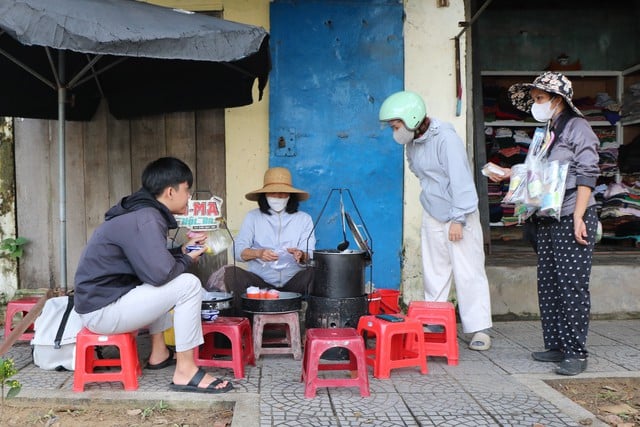
People in Hoi An stop to enjoy xi ma, a dish associated with childhood memories and the slow pace of life here.
That street vendor selling "xí mà" (a type of Vietnamese sweet soup) has nurtured the memories of many generations, including Mr. Le Viet Van, a neighbor of Mr. Ngo Thieu. "My childhood was filled with mornings when my parents would buy me a hot bowl of 'xí mà.' It was delicious and good for digestion. Now I still buy it for my children and grandchildren so they know about this traditional Hoi An dish," Mr. Van shared.
For Mrs. Tran Thi Hanh, buying a bowl of black sesame sweet soup every time she returns from the market has become a habit. "Black sesame sweet soup is best eaten hot, moderately sweet, nutty, and good for hair and health. If you come back from the market a little late, it's all gone; you won't have any left even if you want to," Mrs. Hanh said with a smile.
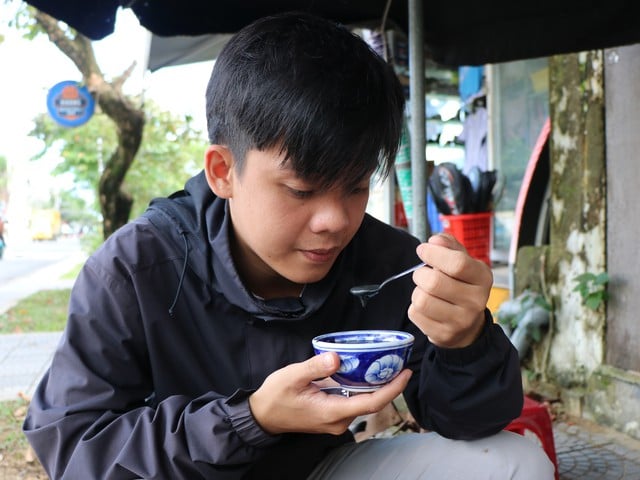
Tourists are curious to try xí mà, and are left with a lingering, unforgettable taste of this simple treat found on the streets of Hoi An.
Not only locals, but many first-time visitors are also easily captivated by its simple yet refined flavor. A tiny bowl of this dessert contains the aroma of roasted sesame seeds, a delicate sweetness, and a subtle hint of traditional Chinese medicine, a treat that leaves a lasting impression, even after just one visit to Hoi An.
Xí mà – a black sesame sweet soup originating from China – arrived in Hoi An with merchants in the 17th century, during the period when it was the most bustling trading port in the Southern region of Vietnam. Through cultural exchanges with Vietnam, China, Japan, and the West, the dish gradually became localized, transforming into a simple yet beloved breakfast treat for the people of Hoi An.
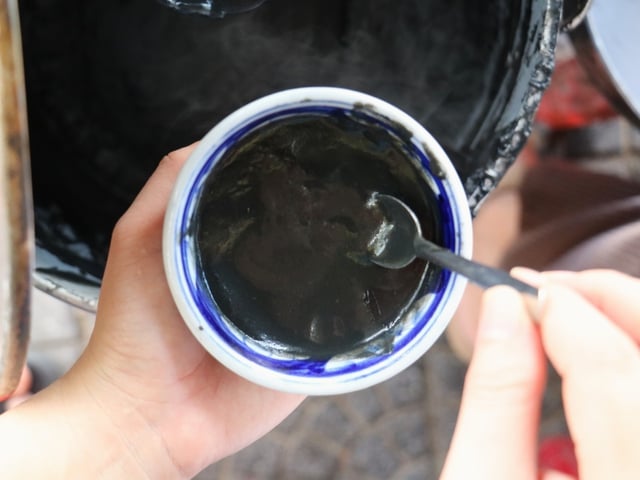
Small, smooth, and subtly sweet sesame seed paste is a familiar breakfast treat for generations of people in the Old Quarter.
Mr. Ngo Thieu (Hoi Tay Ward, Da Nang City) was dedicated to the craft of making "xi ma" (a type of sweet soup) for over 70 years. For him, the pot of "xi ma" was not only a means of livelihood but also a way to preserve family traditions and the memories of the old town. He passed away three years ago, but the secret recipe for making "xi ma," considered a unique tradition, was passed down to his children as a silent legacy.
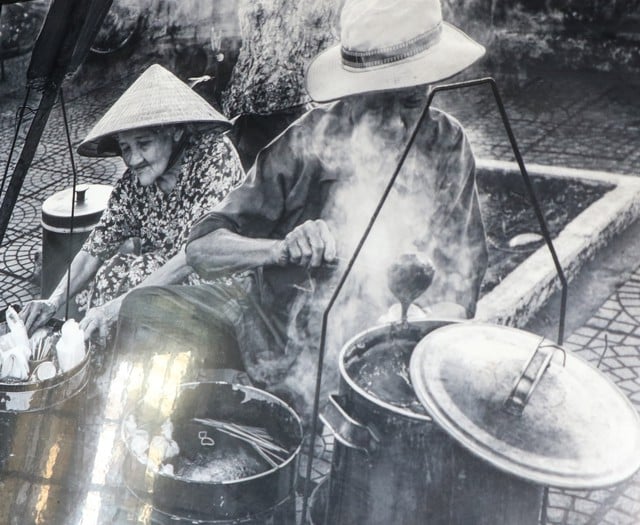
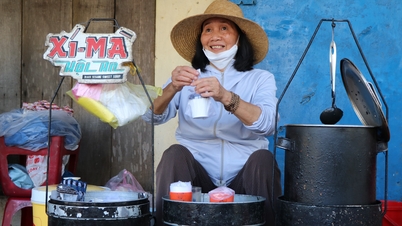
Mr. Ngo Thieu's mobile stall, one of the few street vendors in Hoi An recognized as a cultural attraction, holds cherished childhood memories for generations of Hoi An residents. (Photo: Provided by the owner)
Today, the old man's son, Mr. Ngo Bao, continues to light the stove from 4 a.m. Mr. Bao said that while it's not elaborate in appearance, the process of making "xi ma" (a type of Vietnamese sausage) requires meticulousness and patience in every step.
Black sesame seeds must be roasted over medium heat, then pounded and ground into a fine powder. The leaves of the purslane and centella are ground and strained to extract their refreshing green juice. The Chinese medicinal herbs are cooked separately to preserve their essence. All ingredients are blended with tapioca starch, sweet potato starch, and sugar syrup, stirred over low heat until the dessert becomes thick, smooth, and fragrant. Even a slight deviation will compromise the authentic flavor.
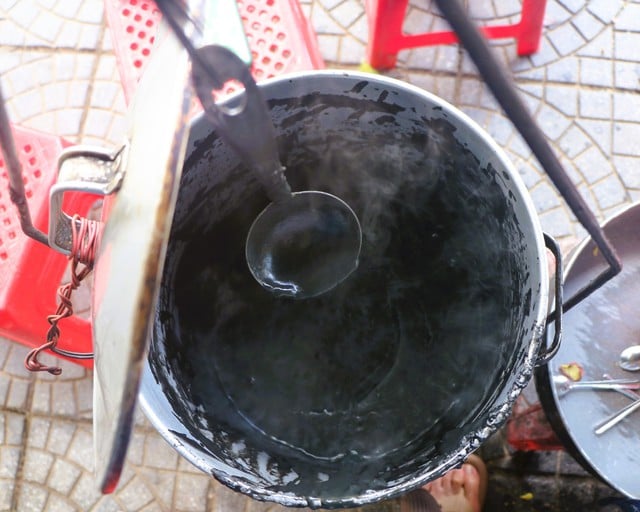
The pot of sesame paste, steaming and emitting a gentle aroma of roasted black sesame seeds, fills the tranquil atmosphere of Hoi An.
Around 7 a.m., his wife, Mrs. Em, would carry her pot of sesame candy from the small alley to the sidewalk to sell until about 10 a.m. "You can't make a living or get rich from selling sesame candy from this stall. But if I give it up, I'll feel guilty towards my father. So, even though our children and in-laws are getting old, we still try to take turns cooking and selling it as a way of fulfilling our filial duty to our father," Mrs. Em said.
In 2019, Mr. Ngo Thieu's street food stall was officially recognized as a Cultural Attraction of Hoi An. For the first time, a street vendor's stall became a "living heritage," where visitors can not only enjoy the food but also listen to the story of a family, a profession, and an ancient town that has persistently preserved its simple values.
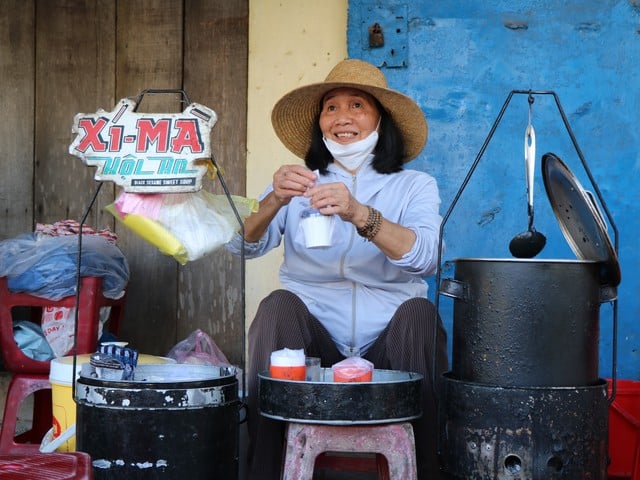
Amidst the moss-covered old town, Mrs. Em, the daughter-in-law of Mr. Thieu, quietly keeps her promise to continue the traditional craft of making "xi ma" (a type of Vietnamese candy) passed down from previous generations.
Amidst today's bustling tourist scene, that humble tea stall remains as unhurried as the rhythm of life in Hoi An. A small cup of tea in the morning, though modest, is fragrant and comforting enough to hold onto time, memories, and the quiet love of those who have chosen to stay and continue their ancestors' craft.
Source: https://phunuvietnam.vn/mot-chen-xi-ma-buoi-som-and-hanh-trinh-giu-nghe-bang-chu-hieu-o-pho-co-hoi-an-238251215165800003.htm

![[Live] 2025 Community Action Awards Gala](/_next/image?url=https%3A%2F%2Fvphoto.vietnam.vn%2Fthumb%2F1200x675%2Fvietnam%2Fresource%2FIMAGE%2F2025%2F12%2F16%2F1765899631650_ndo_tr_z7334013144784-9f9fe10a6d63584c85aff40f2957c250-jpg.webp&w=3840&q=75)
![[Image] Leaked images ahead of the 2025 Community Action Awards gala.](/_next/image?url=https%3A%2F%2Fvphoto.vietnam.vn%2Fthumb%2F1200x675%2Fvietnam%2Fresource%2FIMAGE%2F2025%2F12%2F16%2F1765882828720_ndo_br_thiet-ke-chua-co-ten-45-png.webp&w=3840&q=75)
![[Photo] Prime Minister Pham Minh Chinh receives the Governor of Tochigi Province (Japan)](/_next/image?url=https%3A%2F%2Fvphoto.vietnam.vn%2Fthumb%2F1200x675%2Fvietnam%2Fresource%2FIMAGE%2F2025%2F12%2F16%2F1765892133176_dsc-8082-6425-jpg.webp&w=3840&q=75)
![[Photo] Prime Minister Pham Minh Chinh receives Lao Minister of Education and Sports Thongsalith Mangnormek](/_next/image?url=https%3A%2F%2Fvphoto.vietnam.vn%2Fthumb%2F1200x675%2Fvietnam%2Fresource%2FIMAGE%2F2025%2F12%2F16%2F1765876834721_dsc-7519-jpg.webp&w=3840&q=75)










































![[Photo] Prime Minister Pham Minh Chinh attends the Vietnam Economic Forum 2025](https://vphoto.vietnam.vn/thumb/402x226/vietnam/resource/IMAGE/2025/12/16/1765893035503_ndo_br_dsc-8043-jpg.webp)




















Comment (0)