

Listen to the aspirations of the people.
The Dien Bien Provincial Party Congress has concluded, setting the stage for a new phase of development. I had the opportunity to speak with the Secretary of the Dien Bien Provincial Party Committee, Tran Tien Dung, shortly after the Resolution of the 15th Party Congress was issued. He shared: “Dien Bien has great potential for developing specialty and unique agricultural products. The Resolution of the 15th Party Congress has identified the development of a “green, smart, and sustainable” economy , linked to the transformation of the production structure and the enhancement of added value for agricultural products. This is the direction for the province to focus on leveraging its unique advantages, transforming potential into intrinsic strength in the coming time.”
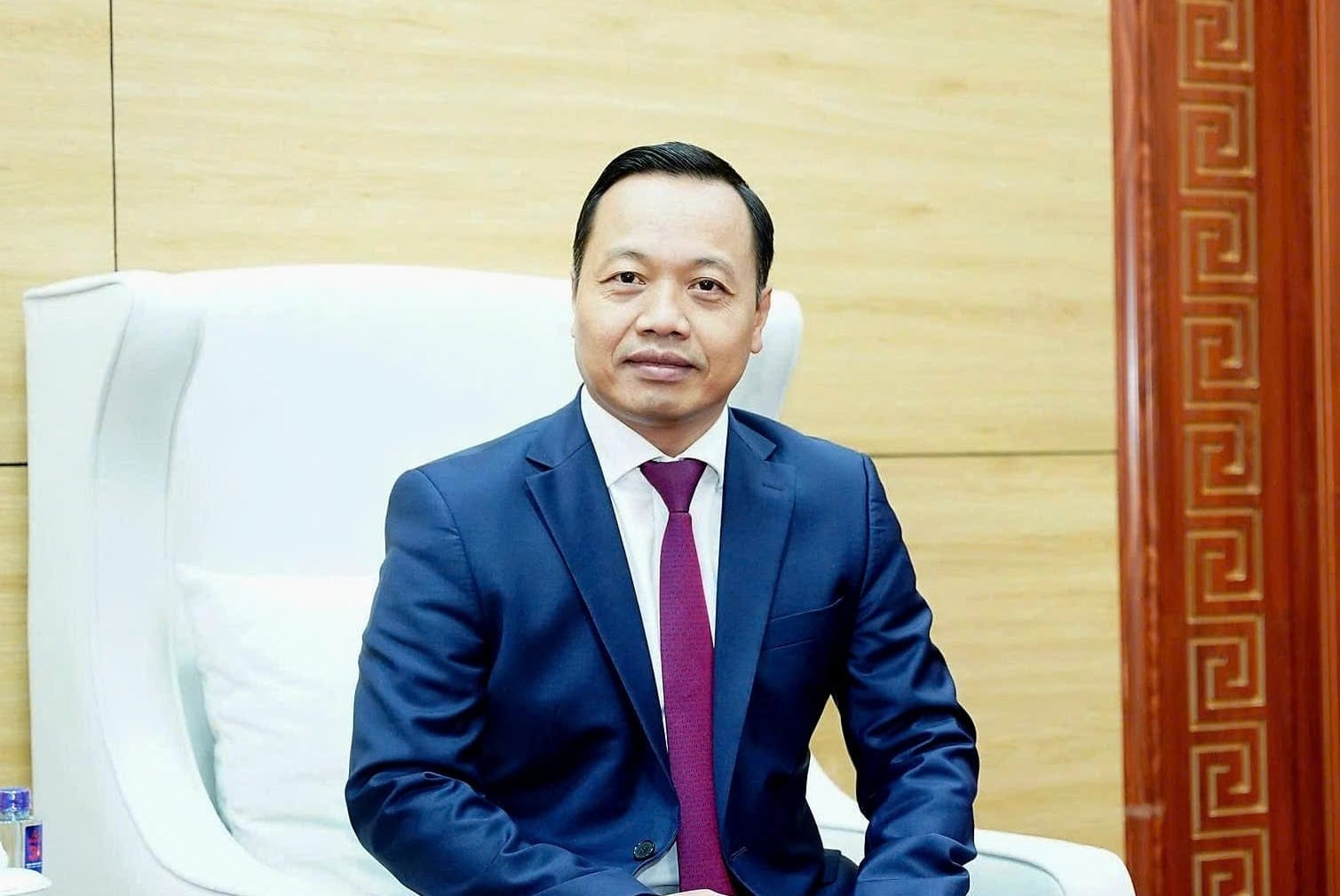
Mr. Tran Tien Dung, Secretary of the Dien Bien Provincial Party Committee. Photo: Tran Huong .
In his remarks, the Secretary of the Dien Bien Provincial Party Committee, Tran Tien Dung, clearly emphasized Dien Bien's strategic location and strengths. He highlighted the Tay Trang and Huoi Puoc international border gates, and soon the A Pa Chai - Long Phu border gate and the A Pa Chai border economic zone, which will help the province expand agricultural trade cooperation, develop raw material areas linked to deep processing, and export specialty products.
"Resolve life – that is a mandate. The goal of this mandate is to prioritize socio-economic development and use the happiness index of the people as a measure," said Tran Tien Dung, Secretary of the Dien Bien Provincial Party Committee.
"But the most important thing is to restructure production towards concentrated commodity production, developing high-value crops and livestock, linked to product consumption and deep processing. We should encourage the establishment of cooperatives linking farmers, businesses, and scientists to promote smart, high-tech production."
Party Secretary Tran Tien Dung spoke thoughtfully when discussing transportation. Transportation in Dien Bien is still considered the biggest "bottleneck." Therefore, developing socio-economic infrastructure, especially transportation, has been identified by the province as one of the three strategic breakthroughs in the Resolution of the 15th Party Congress, aiming to create momentum for rapid and sustainable development.
During the past term, the province expanded and upgraded Dien Bien Airport – a strategic project that opened opportunities for direct connections with major economic centers nationwide, promoting trade, tourism, and investment. The next step will be to focus on the Son La - Dien Bien - Tay Trang Border Gate expressway, a strategic driving force connecting Dien Bien with other provinces in the Northern Delta and international border gates. Alongside this, National Highway 279, National Highway 12 to the A Pa Chai - Long Phu border gate, and urban and rural transportation infrastructure are being planned synchronously, linked to smart cities and the new rural development program. Simultaneously, the province is investing in digital infrastructure, applying smart transportation management and operation technologies, aiming for a Dien Bien that is relatively developed in the region, modern, and integrated.
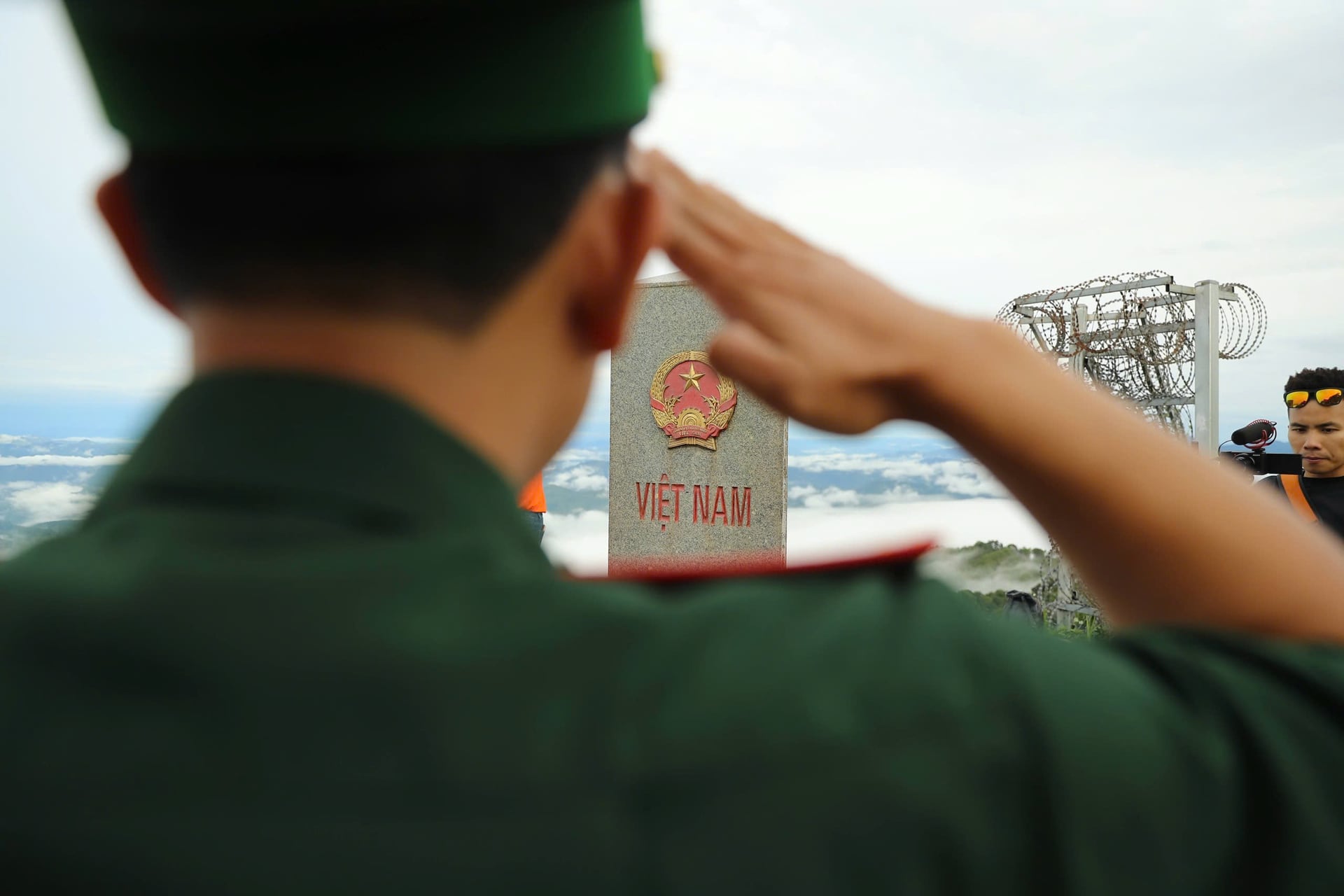
A Pa Chai (Dien Bien) - The westernmost destination of the country.
Dien Bien is also aiming to develop tourism into a key economic sector, effectively exploiting its cultural values and natural landscapes. Ethnic culture and tourism will be new growth drivers, contributing to the shift in economic structure towards a green, smart, and sustainable direction.
Alongside perfecting mechanisms and policies, the province is investing in enhancing competitiveness, concretizing directives and resolutions through action programs, specialized resolutions, and projects… to effectively implement the three breakthroughs, 10 key tasks, restructure the economy, develop strategic infrastructure, improve the quality of human resources, preserve cultural identity, and ensure national defense and security. Dien Bien will not only undergo positive transformation but also create a new image – dynamic, rich in identity, and strongly attractive in the region.
"And the key of all keys is people. The success of the Resolution depends heavily on determination, the courage to think outside the box, to act boldly, to innovate, and to take responsibility in order to move forward."
Secretary Tran Tien Dung's heartfelt words open a door, revealing a generation that inherits the traditional strength of their ancestors, dares to innovate, dares to think and act, and values the contributions and happiness of the people. Their footsteps across Dien Bien Phu are harmonizing in a heroic anthem of aspiration for development, progress, and transformation alongside the nation.
Cherishing the rice grains of Muong Troi
According to Mr. Tran Tien Dung, one of the sectors considered the "backbone" of the locality is agriculture. While Dien Bien's agriculture today may not be a major export region, it has sustained generations, from the hardships of the resistance war to ensuring food security, allowing ethnic minority communities to feel secure and confident in defending the borderlands of the Fatherland. Compared to the land where mountains are now visible from afar, this is truly a miracle.
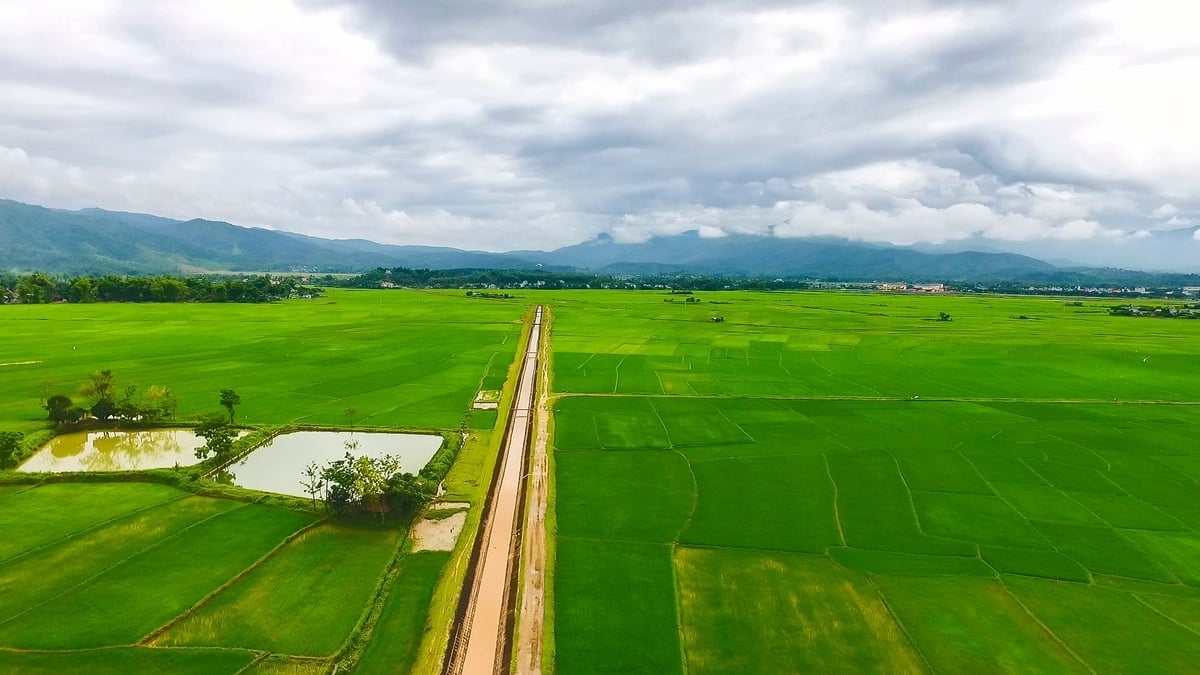
Muong Thanh rice fields. Photo: Tran Huong.
Holding a bowl of fragrant, sticky rice from the fields of Muong Thanh, we cherish the people who cultivate it. Dien Bien rice is likened to the pearl of the Muong Thanh region, pristine white and brimming with vitality.
My guide for the field trip to Muong Thanh was Ms. Chu Thi Thanh Xuan, Deputy Director of the Department of Agriculture and Environment. Ms. Xuan was born and raised in Nam Dinh, graduated from the University of Agriculture in 1996, and moved to Dien Bien to work, where she has been for nearly 30 years. She said: "The Muong Thanh field is as intertwined with my career as my blood and flesh… In this small, narrow valley lies a vast field, one of the four largest fields in Northwest Vietnam (Nhat Thanh, Nhi Lo, Tam Than, Tu Tac)."
After the harvest, the fields are plowed again to prepare for the winter-spring crop. Standing before the dark brown furrows, we talked about "the rice grain of Muong Troi." In my memory, wet rice appeared in Vietnam around 3,000-4,000 years BCE, undergoing a process of domestication from wild rice to become the foundation of traditional agriculture. The Thai people of Northwest Vietnam also believe that their ancestors passed down the tradition of domesticating rice grains throughout history. Ultimately, rice is a gift from heaven to humankind.
“I don’t know when the Muong Troi rice grains originated, I only know that the Muong Thanh fields today produce rice renowned throughout Northern Vietnam. Our profession involves year-round labor, contemplation, and calculation of weather, seasons, and the planting and harvesting process to produce rice grains. We toil, worry, and struggle with the fields from seedlings to rice plants, and then to the rice grains,” said Ms. Xuan. These insightful words flowed from someone with a wealth of knowledge about the Muong Troi land, about a revolutionary land reclamation project imbued with the spirit of Ho Chi Minh’s soldiers, about the 316th Division in Bat Bat, Son Tay, which, following President Ho Chi Minh’s call, built the Dien Bien State Farm, establishing production teams from C1 to C12, which have now become historical landmarks in the form of villages and hamlets…
In those days, the Muong Thanh Valley was vast, yet the area of rice cultivation for a single crop depended solely on rainfall, amounting to less than 4,000 hectares. The great revolution of land reclamation and development, the construction of the Nam Rom irrigation system, and later a series of reservoirs such as Pe Luong, Pa Khoang, Sai Luong, and Hong Khenh, transformed the social landscape and agricultural practices. The Muong Thanh plain expanded; irrigation water ensured two rice crops per year, increasing the cultivated area to 14,000 hectares. The traditional, back-bent paths for planting seedlings were replaced by broadcast sowing; monoculture farming was abandoned.
Ms. Xuan happily informed me that the Muong Thanh rice field project has been included in Resolution No. 09 of the Provincial Party Committee, dated July 29, 2021, and the Provincial People's Committee has begun developing a project proposal. Currently, the Department of Agriculture and Environment has submitted the proposal for approval.
The woman, who had been cheerful, suddenly became pensive: "The Muong Thanh rice field is not only the province's rice granary but also a historical witness to the war against French colonialism in 1954. Protecting the field means protecting food security and preserving historical relics for future generations."
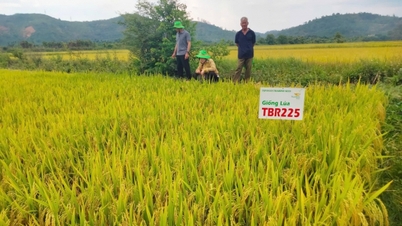
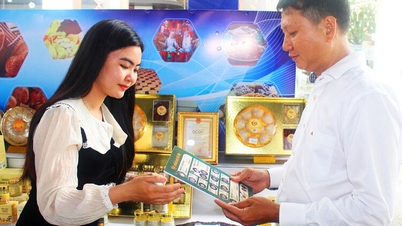
Continuing the story of the rice fields and the precious grains of heaven, we met Quan Ba Toi, Director of Thanh Yen General Agricultural Service Cooperative, a pioneer in implementing a large-scale model rice field of over 60 hectares, with 100 participating households. From this, the "Tam Sang Dien Bien Rice" brand was born, along with two OCOP products: Tam Sang Tam Thom Rice and Tam Sang Seng Cu Rice, which are now available in many large supermarkets and exported abroad.
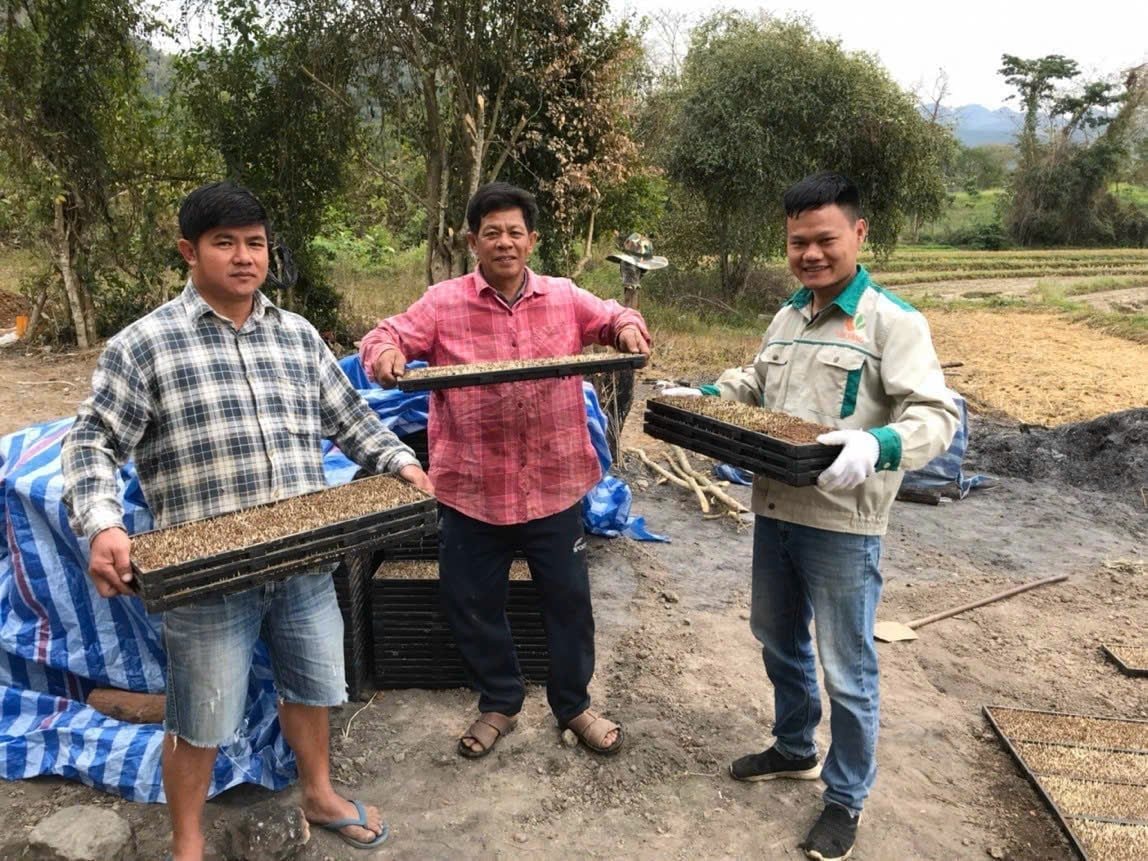
Mr. Quan Ba Toi (standing on the right), Director of Thanh Yen General Agricultural Services Cooperative. Photo: Tran Huong.
Toi recounted: He attributed his success to the province's attention and preferential policies for agricultural development, as well as the support of the government and relevant agencies. In 2020, his cooperative supplied approximately 12,000 tons of Dien Bien rice to supermarkets nationwide, opening up a new business model for production in the Muong Thanh rice fields. Toi's initial success has encouraged many young people in the border highlands such as Sin Chai, Leng Su Sin, Nam Nen, Pa Ham, Pu Hong, etc., to boldly register for OCOP product certification and pursue their entrepreneurial dreams.
Standing before the vast Muong Thanh rice fields stretching as far as the eye can see, I recall the words of Mr. Tran Tien Dung: "Any aspiration for transformation must stem from the aspirations of the people. Any change must be based on ensuring prosperity and happiness for the people. Therefore, in this transformation, we always cherish and are grateful for the Muong Thanh rice grain – a heartwarming support from the beginning, today, and forevermore."
From the Muong Thanh plain, we gazed into the distance. At the foot of the hills, stilt houses, shrouded in wisps of smoke, were intertwined with the colors of the national flag, evoking a feeling of peaceful happiness within me. Dien Bien today is transforming alongside the nation. From its potential in land, climate, and people to the unwavering determination of the entire political system, Dien Bien is continuing to write its own unique story of a heroic historical land with its inherent strength.
Source: https://nongnghiepmoitruong.vn/khat-vong-long-dan-d785550.html



























![[Workers' Month 2026] Spreading love on the Vinh - Dong Hoi frontline: Nearly 1 billion VND spent on caring for the lives of workers.](https://vphoto.vietnam.vn/thumb/402x226/vietnam/resource/IMAGE/2026/05/20/1779237885217_img_8650.jpeg)






















Comment (0)