

When universities are desperate for students.
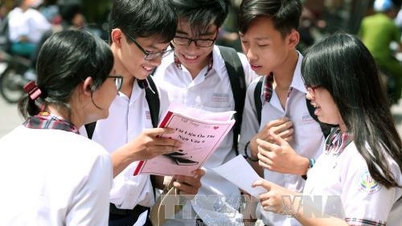
In 2024, 733,600 candidates nationwide registered for university entrance exams. Nearly 673,600 were admitted in the first round. By the end of the enrollment confirmation period on the Ministry of Education and Training's system, 81.87% of candidates had been officially admitted.
Therefore, only about 60,000 candidates failed to get into university in 2024. This is because candidates registered for more options than they could handle, while their scores still gave them a chance to be admitted to other options. Consequently, many universities are still "desperate" for students and are recruiting additional students immediately after the first round of admission scores are announced.
This year, with no early admissions process allowed, many universities are anxious and worried about not having secured enough students. Some universities have resorted to "tricks" to get students in right after the application deadline.
Gia Dinh University sent out admission invitations for its 2025 regular undergraduate program starting in early August, inviting candidates to complete the enrollment procedures for a free freshman skills training course themed "GenAI Generation for International Integration," upon which they will receive a certificate.
Van Hien University announces support for candidates with 50-60% tuition fee reduction for the first semester and 10-30% tuition fee reduction for the second semester if candidates register within the specified period, the second phase lasting from August 1-5.
In mid-July, Hung Vuong University in Ho Chi Minh City sent out admission letters for its 2025 regular undergraduate program, based on the application preferences submitted through the academic transcript review process. Successful applicants are required to go to the university's campuses to complete the enrollment procedures within the specified timeframe.
On August 20th, before the deadline for virtual filtering as stipulated, Hung Vuong University in Ho Chi Minh City announced the cutoff scores for the method of considering high school graduation exam results. The cutoff scores ranged from 15-20/30 points. This is the lowest minimum score for application acceptance announced by a higher education institution this year (12/30 points).
According to regulations from the Ministry of Education and Training, the admission cut-off scores can only be announced after the virtual filtering period has ended (the most recent information is August 22nd).
However, after the Ministry of Education and Training postponed the deadline for the virtual filtering process, the school withdrew this announcement.
The admission plans of some universities also raise many concerns. For example, in its 2025 admission plan, Gia Dinh University provided information on admissions for the two most recent years. In 2024, when universities were still allowed to conduct early admissions, 27 out of 27 majors had no confirmed enrollments through the method of considering high school graduation exam results, despite having quotas and cut-off scores of 15/30. Candidates also refused to participate in the method of considering the results of the National University of Ho Chi Minh City's aptitude test.
Regarding the academic transcript-based admission method, some candidates have confirmed their enrollment. In particular, the Computer Networks and Communications major still has 3 zeros (no candidates confirmed enrollment across all three admission methods) despite having 40 quotas. A similar situation occurred in 2023 for all three admission methods of the university.
Long-term consequences
Over the years, a significant number of students who were accepted into university have declined to enroll. The reasons stem from being accepted into unsuitable programs; prioritizing high school achievements over other options; and students choosing to study abroad instead.
In 2024, approximately 122,107 candidates did not confirm their enrollment, accounting for 18.13% of the total number of candidates admitted in the first round. In 2023, nearly 118,000 candidates admitted to universities in the first round did not confirm their enrollment. In 2022, this number was over 103,000 candidates...

The head of a private university admitted that the number of students who completely fail to get into universities in Vietnam is very small. This is the result of several factors: expanded enrollment quotas; increasingly diverse admission methods (high school graduation exam, academic transcript review, international certificates, separate entrance exams, etc.); and a clear stratification between universities, from top-tier institutions to local and private universities. As a result, most students can find at least one way to get into university.
However, this phenomenon also leaves behind a number of consequences. Firstly, university degrees are at risk of gradually losing their value as a measure of competence, because almost anyone can pass the university entrance exam, making the degree no longer a clear indicator of ability.
Secondly, university education risks exceeding market demand, especially in popular fields where there is already a surplus of manpower, leading to unemployment among graduates or graduates working in unrelated fields.
Thirdly, uneven student intake places significant pressure on schools, affecting the quality of education. This also leads to a waste of social resources.
According to the head of the private university, lax admissions procedures have led many universities to accept students with weak academic abilities, putting pressure on teaching and affecting the quality of education.
Many families invest 3-4 years in university education for their children, but afterward, the students cannot find jobs in their field or have to return to vocational training. Ultimately, the mentality of "universal access to university" leads to less attention being paid to vocational and college-level education, while the labor market suffers from a severe shortage of technical personnel and skilled workers.
Overall, the fact that very few candidates fail to get into university is not necessarily a completely positive sign. The issue is the need to rebalance the education system, between higher education and vocational training, and to improve quality instead of just expanding quantity. Only then will a university degree truly reflect competence and education will meet the needs of socio-economic development.
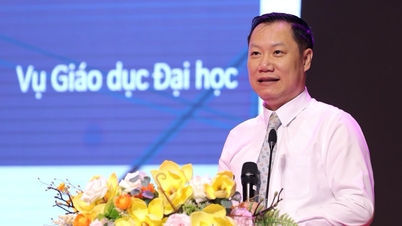
In response to a student's question about whether university degrees are truly "inflated," a representative from the Department of Higher Education affirmed that a university degree certifies knowledge and skills in a particular field when students enter the labor market. Without continuous learning and effort, opportunities will go to others or be replaced by AI. A higher number of university places means more opportunities for everyone to pursue their education.
Source: https://tienphong.vn/kho-nhu-truot-dai-hoc-post1771352.tpo






















![[VIDEO] Launch Ceremony of the 2026 Summer Youth Volunteer Campaign](https://vphoto.vietnam.vn/thumb/402x226/vietnam/resource/IMAGE/2026/05/23/1779546728859_1000028945-4837-jpg.webp)





































































Comment (0)