
The annual report on the digital economy in Southeast Asia forecasts that Vietnam's digital economy will reach $39 billion in 2025. Photo: Google
In reality, the digital economy and the green economy are considered two strategic pillars of sustainable development. The combination of digital transformation and green transformation is often referred to as a "dual transformation" because it not only opens up dynamic avenues for economic recovery and growth, but also helps restructure the economy towards a smart, energy-efficient, and environmentally friendly direction, contributing to the realization of sustainable development goals for the world and Vietnam.
Digital economy - A driver of breakthrough growth.
The digital economy is increasingly asserting its role as a strategic pillar in the growth models of many countries, as technology and data are not only key production factors, but also become core "ingredients" that shape the structure and driving force of the global economy.
In general terms, the digital economy encompasses all economic activities that are operated, managed, and developed primarily on a foundation of digital technology and data, with the digital environment serving as the main space for operation, connection, and interaction. Beyond simply applying technology in production and business, the digital economy also focuses on innovation, helping to boost productivity, quality, and efficiency across the entire economy.
Unlike traditional economic models that rely heavily on physical resources, the digital economy produces fewer emissions and is more environmentally friendly. The outstanding characteristics of the digital economy are its rapid growth rate, flexible scalability, and the creation of a comprehensive innovation space where data, artificial intelligence (AI), cloud computing, and automation become key elements for new value creation. This forms the foundation for modern business models, fosters a high-quality labor market, and enhances national competitiveness.
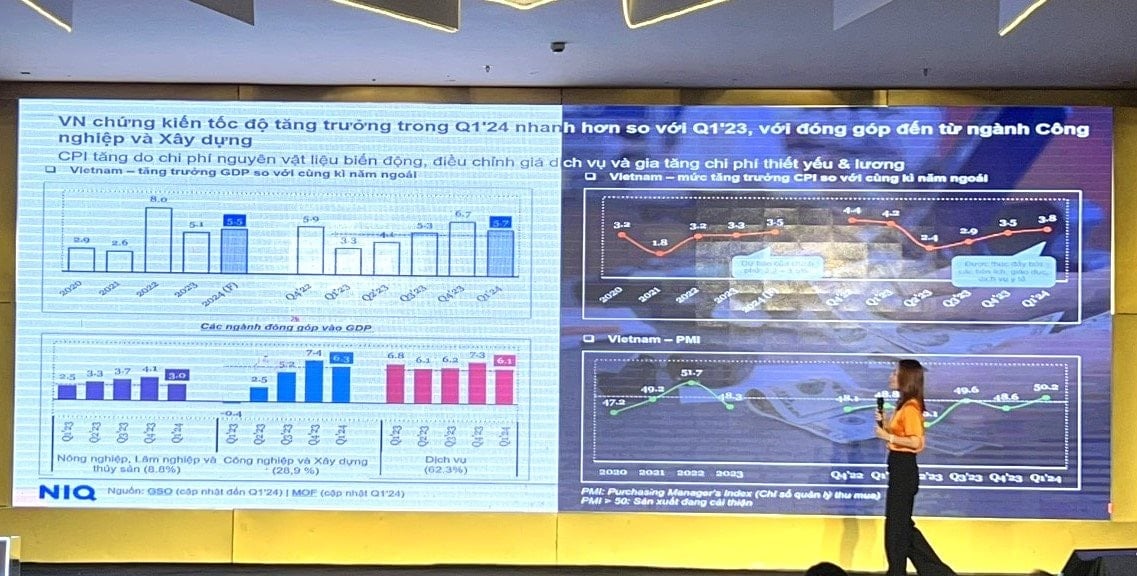
By 2025, Vietnam's digital economy is projected to reach US$72.1 billion, equivalent to 14.02% of GDP. (Illustration: Lam Giang)
The achievements in Vietnam in recent years clearly demonstrate the driving role of the digital economy. According to a 2025 report, the value of Vietnam's digital economy is projected to reach US$72.1 billion, equivalent to 14.02% of GDP.
This is a significant step forward compared to the 10.5% of GDP in 2023. On average, during the 2021-2025 period, this sector contributed approximately 13.2% of GDP, demonstrating that the digital economy has moved beyond a supporting role and become a crucial component of national economic growth.
E-commerce accounts for two-thirds of the total market size, with revenue exceeding $25 billion and a rapidly expanding number of online consumers. Beyond retail, many sectors such as finance and banking, logistics, tourism, and education are also increasing their digital activities, contributing to the diversification of revenue sources and job creation in the economy.
The impact of the digital economy on the national economy has been clearly demonstrated in three aspects.
Firstly , the digital economy helps improve labor productivity by optimizing production processes, reducing transaction costs, and increasing the speed of information processing.
Secondly , the digital economy creates new business models such as e-commerce platforms, the sharing economy, and digital financial services. These new platforms have expanded the economic landscape and stimulated entrepreneurship and innovation.
Thirdly , the digital economy helps businesses improve their ability to collect and analyze data, thereby enhancing their decision-making capabilities, market forecasting, and risk management.
However, despite its outstanding achievements, Vietnam's digital economy still faces many challenges that need to be addressed promptly. Domestic added value remains limited because most digitalization activities have only progressed to the stage of technological transformation in traditional sectors, and have not yet resulted in many high-value "Make in Vietnam" products.
The digital divide between regions and population groups remains significant, resulting in uneven access to technology. In particular, there is a shortage of high-quality human resources in technology and data analytics, while digital infrastructure in many localities does not yet meet the requirements for rapid and secure development.
For the digital economy to truly become a breakthrough driving force, Vietnam needs to continue investing in the comprehensive development of digital infrastructure, encourage innovation in businesses, and build flexible policy mechanisms to create a favorable environment for public-private cooperation in the new era.
Green economy - The foundation for sustainable development
You may also like

When capital finds its true valueThe Da Nang Venture and Angel Investment Forum - DAVAS 2026 left a strong impression, as technological ideas were not only heard but also found opportunities to enter the global market. In the context of climate change, biodiversity degradation, and worsening environmental pollution, green economic development is seen as a strategic direction to ensure a sustainable future for all nations.
A green economy is understood as an economic growth model that is linked to a commitment to both creating economic value and protecting the environment, while also providing harmonious social benefits. Instead of sacrificing growth for excessive resource exploitation, a green economy aims for responsible energy use, reduced emissions, increased carbon sequestration, and nature conservation.

Vinamilk's LGV robots help reduce CO₂ emissions by 62% compared to fossil fuel-powered forklifts. Photo: Nam Anh
The goal of this model is not only to promote clean growth, but also to create sustainable livelihoods in the long term through activities such as climate change adaptation, reforestation, water resource protection, and pollution prevention.
Vietnam demonstrated strong determination by committing to achieving net-zero emissions by 2050 at COP26. This is a significant milestone showcasing the responsibility of this developing nation towards the international community.
To realize this goal, Vietnam plans to mobilize more than US$2.4 trillion in investment for energy transition, green infrastructure, and technological innovation from now until 2050. In the medium term, Vietnam aims to reduce greenhouse gas emission intensity by less than 15% compared to 2014 by 2030, while expanding the carbon measurement, monitoring, and pricing system.
This goal presents not only a significant challenge in terms of resources and institutions, but also an opportunity to reshape the economy towards greater efficiency, self-reliance, and environmental friendliness.

Many businesses have effectively implemented green production systems. Photo: Minh Anh
Vietnam's green economy is being built on four main pillars. Firstly, renewable energy, with solar, wind, and biomass power projects developing strongly, especially in the South Central and Southwest regions.
Secondly, there is the circular economy, which focuses on recycling and reusing materials and reducing environmental waste, a direction that many large businesses such as Vinamilk, Unilever, and Sabeco are implementing.
Thirdly, there is green agriculture and green industry, based on clean technology, low-emission production processes, and efficient resource management. Finally, green finance and green bonds are considered the "lifeblood" of the green economy, providing sustainable capital for renewable energy projects, public transportation, or climate change mitigation infrastructure.
According to the Ministry of Finance, by mid-2025, the size of the green bond market in Vietnam will exceed US$2.5 billion, reflecting the great potential of the financial sector in promoting green transformation.
The green economy opens up tremendous opportunities for Vietnam. Global demand for environmentally friendly products is increasing sharply, enabling Vietnam to attract high-quality FDI from corporations that prioritize sustainable development.
Green initiatives also contribute to enhancing national prestige, expanding access to carbon markets, and creating a foundation for innovation. However, significant challenges remain, such as high transition costs, lack of mastery of core technologies, and limited domestic financial resources.
This requires an effective coordinated strategy between the government, businesses, and international institutions, considered a "green alliance" acting together towards sustainable development goals.
The digital economy and green economy drive sustainable growth.
The digital economy and the green economy do not exist separately but are gradually converging, creating a new development model called the "dual transformation" model, aiming to promote sustainable growth in both environmental and economic aspects.
At the macro level, digital technology plays a crucial role as infrastructure and a key tool supporting green growth strategies. Thanks to internet and information and communication technology solutions, "green" productivity is significantly improved as production, operation, and transportation processes are optimized, reducing energy consumption and emissions.
Recent studies show that the application of digital technology helps reduce CO₂ emissions five times more than the emissions generated by the information and communication technology sector itself, demonstrating the potential contribution of digital transformation to the goal of global carbon neutrality.
Digital technology not only boosts efficiency but also becomes a fundamental driving force for sustainable development. Artificial intelligence (AI) and the Internet of Things (IoT) are helping to optimize power distribution, coordinate supply and demand, and integrate renewable energy sources such as wind and solar into smart grids.
Big data is being applied in urban management, traffic forecasting, congestion reduction, and air pollution control. In the fields of commerce and logistics, blockchain is contributing to building green supply chains, ensuring transparency in product traceability and emission control at each stage, thereby enhancing consumer and investor confidence.
From a business perspective, the intersection between the digital economy and the green economy is clearly demonstrated through digital transformation in energy management and production processes. Real-time data-driven management systems allow for monitoring electricity and water consumption and carbon emissions at each stage, thereby helping businesses adjust operations, improve "green" production efficiency, and reduce operating costs.
Many large businesses in Vietnam have implemented smart energy management models, using IoT sensors and data analytics platforms to monitor emission levels, contributing to achieving ESG (Environmental, Social, Governance) goals.
However, integrating the two models still presents many challenges. Synchronized policies and solutions are needed to effectively combine digital development and environmental protection, avoiding situations where digital technology creates additional pressure on electronic waste or excessive energy consumption. At the same time, the design and application of digital technologies should be encouraged to promote sustainable consumption and production behaviors, where the three elements—people, technology, and nature—coexist harmoniously for a green and digitized future.
To realize the goal of "dual transformation" towards sustainable development, Vietnam needs to simultaneously improve the legal framework for both the digital economy and the green economy, ensuring consistency, transparency, and feasibility in policy implementation.
Furthermore, strong investment in research and development (R&D) and green technology innovation will help increase competitiveness and technological self-reliance. In addition, the government needs to build a rigorous system for assessing the impact of the digital economy on the environment, promote international cooperation, and attract high-quality FDI.
At the same time, the training of human resources with digital skills needs to be emphasized, and businesses should be encouraged to adopt environmentally friendly technologies through tax incentives and green credit.
In the long term, the green digital economy is not just a trend, but a pillar of a new growth model, helping Vietnam create a fair, innovative, and sustainable economy where technology serves people and develops in harmony with nature.
Source: https://hanoimoi.vn/kinh-te-so-va-kinh-te-xanh-chuyen-doi-kep-thuc-day-phat-trien-ben-vung-tai-viet-nam-730811.html




























































![[Video] Sunset at Lap An Lagoon – Where the sun sets over the fishing nets](https://vphoto.vietnam.vn/thumb/1200x675/vietnam/resource/IMAGE/2026/05/31/1780192137701_beach-landscape-sea-water-nature-grass-745871-pxhere-com.jpeg)




































Comment (0)