

 |
| Graphics: TO HAN |
That opportunity will not translate into strength if institutional bottlenecks, business environment constraints, access to resources, and the internal capabilities of businesses are not genuinely addressed. The requirement is to create incentives for the private sector to truly grow in both quality and quantity.
Bridging the gap between implementation and policy.
At the launch ceremony of the Vietnam Private Sector Economic Report and the Provincial Competitiveness Index (PCI) 2025, organized by the Vietnam Chamber of Commerce and Industry (VCCI) on May 15th, an analysis of the current private sector economic landscape was presented.
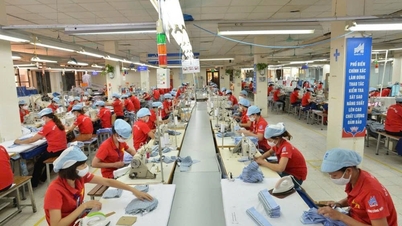
Deputy Secretary General and Head of the Legal Department of VCCI, Dau Anh Tuan, commented succinctly: "Numerous but not yet strong." According to Mr. Tuan, this sector accounts for 96.6% of the total number of active businesses, with over 1 million enterprises; however, more than 80% have fewer than 50 employees and over 70% have registered capital of less than 10 billion VND. These figures show that the majority of businesses are still small-scale, have thin capital accumulation, rely heavily on family experience for management, and have limited resilience to market fluctuations. Therefore, even a single drop in orders, an increase in expenses, a disruption in cash flow, or lengthy procedures can disrupt production and business plans.
Notably, 60.2% of businesses consider finding customers the biggest difficulty, the highest level in the past five years; specifically, 64.4% in the manufacturing industry and 60.4% in agriculture, forestry, and fisheries. 75.5% of businesses stated they cannot obtain credit without collateral. This reflects the double pressure on businesses: uncertain "output" and difficult consumer markets, while "input," especially credit access, remains uncertain. Many businesses have ideas, orders, and operational capabilities but lack the financial resources to expand production, invest in technology, or hire more workers.
Furthermore, although the government has issued many policies to support businesses in their recovery and development, the gap between policy and implementation remains a major concern. Businesses report having to supplement their applications multiple times, and projects being delayed due to differing interpretations among management agencies; even procedures that have been simplified in writing still take a lot of time and money to implement.
Currently, the government has no shortage of policies; the issue is unlocking resources to put those policies into practice. When institutions are not truly streamlined, procedures remain complex, and access to capital, land, and information is limited, these "golden opportunities" are difficult to transform into drivers of growth. Chairman of VCCI Ho Sy Hung |
According to VCCI Chairman Ho Sy Hung, while these obstacles may not cause immediate major disruptions, their prolonged nature will silently create barriers, slowing down long-term investment decisions, production expansion, and technological innovation. Currently, the government has no shortage of policies; the issue is unlocking resources to put policies into practice. When institutions are not truly streamlined, procedures remain complex, and access to capital, land, and information is limited, "golden opportunities" are difficult to transform into growth drivers. Reform is not just about cutting a few more procedures, but about removing the bottlenecks that businesses face daily, from policy implementation to access to resources and strengthening confidence in long-term investment. No matter how progressive a policy is, it will be difficult to be effective if implementation is hampered by a fear of responsibility, avoidance, shirking, or rigid application; in that case, the ultimate cost will still fall on the people and businesses.
The Vietnam Chamber of Commerce and Industry (VCCI) recommends that businesses' opinions should be solicited more genuinely, and that legal mechanisms should be built to be more accessible, understandable, and enforceable, thereby maximizing convenience for production and business activities.
Focus on removing bottlenecks.
Recognizing these bottlenecks, at the beginning of the new term, the Government issued 8 resolutions on reducing, decentralizing, and simplifying administrative procedures and business conditions, aiming to comprehensively amend and supplement 163 legal documents. The goal was to reduce administrative procedures by at least 30%, processing time by 50%, compliance costs by 50%, business conditions by 30%, and eliminate 100% of unnecessary procedures. As a result, 184 procedures were abolished, 134 procedures were decentralized to local authorities, and 349 procedures were simplified; 890 business conditions were abolished, and 4 conditions were simplified; simultaneously, the management mindset shifted strongly from "pre-inspection" to "post-inspection".
Mr. Nguyen Duy Hung, representative of Tan Hiep Phat Group, argued that what businesses need is not preferential treatment, but a fair, safe, transparent, and consistently enforced business environment. Often, obstacles don't lie in major policies, but in slow processing of documents, misinterpretations of regulations, or even minor procedures that drag on, causing businesses to miss market opportunities. Therefore, reform should not be measured solely by the number of documents eliminated or meetings held, but by the time businesses save, the reduced costs, the removal of obstacles, and the strengthening of trust. Reform is only truly meaningful when businesses perceive changes in every transaction with the government apparatus.
Reform should not be measured solely by the number of documents eliminated or the number of meetings held, but by the time businesses save, costs reduced, obstacles removed, and trust strengthened. Reform is only truly meaningful when businesses perceive a change in every interaction with the government apparatus. Mr. Nguyen Duy Hung, representative of Tan Hiep Phat Group |
Experience from localities with good governance quality according to the PCI ranking shows that reform cannot be just a slogan. Chairman of the Quang Ninh Provincial People's Committee, Bui Van Khang, shared that Quang Ninh has been among the top-ranked localities in the PCI ranking for 13 consecutive years. However, improving the business environment is not a seasonal ranking trend, nor is it a superficial race based on investment incentives or production costs. More importantly, it's about institutional quality, governance capacity, innovation, and the ability to build trust for businesses. In this new phase, with higher growth demands, fiercer competition, and greater pressure for innovation, the private sector needs a truly thriving ecosystem. In this ecosystem, a proactive government should not only talk about reform, but also help businesses reduce risks, see opportunities, and build sufficient confidence for long-term investment.
It is clear that the private sector is facing a great opportunity as the message of reform is clear and the pressure for innovation is increasing. Especially after more than a year since Resolution No. 68-NQ/TW on the development of the private sector came into effect, the greatest expectation is not to create a larger private sector in terms of quantity, but to form a stronger force of businesses in terms of quality, with better resilience, greater ambition, and sufficient competitiveness in the global supply chain. To achieve this, the "bottlenecks" need to be decisively and effectively removed to create a more streamlined institutional framework, more predictable policies, and fairer access to resources. Besides support from the State, businesses must also proactively innovate more strongly, truly becoming the most important driving force contributing to the double-digit growth target of the national economy in the coming period.
https://nhandan.vn/kinh-te-tu-nhan-truoc-co-hoi-lon-de-but-pha-post962914.html
Source: https://huengaynay.vn/kinh-te/kinh-te-tu-nhan-truoc-co-hoi-lon-de-but-pha-165728.html


















































































































Comment (0)