Amidst the diverse ethnic symphony of Tuyen Quang province, there are artisans like silkworms of the mountains and forests, silently spinning their silk, dedicating their entire lives to the wellspring of national culture. They not only preserve cultural memories but are also "living treasures," passing on the flame and keeping the soul of the nation intact on the land of Tuyen Quang. |
|
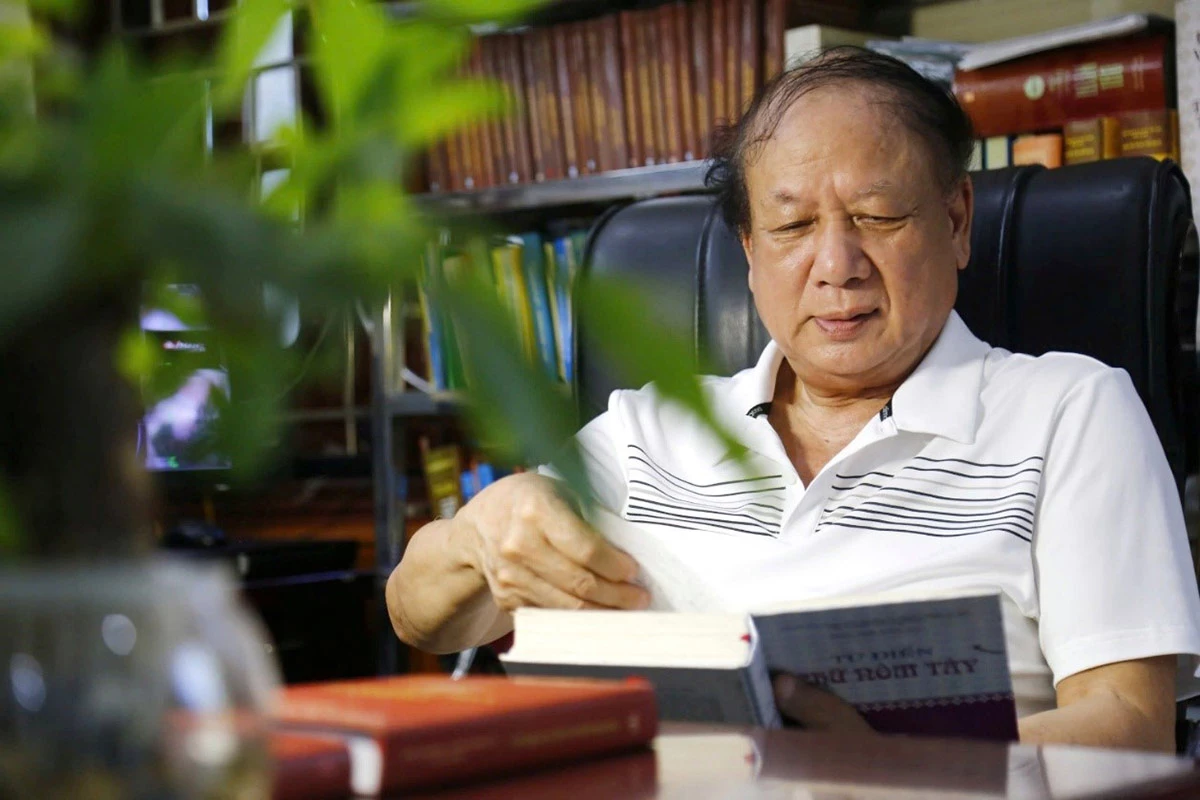
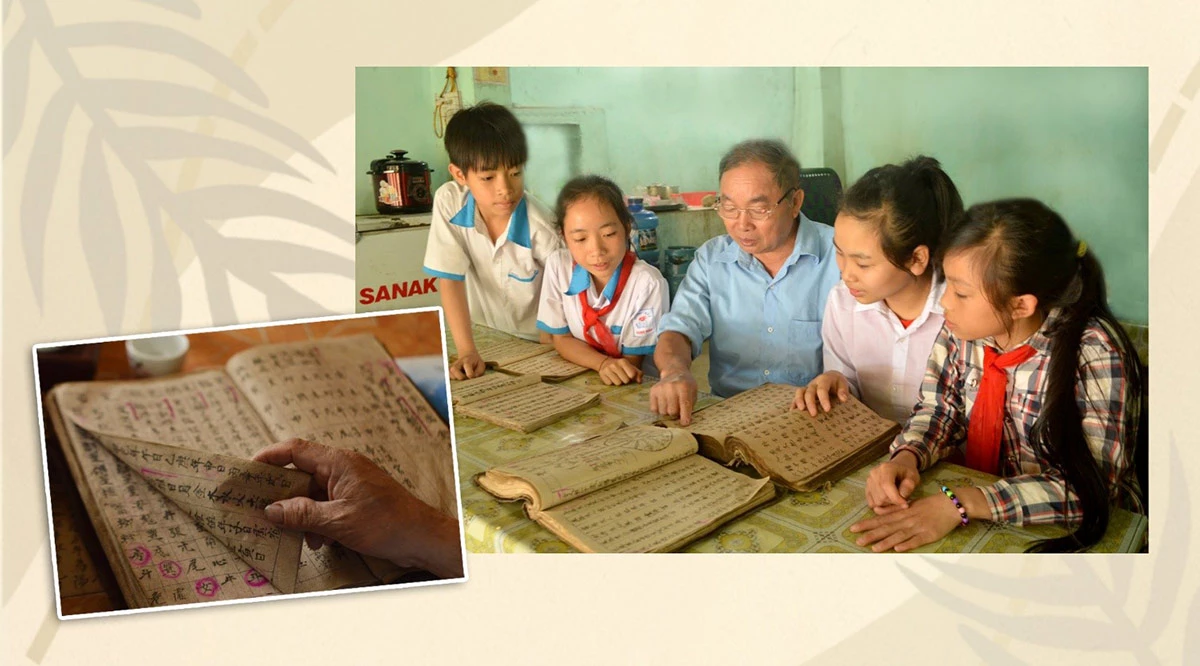
Mr. Tong Dai Hong was born in Tan My commune, a Tay ethnic village rich in cultural traditions with traditional folk songs such as Then, Tinh Tau, and Coi. The Tay people in his hometown are very studious; from a young age, the elders would advise their children, "First, slu tha; second, gia giuoc" (First, literacy; second, medicine). Over time, they accumulated knowledge and experience by recording it on pages written in Tay Nôm script. These included folk remedies, rituals, teachings, and ancient stories… which the Tay people collectively called "thong khon," meaning "bag of wisdom."
|
Folklorist Tong Dai Hong |
To unlock the "thong khon" (wisdom) containing the essence of Tay people's knowledge, he translated and transcribed dozens of books on various topics: worship rituals, prayers; advice and teachings, how to treat others, filial piety, marital fidelity; and folk remedies. After many years of research, he designed and implemented the Tuyen Quang Tay Nôm script on a computer, essentially digitizing the Tay Nôm script. Currently, with over 4,000 sets of Tay Nôm scripts for literary works, he believes this is the fastest way to preserve and safeguard this "treasure trove of wisdom," spreading knowledge to the community and future generations.

|
Not only locals but also foreigners seek out folk culture researcher Tong Dai Hong to learn about the Tay Nôm script. |
The journey of unlocking his "knowledge" was truly meaningful. In July 2025, after 15 years of diligently collecting and researching, he published the "Tuyen Quang Tay Nom Dictionary" (Labor Publishing House). This is the first dictionary of the Tay language, demonstrating the great effort and dedication of Mr. Tong Dai Hong in his research.
The book contains 6,300 words, each written in the Han Nom, Tay Nom, and Vietnamese scripts. "This work is a valuable addition to the linguistic and writing systems of Vietnam's ethnic minority communities," shared Mr. Le Hong Ly, President of the Vietnam Folk Arts Association.
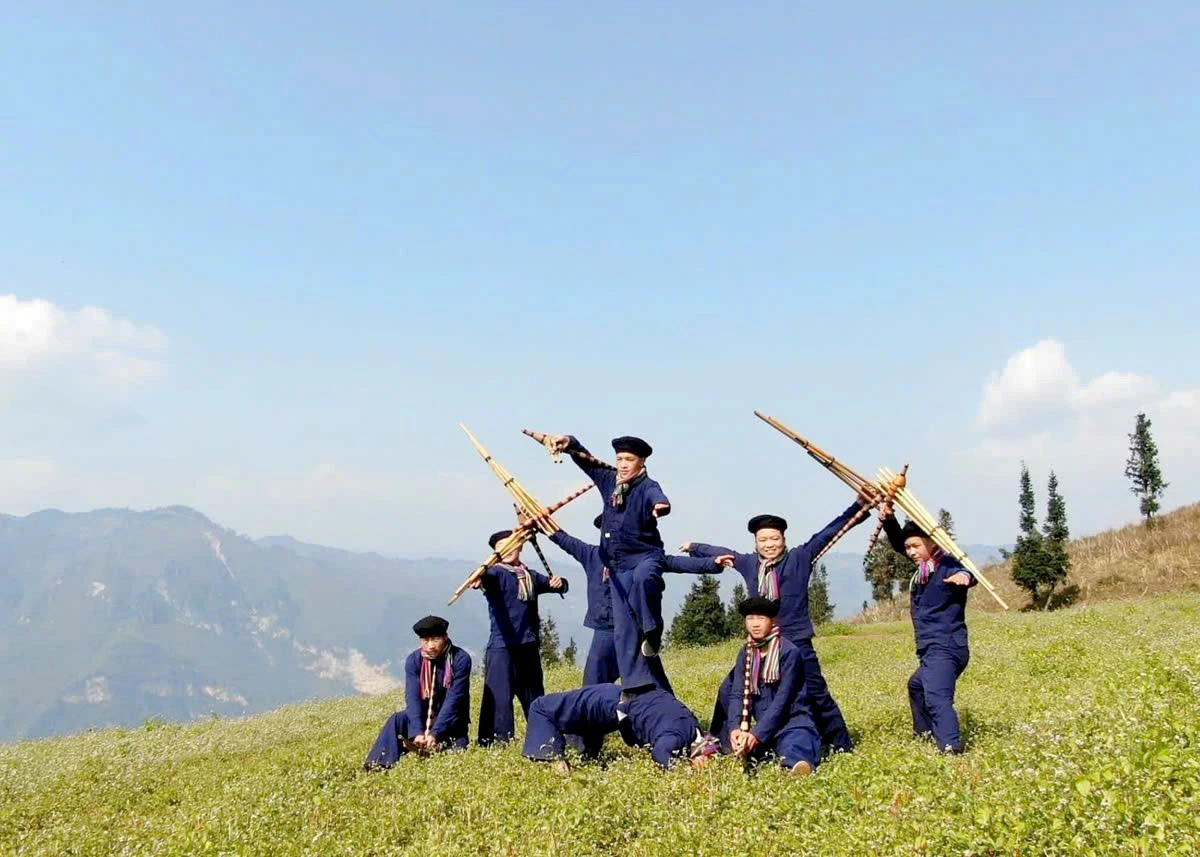
Mr. Vang Cha Thao, a native of Chung Pa A village, Pho Bang commune, is a living source of knowledge about Mong culture. From his childhood, the sound of the Hmong flute and the rituals have permeated his soul. At the age of 13, young Thao became a flute master, and by 18, he had mastered traditional rituals. His profound understanding of Hmong culture led him from the position of Deputy Secretary of the Party Committee of the commune to the Chairman of the Folk Artists Association of Dong Van district.
Currently, Mr. Thào is a member of the Provincial Cultural Values Advisory and Collection Team, and also the author of three valuable research papers on: the Naming Ceremony, the Housewarming Ceremony, and the Origin of the Hmong Flute at the Provincial Museum.
Distinguished artisan Vàng Chá Thào has always been passionate and concerned about preserving the Hmong flute culture. For decades, he has regularly visited schools or opened free classes at his home to teach Hmong flute dancing, customs, and beliefs to the younger generation.

|
Classes taught by the distinguished artisan Vàng Chá Thào. |
Every Friday afternoon, Mr. Thào's rustic earthen house is filled with the sounds of Hmong flutes, drums, two-stringed fiddles, and folk songs. This free class attracts nearly 30 Hmong children aged 7 to 15. Beyond simply teaching, Master Vàng Chá Thào harbors a far-reaching vision: to take the Hmong flute music further afield. He has established the Phố Cáo Hmong Flute Club with 15 members who are his students and have mastered the techniques.
Furthermore, with his prestige and expertise, Mr. Thào actively campaigned for the people to eliminate outdated customs. To date, in Phố Cáo, 7 out of 12 clans have used coffins for burials, 16 out of 18 villages have shortened funeral times, and most weddings are now held according to modern customs.
People's Artist Sin Van Phong is considered a "living treasure," the "soul" of the village. He is one of the rare individuals who can fully perform all the traditional rituals of the Pa Then people in My Bac village, Tan Trinh commune. The lesson begins early in the morning and ends when the houses are lit up with electric lights. Many children and young people from the village listen attentively to every word of the teacher who has been dedicated to the folk rituals of his ethnic group for nearly 40 years.

|
The class of People's Artisan Sìn Văn Phong. |
Mr. Phong explained that becoming a Pà Thẻn shaman is a difficult process. The Pà Thẻn people have hundreds of rituals; even those who are quick learners take five years to master them, while some may take a decade or more to learn enough to become a shaman. Therefore, finding a successor is a truly challenging journey.
Every year, Master Sin Van Phong opens free classes for about 10-12 students. Mr. Phong is delighted that after many years of dedicated training, 3-4 young students have received the initiation ceremony. Hung Van Tam shared: "After 8 years of training, I have received the initiation ceremony. Currently, I can perform many simple rituals, and as for the fire-jumping ritual, I am trying to practice under Master Phong's guidance, and I'm sure I will be able to do it."

|
|

|
|
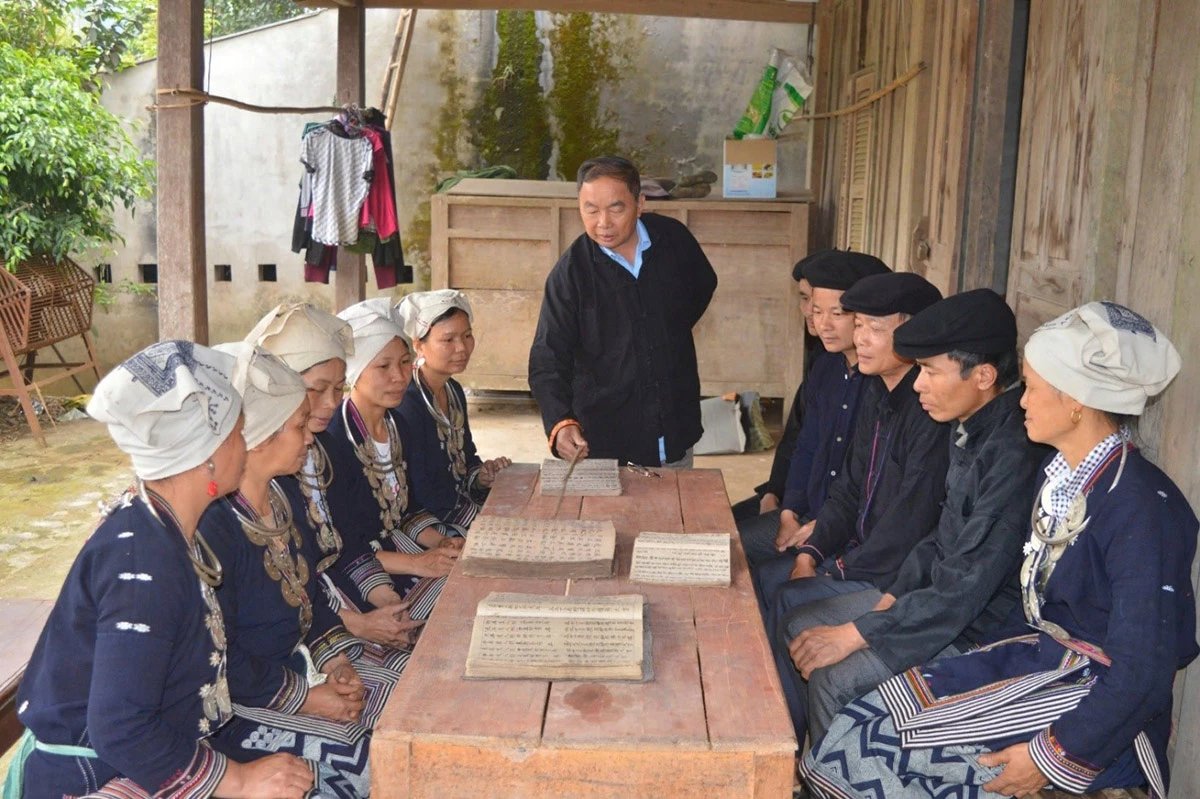
“Cha phin” is the first word Mr. Chu Tuan Ngan, from Ban Pinh village, Hung Loi commune, teaches his students. In the Dao language, “cha phin” means ancestors, origins. He explains that the Dao people must remember “cha phin” just as forest birds never forget to return to their nests after foraging, and forest leaves always fall back to their roots. Remembering ancestors and origins is essential for growth and maturity; even after death, the spirit will still be recognized by ancestors and will not get lost. Mr. Ngan teaches in a very easy-to-understand way, and it is precisely this clear explanation and analogy that makes many people enjoy learning.
|
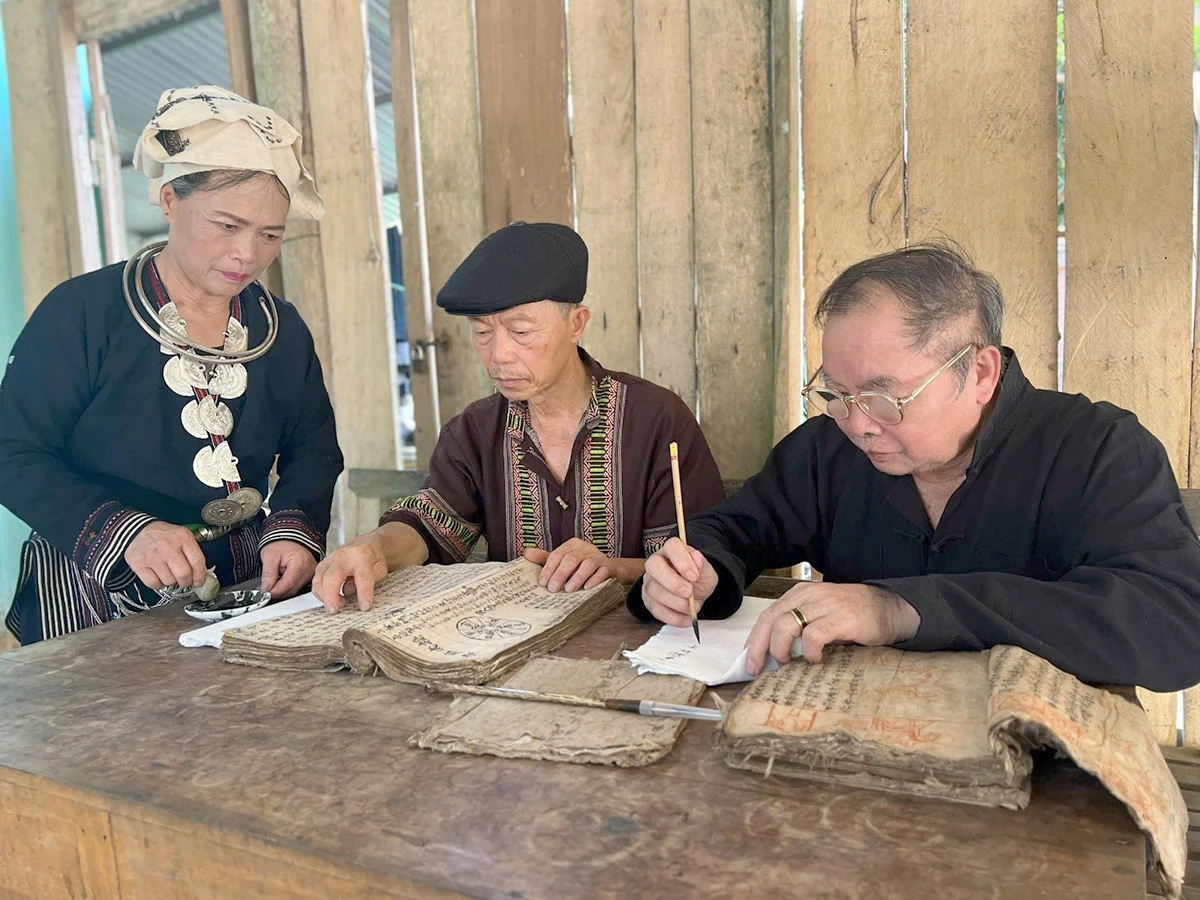
Mr. Chu Tuan Ngan (far right) with his students in the process of computerizing the Dao Nôm script. |
The story of Mr. Chu Tuan Ngan from Ban Pinh village, Hung Loi commune, who took the initiative to teach the Dao script, has earned him endless praise from the entire village: "He's truly a good person. Thanks to him, the children of Ban Pinh and even the Dao people in Thai Nguyen ... can all learn the script of their ancestors."
Mr. Ngan said that nowadays, young people only learn standard Vietnamese and are good at foreign languages, but they can't remember the characters of their ancestors. The vast collections of books passed down through generations lie dormant in wooden chests, and the worry about the disappearance of the Dao script fills him with anxiety. These concerns prompted him to submit an application to the commune's People's Committee to open a literacy class, which the commune approved.
Thus, Mr. Chu Tuan Ngan opened classes. Gradually, the classes attracted more and more people. Dao people from many communes such as Chiem Hoa, Kien Dai, Ham Yen… also “knocked on the door” to ask to enroll. What amazed and impressed the community was how artisan Chu Tuan Ngan, at nearly 80 years old, was so pioneering in applying information technology. The story of him and his dedicated student, Mr. Dang Van Xuan, diligently working on old computers to prepare lessons, spread and inspired many on social media.
|
The class of artisan Chu Tuan Ngan. |
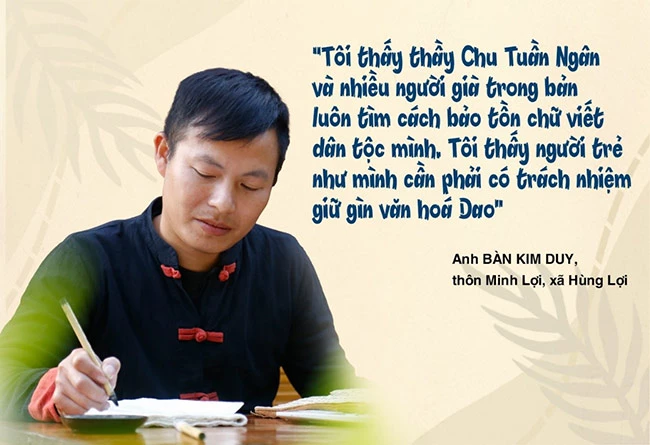
Mr. Chu Tuan Ngan's work has inspired many young people. Every day after work, Mr. Ban Kim Duy, from Minh Loi village, Hung Loi commune, diligently prepares documents, collects characters, compiles lists, "draws" characters, checks them, and then performs the technical operation of encoding Dao Nôm characters onto a computer. To date, he has computerized over 10,000 sets of Dao Nôm characters onto computers, covering over 100 ancient books including: narrative poems, worship books, religious texts, genealogies, and basic writing instruction texts… Not stopping there, Duy is the leader of a Facebook group called "Preserving Dao Culture and Writing" with 1,000 members. On the group, people often discuss the meaning of the characters, post videos teaching how to write, and the members enthusiastically participate.
|
|
In recent years, through social media, he has connected with many profound Dao scholars to translate ancient books such as: "Books on Family Genealogies," "Texts on the Migration Journey of the Dao People," "The Story of Ban Dai Hoi and Dang Thi Hanh," etc. According to Dr. Ban Tuan Nang, they have just completed translating four books and are currently awaiting review and publication approval from the Institute of Han Nom Studies.
The image of Nguyen Xuan Huu, a young man from Bac Quang commune, with his zither on his shoulder, traveling along roads from Tuyen Quang to Cao Bang, has become familiar to many. Thanks to him, many students, from elementary school children just learning the zither to elderly people nearly 90 years old, still enthusiastically sing the ancient Then melodies.
Not confined to the classroom, Xuan Huu is also a "pioneer" in bringing Then music to the online space. He skillfully utilizes digital platforms like YouTube and Facebook to record his lessons and emotionally charged performances. His YouTube channel, "Xuan Huu Dan Tinh," currently has nearly 50,000 subscribers and attracts tens of thousands of views from audiences both domestically and internationally.

|
Mr. Nguyen Xuan Huu from Bac Quang commune introduces Then singing to foreign tourists. |
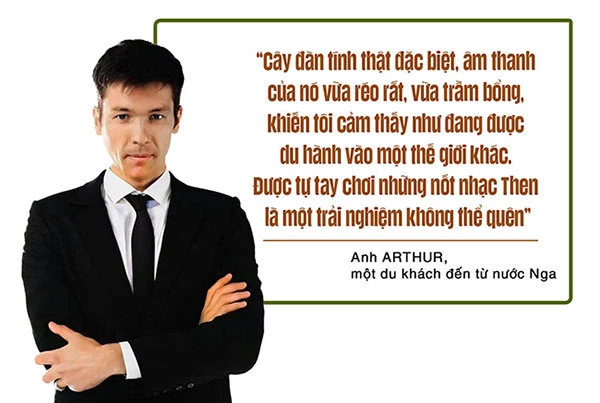
With a more forward-thinking vision, he boldly experimented with combining Then singing and the Tinh lute, seeing it as killing two birds with one stone: introducing the essence of Then to international friends while simultaneously creating additional livelihoods for his people. And indeed, the results exceeded expectations, especially from foreign visitors.
Xuan Huu recounted with a sparkle of joy in his eyes: "Some tourists are so captivated that they learn Then until midnight. They are very passionate, learning each verse, each note. Even if they don't fully understand the profound meaning of the Then lyrics, they feel the soul and emotion within them." Even after returning home, many tourists continue to share their impressions of the Then instrument with their friends, and even more remarkably, they recommend their friends to directly visit Xuan Huu to chat, listen, and learn Then.
|
|

|
|
The Hmong community both domestically and internationally knows Ly Phuoc Tinh, from Minh Tien village, Binh Xa commune, for his handsome appearance, lyrical singing voice, and exceptional acting skills showcased in his meticulously produced Hmong-language music videos on digital platforms. Many of his videos have garnered massive views and enthusiastic online comments, earning him the title of "the village's idol" for connecting Hmong culture to the wider world.

|
|
Using a smartphone, since 2020, Phuoc Tinh has taught himself to shoot, edit, and create videos that attract many viewers. He has a large fan base, owning a TikTok account with over 683,000 followers, a Facebook account with 112,000 followers, and a YouTube channel with over 62,000 subscribers. He has self-funded many music videos in the Hmong language. The videos are professionally scripted, staged, and choreographed, making viewers feel as if they are transported to the vast mountain and forest landscapes of Tuyen Quang, Son La, and Lai Chau.
Phuoc Tinh connects with many young Hmong people across the country to sing songs in the Hmong language. The lyrics are subtle, combining folk music with modern music. Loved and supported by many, he shared: “For me, fame must benefit the community, must create value from the videos I create. As a young Hmong person, I must find ways to contribute to promoting my ethnic culture, conquer the digital platform, and think bigger with my passion.”

|
Behind the scenes of Ly Phuoc Tinh's music video. |
Looking at Tuyen Quang today, one can clearly feel a continuous flow of culture. Traditional values, cherished and passed down by previous generations, are respectfully received and preserved by subsequent generations. All of this is thanks to the hands, minds, and hearts of countless artisans – the silent guardians of heritage. Thanks to them, ancient cultural features are no longer just memories, but have become a vital part of life, harmonizing with the rhythm of contemporary life, creating a Tuyen Quang rich in unique character!
Performed by: Hoang Bach - Hoang Anh - Giang Lam - Bien Luan
Thu Phuong - Bich Ngoc
Part 1: Unveiling the treasures of the ethnic groups of Tuyen Quang
Part 3: The Silence After the Brilliant Harmony
Source: https://baotuyenquang.com.vn/van-hoa/202508/ky-2-truyen-lua-di-san-8600fc2/








![[Photo] Solemn bathing ceremony and Buddha procession in Hue](https://vphoto.vietnam.vn/thumb/1200x675/vietnam/resource/IMAGE/2026/05/31/1780228263543_1-jpg.webp)
![[Image] Hanoi Police officially crowned champions of V-League 2025/2026](https://vphoto.vietnam.vn/thumb/1200x675/vietnam/resource/IMAGE/2026/05/31/1780244769054_ndo_br_039d561b692be875b13a-jpg.webp)
![[Photo] The General Secretary, President and his wife begin their state visit to the Philippines.](https://vphoto.vietnam.vn/thumb/1200x675/vietnam/resource/IMAGE/2026/05/31/1780230559452_anh-man-hinh-2026-05-31-luc-19-28-11.png)
![[Photo] Admire the coral "masterpiece" amidst the million-year-old heritage of Dak Lak province.](https://vphoto.vietnam.vn/thumb/1200x675/vietnam/resource/IMAGE/2026/05/31/1780221235105_anh-man-hinh-2026-05-31-luc-16-53-27.png)















![[Video] Sunset at Lap An Lagoon – Where the sun sets over the fishing nets](https://vphoto.vietnam.vn/thumb/340x192/vietnam/resource/IMAGE/2026/05/31/1780192137701_beach-landscape-sea-water-nature-grass-745871-pxhere-com.jpeg)






















































Comment (0)