

From North to South, many buildings still preserve valuable stained glass windows to this day, such as: Hanoi Cathedral, Cua Bac Church, Ham Long Church, Notre Dame Cathedral in Ho Chi Minh City, Huyen Si Church... Many sets of windows remain almost intact, depicting religious stories using traditional European stained glass techniques. These windows reveal the high level of craftsmanship and artistic inspiration of a historical period where architecture and religious art were closely intertwined.
 |
| The stained glass painting "School of Athens" was adapted by artist Ho Vuong and his collaborators from a world- renowned artwork. Photo provided by the subject. |
Over time and through war, many stained glass artworks have cracked, broken, or lost detail. In many churches, to ensure safety and maintain operation, restoration teams have been forced to replace them with temporary panes of glass, accepting the aesthetic discrepancies. In the initial stages, the almost only option was to seek out major European glass manufacturers, those who had previously produced stained glass for cathedrals in Vietnam, and commission them to recreate the originals, hoping to restore the original appearance as much as possible.
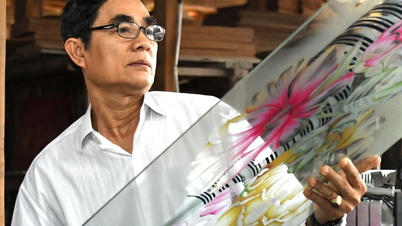
In recent years, thanks to the dedication of domestic artisans and artists, restoration work is no longer entirely dependent on external resources. Among them, artist Ho Vuong is a prime example. Starting with interior decorative glass, he gradually became captivated by the spiritual depth of stained glass and decided to pursue a specialized career in this field. Artist Ho Vuong has traveled to many European countries and the United States to learn directly from master artisans, studying styles ranging from Gothic and Roman to Art Nouveau, aiming to master the techniques of color coordination, glass cutting, and light manipulation—core elements that create the soul of each artwork.
If creating a stained glass painting is the process of constructing a new visual world, then restoration is a journey to rediscover the visual memory of the work, where the craftsman needs to understand the spirit of the original before proceeding. In this process, Vietnamese stained glass artists have participated in many large-scale projects. Artist Ho Vuong has also left his mark through works at the Fatima Church in Binh Trieu, the stained glass series at Huyen Si Church, and two large-scale stained glass paintings at Phu Cuong Cathedral...
At Huyen Si Church, one of the oldest churches in Ho Chi Minh City, many stained glass panels are damaged, leaving no trace of the artist or manufacturer. To accurately recreate the artwork, artist Ho Vuong sent samples to a laboratory in the United States for color analysis, and also compared them with contemporary stained glass paintings in Europe to restore the lost details.
Alongside efforts to preserve heritage, there is an expansion into contemporary creativity. Vietnamese artisans and artists are not stopping at recreating the past but are experimenting with new limits of stained glass. The work "The School of Athens" can be considered a prime example, adapted from Raphael's famous fresco and currently housed at the Stained Glass Art Museum (Suoi Hai commune, Hanoi), founded by diplomat Nguyen Xuan Thang.
The project spanned five years, employing a layered enamel technique with multiple firings at temperatures ranging from 600 to 800 degrees Celsius. Each layer of color applied to the glass required precise calculations to recreate nearly 50 faces with varying expressions—a long-standing challenge in traditional stained glass art. The result is not only a large-scale work but also marks a significant technical advancement, demonstrating the Vietnamese people's efforts in approaching and transforming world heritage through stained glass.
It is clear that the restoration of stained glass is not simply about recreating form, but also opens up opportunities to transform heritage into material for contemporary creation. Each restored pane of glass not only enhances the aesthetic value of the structures but also revives memories that seemed to have been erased by time. Through these efforts, restoration and preservation activities become more relevant to contemporary life, proving that they can give wings to art and allow it to continue to flourish.
Source: https://www.qdnd.vn/van-hoa/doi-song/ky-cong-phuc-che-tranh-kinh-mau-1033127














































































Comment (0)