

Recently, doctors from the Adult Cardiology Department, Cardiovascular Center, E Hospital, successfully performed transcatheter aortic valve replacement (TAVI) on two patients, aged 91 and 74, both suffering from severe aortic stenosis and severe heart failure.
TAVI technique saves the lives of two elderly patients.
The 91-year-old woman has a history of two myocardial infarctions, stage 2B renal failure, and has been monitored for aortic valve stenosis for 8 years. In recent years, she has been repeatedly hospitalized due to shortness of breath and critical acute pulmonary edema.
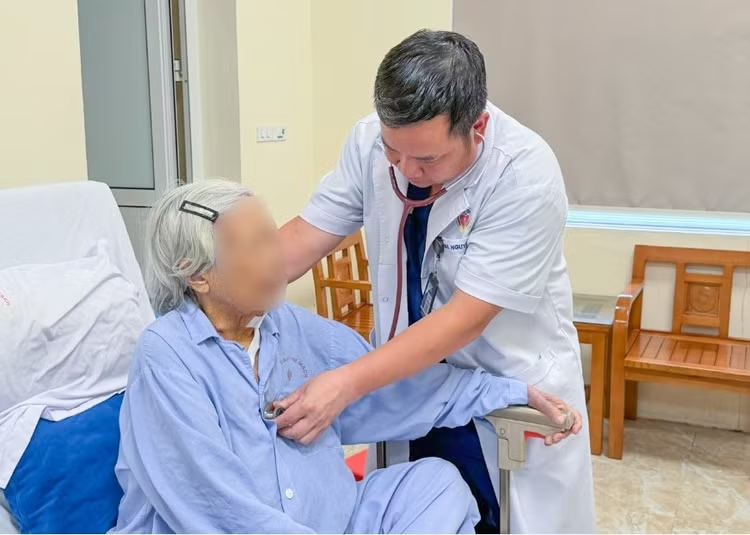
According to Dr. Phan Thao Nguyen, Deputy Director of E Hospital and Head of the Adult Cardiology Department at the Cardiovascular Center, the elderly woman was recently admitted to the hospital in a state of severe heart failure, completely dependent on oxygen, unable to walk, and requiring cardiac support medication and forced diuretics. Her kidney function was impaired, resulting in a urine output of only slightly more than 1 liter per day.
The 512-slice CT scan revealed severe calcification throughout the patient's entire aortic system. Both iliac-femoral arteries were narrowed to approximately 4.7 mm at their narrowest point, perfectly fitting the size of the interventional device.
"The challenge now is to replace the aortic valve. However, for a 91-year-old woman with multiple organ failure, performing open surgery using the traditional method would result in an extremely poor postoperative recovery prognosis," Dr. Nguyen shared.
The doctors decided to perform aortic valve dilation first. After two successful dilation procedures, the patient was weaned off oxygen and their respiratory function improved. On the fifth day, the interventional team proceeded with transcatheter aortic valve replacement via the femoral approach.
After more than 1.5 hours of intervention, the new heart valve was correctly positioned, with no leakage at the valve base. Just 4 hours after the procedure, the elderly woman had her endotracheal tube removed and was able to eat, drink, and walk.
The second case involves a 74-year-old man who underwent double biological valve replacement surgery at the Cardiovascular Center 11 years ago. Recently, the patient experienced shortness of breath and chest pain. Examination results showed a 60-70% stenosis of the anterior interventricular artery, and the old biological valves had degenerated over time.
According to Dr. Phan Thao Nguyen, the biggest challenge is the structure of the old biological valve. Fortunately, the type of valve implanted previously belonged to a class that could be dilated and the valve ring broken down to perform the "valve within a valve" technique.
Doctors accurately measured the parameters and proceeded to implant a new TAVI valve inside the old, degenerated biological valve. The procedure lasted over an hour and went smoothly. The patient's health is now stable, and they can resume normal activities.
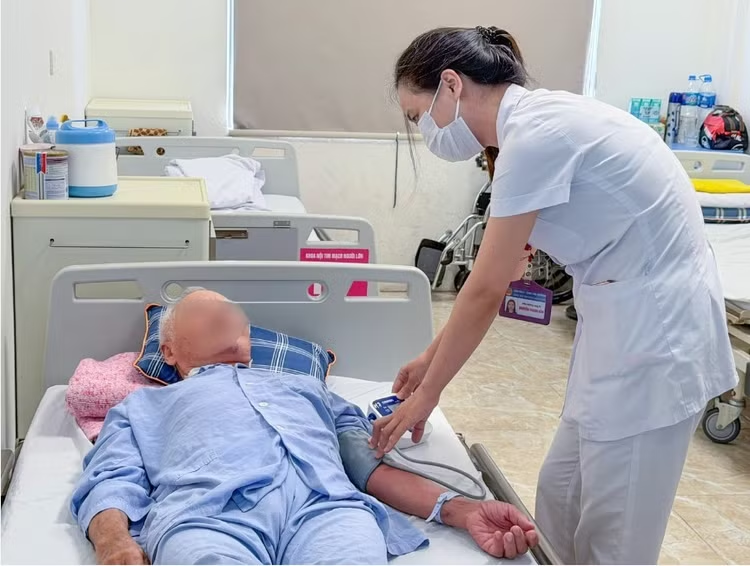
Opening up opportunities for elderly patients to live better lives.
According to Dr. Phan Thao Nguyen, TAVI is considered a major breakthrough in modern cardiovascular intervention, especially suitable for the elderly or those who are not eligible for open surgery.
Unlike open surgery, which requires cutting through the sternum, stopping the heart, and using extracorporeal circulation, TAVI only requires inserting an artificial heart valve through a catheter from the femoral artery, which is approximately 5-6 mm in size.
According to cardiologists, patients can sit up and walk around within 12-24 hours after the intervention. The hospital stay is usually about 5 days.
Currently, only about 8 major cardiovascular centers in Vietnam routinely implement this technique. The "valve-within-valve" technique, which is particularly complex, has only been performed in just over 30 cases nationwide, with the Cardiovascular Center at E Hospital having performed 8 of them.
According to Dr. Phan Thao Nguyen, the prevalence of aortic valve disease currently accounts for about 5-6% of the population. The disease often progresses silently for many years, but once symptoms such as fainting, shortness of breath, arrhythmias, or chest pain appear, the risk of death within 1-2 years without intervention can reach 80-90%.
According to doctors, in the context of an increasingly evident aging population, the need for access to minimally invasive cardiovascular intervention techniques such as TAVI will continue to grow.
However, the cost of treatment remains high, a barrier for many patients. Experts expect that health insurance will gradually expand coverage to increase people's access to modern medical technology.
Warning signs of aortic valve stenosis should not be ignored.
Cardiologists warn that aortic valve stenosis often progresses silently over many years. Many people only discover the condition when heart failure or dangerous complications have already occurred.
People, especially the elderly, should seek cardiovascular check-ups early if they experience the following symptoms:
- Shortness of breath when exerting oneself, climbing stairs, or walking short distances.
- Chest pain, a feeling of heaviness in the chest.
- Dizziness, fainting.
- Rapid heartbeat, palpitations, irregular heartbeat.
- Prolonged fatigue, reduced mobility.
- Swollen legs, difficulty breathing when lying down.
According to doctors, echocardiography is an important method for early detection of aortic valve stenosis and assessment of valve damage. Elderly individuals, those with a history of cardiovascular disease, hypertension, kidney failure, or who have undergone biological valve replacement should have regular cardiovascular checkups for monitoring and timely intervention, avoiding the risk of heart failure and sudden death.
>>> We invite our readers to watch the video: People will soon receive free periodic health check-ups worth approximately 350,000 VND per visit:
Source: https://khoahocdoisong.vn/ky-thuat-tavi-cuu-cu-ba-91-tuoi-suy-tim-nang-post2149100676.html
![[Image] Close-up view of the interchange connecting the two expressways and Long Thanh Airport.](https://vphoto.vietnam.vn/thumb/1200x675/vietnam/resource/IMAGE/2026/05/25/1779703378210_ndo_br_z7863716673926-224453a31600126cce10622af6290afd-4549-jpg.webp)
![[Image] Hanoi's urban life under the challenge of a "scorching hot" environment](https://vphoto.vietnam.vn/thumb/1200x675/vietnam/resource/IMAGE/2026/05/25/1779706979265_nang-nong-t5-2026-minh-duy-7-4636-jpg.webp)


















![[GALLERY] How it works reveals why operating Patriot is extremely expensive.](https://vphoto.vietnam.vn/thumb/402x226/vietnam/resource/IMAGE/2026/05/25/1779713284469_61-patriot-missile-system-how-it-works-air-defence-missiles-5.gif)
![[GALLERY] Shocking: Vietnamese youth spend 7 hours online every day](https://vphoto.vietnam.vn/thumb/402x226/vietnam/resource/IMAGE/2026/05/25/1779712983331_dien-1-png.webp)































































Comment (0)