

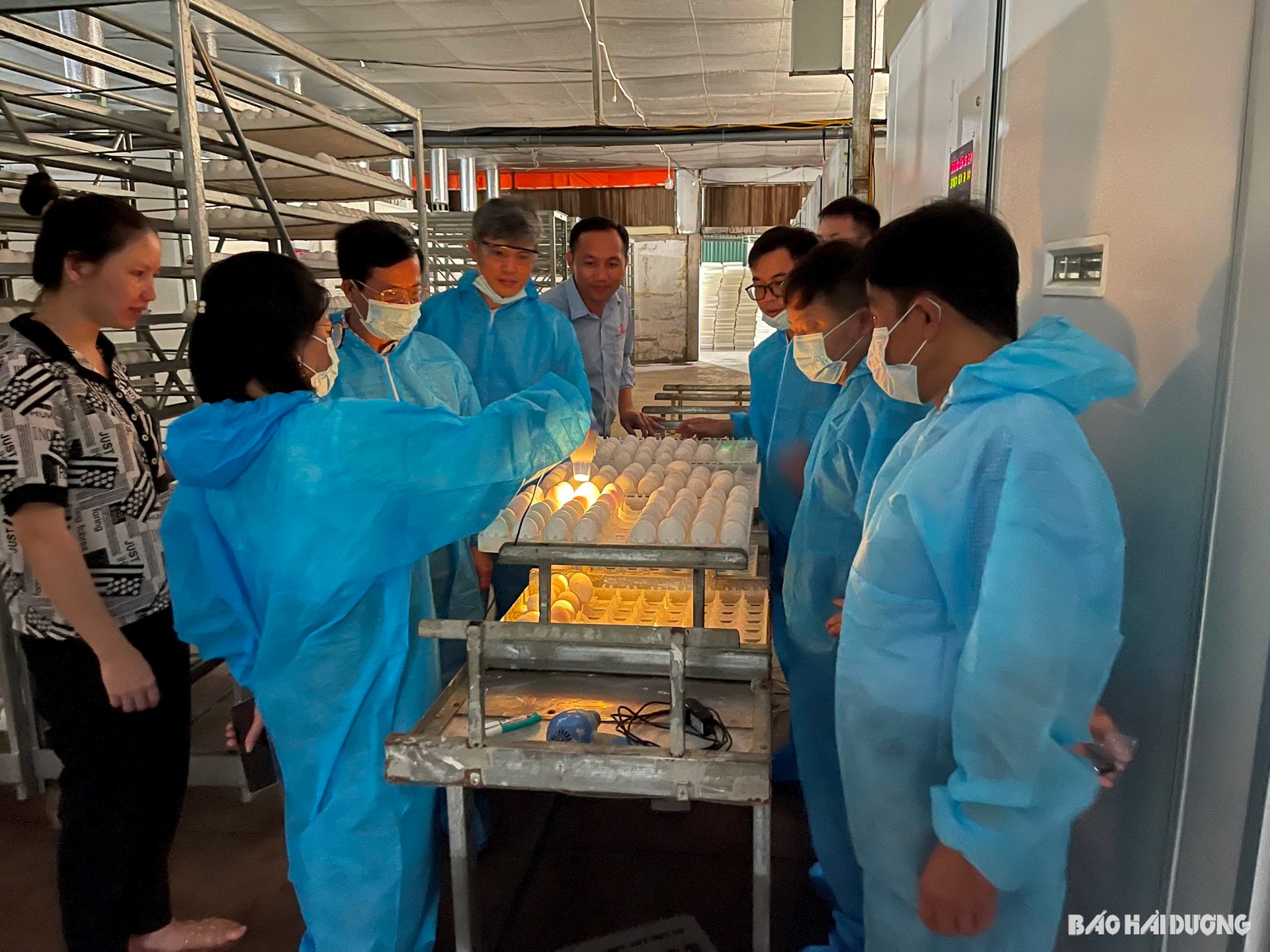
Following Typhoon No. 3 and subsequent flooding, significant damage was caused to agricultural production and livestock farming, including poultry farming, in many localities in Northern Vietnam, as well as in Hai Duong province . Immediately after recovering from the storm, poultry farms began planning for restocking to maintain farming operations and ensure food supply for consumers. In poultry farming, the brooding stage is crucial for a healthy flock of chicks that grow and develop well, minimizing disease outbreaks. To successfully manage the brooding stage, farmers should pay attention to the following techniques:
Shelters and equipment
Preparing brooding houses and cages is essential in raising chickens of all scales. When brooding poultry, the temperature must be warm in winter and cool in summer, and it is absolutely necessary to avoid rain and drafts.
Farmers should use bedding materials such as rice husks, sawdust, or straw. Rice husks are preferred because they have good moisture absorption and are inexpensive. A layer of bedding material 9-13 cm thick is suitable.
The stocking density in the brooding area will be gradually reduced according to the age of the chicks. Specifically, the appropriate stocking densities are as follows: week 1: 30 - 40 chicks/ m² ; week 2: 20 - 30 chicks/ m² ; week 3: 15 - 25 chicks/ m² ; week 4: 12 - 20 chicks/ m² .
For young chicks, feeders and waterers can be trays or baskets measuring 50 x 50 cm, with a density of 50 chicks per tray, gradually replacing the feeders as the chicks grow; during the brooding period, provide water using 1-liter plastic troughs.
barn temperature
There are several methods of using heat during the brooding process, including:
Using light bulbs : Farmers should use infrared light bulbs with a wattage appropriate to the number of chicks being brooded.
Using charcoal stoves : This method is commonly used in large-scale poultry farms due to its affordability. However, this method requires farmers to be very careful to avoid suffocating poultry with charcoal fumes.
Select breed
Choosing the right breed greatly influences the efficiency of poultry farming, including breeds for meat and egg production. Farmers should select healthy chickens with bright eyes, fluffy feathers, agile movements, and uniform size…
Brooding technique
Temperature: Depending on the season and weather, adjust the brooding temperature accordingly. Monitor the flock's condition to determine the temperature level. If the chicks huddle together near a light bulb or charcoal stove, they are not getting enough heat, and you need to increase the temperature. If they spread out and drink a lot of water, they are overheating. In case of rain or drafts, the flock will gather in sheltered areas. Monitoring the brooding temperature is essential, so place a thermometer inside the coop. Specific temperatures for each brooding stage are: 31-32 ° C for chicks 0-7 days old; 28-30 ° C for chicks 8-21 days old; and 22-28 days old, 22-28 ° C.
Lighting during the brooding period is very important for chicks because it helps them eat more and stimulates their growth.
Newly imported chicks should be given water mixed with glucose, vitamin C, and electrolytes. This should be given to the chicks within the first 2-3 hours to reduce stress and boost their immune system.
Chick feed needs to be high-quality, nutritious, but easily digestible. Feed them several times a day, in small amounts each time, to ensure the feed is always fresh.
During the brooding period, farmers must always keep the pens clean, dry, well-ventilated, and warm in winter. Bedding should be replaced immediately if it becomes damp, feed and water troughs should be cleaned regularly, and the pens should be disinfected periodically.
Vaccination schedule
Marek's disease vaccine for 1-day-old chickens;
First dose of Lasota vaccine for chickens 3-5 days old;
Chickenpox vaccine is given to chickens at 7 days old;
The first Gumboro vaccine dose is given to chickens at 10 days old, and the second Lasota vaccine dose is given at 21-24 days old.
Regularly monitor weather and disease information for poultry flocks to develop appropriate farming plans and minimize losses caused by natural disasters and diseases.
NGUYEN MINH DUC, Provincial Department of Livestock and Veterinary MedicineSource: https://baohaiduong.vn/ky-thuat-um-ga-con-393839.html


![[Photo] General Secretary To Lam receives President of the European Council Antonio Costa](/_next/image?url=https%3A%2F%2Fvphoto.vietnam.vn%2Fthumb%2F1200x675%2Fvietnam%2Fresource%2FIMAGE%2F2026%2F01%2F29%2F1769697816651_a1-bnd-5216-9741-jpg.webp&w=3840&q=75)


![OCOP during Tet season: [Part 3] Ultra-thin rice paper takes off.](/_next/image?url=https%3A%2F%2Fvphoto.vietnam.vn%2Fthumb%2F402x226%2Fvietnam%2Fresource%2FIMAGE%2F2026%2F01%2F28%2F1769562783429_004-194121_651-081010.jpeg&w=3840&q=75)


![OCOP during Tet season: [Part 2] Hoa Thanh incense village glows red.](/_next/image?url=https%3A%2F%2Fvphoto.vietnam.vn%2Fthumb%2F402x226%2Fvietnam%2Fresource%2FIMAGE%2F2026%2F01%2F27%2F1769480573807_505139049_683408031333867_2820052735775418136_n-180643_808-092229.jpeg&w=3840&q=75)
![OCOP during Tet season: [Part 1] Ba Den custard apples in their 'golden season'](/_next/image?url=https%3A%2F%2Fvphoto.vietnam.vn%2Fthumb%2F402x226%2Fvietnam%2Fresource%2FIMAGE%2F2026%2F01%2F26%2F1769417540049_03-174213_554-154843.jpeg&w=3840&q=75)





Comment (0)