

A swift, bold, unexpected, and decisive attack.
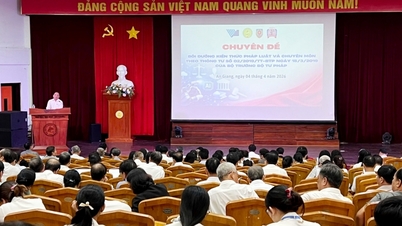
Colonel Tu De, Hero of the People's Armed Forces, former Deputy Director of the Military Training Department, General Staff, Ministry of National Defense , and many veterans who participated in the Ho Chi Minh Campaign in 1975 recently held a gathering with veterans, officers, soldiers, and youth union members of Can Tho City to commemorate the 50th anniversary of the Liberation of the South and the reunification of the country. Colonel Tu De was a pilot of the Quyet Thang Squadron - one of the pilots who directly bombed Tan Son Nhat airport on April 28, 1975.
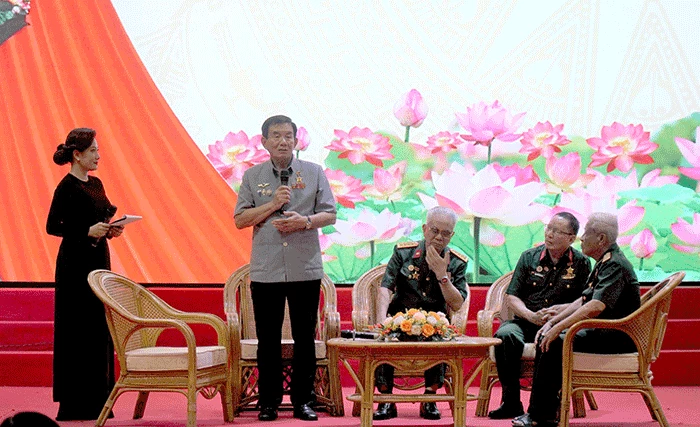
Hero of the People's Armed Forces, Colonel Tu De, recounts his experiences flying A-37 aircraft with his comrades to bomb Tan Son Nhat airport on April 28, 1975.
At that time, Colonel Tu De was working in Company 4, Regiment 923, 371st Air Force Division. “After our troops liberated Hue and Da Nang, the General Staff and the Air Defense and Air Force Command developed a new tactic: using captured enemy aircraft to attack the enemy. I was one of the pilots selected to carry out the bombing mission at Tan Son Nhat airport. We faced many difficulties because we had previously been trained to fly Soviet-made fighter planes. But with the spirit of ‘Speed, boldness, surprise, and decisive victory,’ we learned how to switch aircraft in a few days instead of taking at least three months,” Colonel Tu De recalled.
After liberating Da Nang, our forces captured many American-made A-37 attack aircraft. However, all the aircraft were damaged. The Air Defense and Air Force Command sent skilled technicians to Da Nang airport and simultaneously called upon technicians from the Republic of Vietnam Air Force to come forward and assist with repairs. After a short time, five A-37s were ready for combat.
According to Colonel Tu De, before the squadron attacked Tan Son Nhat airport, he and his comrades had three main concerns: aircraft malfunctions mid-flight, bad weather, and being "fired by our own troops" because it was a secret mission. The Quyet Thang squadron flew to Bien Hoa in rather bad weather, but the weather cleared up upon reaching Tan Son Nhat airport. The squadron quickly dropped bombs, destroying 24 enemy aircraft, fuel depots, weapons depots, etc., before flying back to Phan Rang. The Quyet Thang squadron's attack on Tan Son Nhat airport is likened to the "Sixth Army" in the historic Ho Chi Minh Campaign, dealing a fatal blow and paralyzing the enemy's will to resist before our troops advanced to liberate Saigon.
Captain Vu Dang Toan, former Political Commissar of Company 4, Battalion 1, 203rd Tank Brigade, 2nd Corps, was the commander of tank number 390. Tank 390 and tank 843 were the first two tanks to enter the Independence Palace on the morning of April 30, 1975. According to Captain Vu Dang Toan, on April 30, the enemy still fiercely resisted as our troops advanced into Saigon. At the Saigon Bridge, the enemy deployed many weapons and forces to confront the revolutionary army. After crossing the Saigon Bridge, the deep penetration assault force of the 203rd Tank Brigade split into two columns advancing towards the presidential palace of the Saigon puppet regime. The street battle continued until our two tanks arrived in front of the Independence Palace...
In front of the Independence Palace, tank number 843 stopped at the side gate due to engine failure. Sergeant Nguyen Van Tap, the driver of tank number 390, asked Captain Vu Dang Toan: "What should we do now?" Captain Toan ordered the tank to ram straight into the main gate. Afterward, Captain Toan dismounted and assisted Captain Bui Quang Than of tank 843 in entering the Independence Palace to plant the flag of the National Liberation Front of South Vietnam. Captain Toan shared: "We were ordered that whoever arrived first would plant the flag. When we entered, President Duong Van Minh and the Saigon puppet regime's cabinet were waiting to surrender to the revolutionary army."
Mr. Nguyen Khac Nhu, former Operations Assistant, 66th Regiment, 2nd Corps, was one of those present in Jeep number 15770 – the vehicle that followed two tanks into the Independence Palace on April 30, 1975. In a photograph taken by a foreign journalist showing President Duong Van Minh being escorted by liberation forces to Saigon Radio Station, Mr. Nguyen Khac Nhu is the one carrying a pistol in the back. “Mr. Minh demanded to travel in an armored vehicle because the situation in Saigon was chaotic, but Mr. Pham Xuan The, Deputy Commander of the 66th Regiment, said: ‘We already have a vehicle.’ Afterwards, we took Mr. Minh to Saigon Radio Station to read the unconditional surrender statement. After Mr. Duong Van Minh finished reading, he was taken back to the vehicle to return to the Independence Palace,” Mr. Nguyen Khac Nhu recounted.
Heroic Tay Do
At 11:30 AM on April 30, 1975, President Dương Văn Minh read the unconditional surrender declaration over the radio. In many places, the puppet army and government laid down their arms and surrendered. In Cần Thơ, at that time, the fighting of the officers and soldiers of the Tây Đô 3 Battalion had just ceased.
Hero of the People's Armed Forces, Colonel Pham Hong Thay (Bay Thay), former Battalion Commander of the 3rd Tay Do Battalion, recounted: From the evening of April 29th, the enemy crossed the Can Tho River and took up positions in the liberated zone. At around 5:30 AM, the 3rd Tay Do Battalion was ordered to attack the enemy until noon, forcing them to retreat to the Ring Road. Through intercepted enemy radio waves, Mr. Bay Thay requested the enemy to lay down their weapons and take off their uniforms so that the 3rd Tay Do Battalion could receive them. At around 11:30 AM, all enemy troops stationed on the Ring Road surrendered. The 3rd Tay Do Battalion prepared to advance into the inner city of Can Tho.
Witnessing the officers and soldiers of the Tay Do 3 Battalion escorting prisoners along the Ring Road, Mr. Bay Thay felt a surge of pride and emotion on liberation day, because just about a month earlier, fierce battles were still raging between the enemy and units of Military Region 9 and the Tay Do 3 Battalion… According to Mr. Bay Thay, after many defeats in the Central Highlands Campaign and the Hue-Da Nang Campaign, the enemy retreated and established a dense defensive line along the Ring Road. They launched many attacks on the liberated areas to prevent the revolutionary forces from advancing along the Ring Road and prolong their collapse. The Tay Do 3 Battalion and other units of Military Region 9 bravely held their ground, repelling many enemy attacks in April 1975.
On the evening of April 30th, the 3rd Tay Do Battalion advanced into the inner city of Can Tho, setting up camp in the area around Nhi Kieu Bridge. This place holds many memories for Mr. Bay Thay from 1968. During the Tet Offensive, Mr. Bay Thay was seriously wounded while attacking the Phong Dinh Governor's Residence with the officers and soldiers of the Tay Do Battalion. Mr. Bay Thay retreated and hid under a row of stilt houses by Xang Thoi Lake. At night, he went ashore to find a way out but encountered the enemy and had to return. For three consecutive nights, Mr. Bay Thay did not eat or drink. The wounds on his hands and feet turned a deep blue. "I will never forget the night I left my shelter, trying to find my way back to my unit with my body covered in wounds, not thinking I would survive. On the day of liberation, I returned to my comrades, stationed near where I was so close to death, in the joy of victory, with the country at peace and unified," Mr. Bay Thay shared.
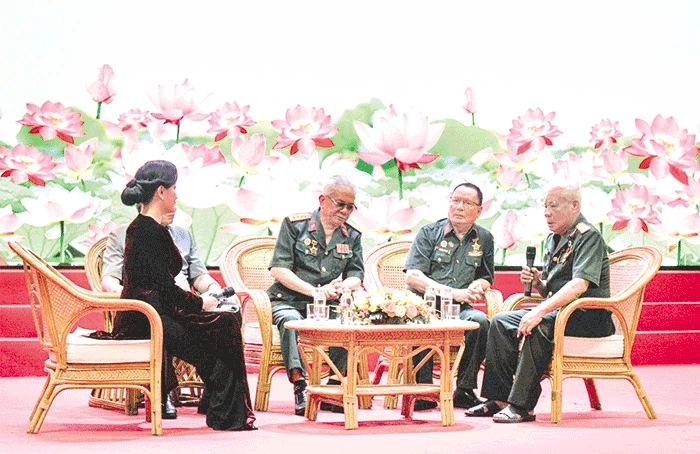
Hero of the People's Armed Forces, Major General Le Thanh Son (far right) shares his memories of participating in the liberation of Can Tho on April 30, 1975.
During a meeting with veterans who entered the Independence Palace on April 30, 1975, was Hero of the People's Armed Forces, Major General Le Thanh Son (Ba Ngay), former Commander of the Can Tho Provincial Military Command. Major General Le Thanh Son was deeply moved when he heard the veterans' heroic accounts of the moment they confronted President Duong Van Minh and the Saigon puppet regime's cabinet. In Can Tho, on the evening of April 30, 1975, Comrade Tran Minh Son (Bay Manh), Deputy Secretary of the Can Tho Provincial Party Committee; Mr. Ba Ngay, Commander of the Can Tho Provincial Military Command, along with comrades from the front lines, also entered the Phong Dinh Governor's Palace.
Earlier, the Can Tho armed forces, along with the main forces of Military Region 9, advanced to capture the headquarters of the 4th Tactical Zone and the puppet regime, as well as other key enemy positions. “At the provincial governor's residence, Brigadier General Mach Van Truong, commander of the enemy's 21st Division, asked, ‘Where did you come from so early?’ I replied, ‘Wherever there are civilians, there are liberation forces…’” - Mr. Ba Ngay recounted.
Fifty years later, Mr. Ba Ngay still remembers many memories of the day when the troops of the Tay Do Battalion, the Can Tho Special Forces, the local militia, and the main units of Military Region 9... advanced to liberate Can Tho. The revolutionary army coordinated seamlessly with internal networks to force the enemy to surrender, take over key locations, and maintain security and order in the early days of liberation.
Amidst the happiness and joy of liberation day, there was also sorrow for the comrades who sacrificed their lives before the country's reunification. Mr. Ba Ngay expressed his hope: "The sacrifices and contributions of previous generations to today's peace are immense. I hope that the current generations will always preserve and promote the heroic traditions of our homeland, the Vietnam People's Army, and the city's armed forces; strive to improve their skills and training, and actively participate in building our homeland and country... Especially, each individual should always study and follow the thoughts, morals, and style of President Ho Chi Minh."
Text and photos: PHAM TRUNG
Source: https://baocantho.com.vn/ky-uc-hao-hung-ve-ngay-toan-thang-a185930.html






















































Comment (0)