

Ms. Hoa's village has a tradition of growing winter crops. Thanks to these crops, many families in the village have enough to eat and save. She herself, thanks to her parents' cabbage and kohlrabi crops, earned enough money for her education and eventually became an agricultural engineer.
It was the weekend, and there was a family memorial service, so Ms. Hoa took advantage of the opportunity to come home the day before to help her mother and take her children to play in the fields. Seeing the vast vegetable fields, her daughter excitedly ran down to the field. After a while, Ms. Hoa saw her daughter sit down on the grassy bank, observing, then stand up and ask her mother:
- Mom, why are the vegetables so healthy but the grass is all wilted? I smell something really strong.
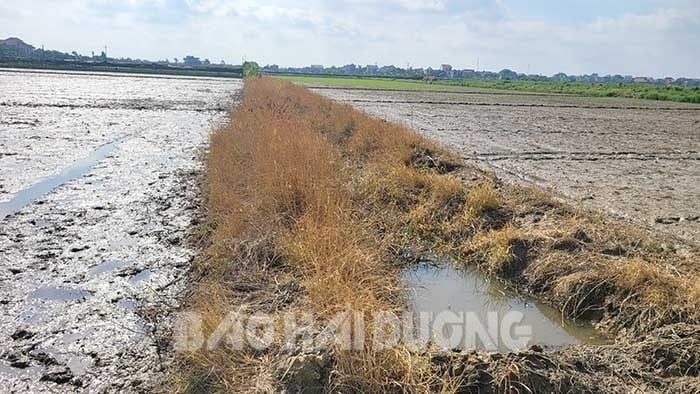
Hearing her child's words, Mrs. Hoa finally noticed. Indeed, the grass on the embankment was completely burnt. Looking closely, she realized it wasn't burnt by the dry weather, but rather seemed to have been sprayed with chemicals. After walking a short distance, Mrs. Hoa met her neighbor, Mrs. Hong, who was spraying something on the grass next to the cabbage field. She approached to greet her, and Mrs. Hong enthusiastically asked:
"When did you get back, Ms. Hoa? Why are you out in the fields like this? We farmers work so hard. We have a few acres of cabbage, and no matter how much fertilizer we use, they're growing so slowly. I don't know if they'll be ready for Tet (Lunar New Year). And these weeds... we've sprayed them several times, and we thought they were dead, but after just a few rains, they're all thriving again."
Hearing Mrs. Hong mention spraying herbicide, Ms. Hoa was startled. It turned out that the burnt, dry grass her daughter had mentioned smelled pungent was indeed sprayed with herbicide. Looking around the entire field, Ms. Hoa saw that several irrigation ditches were also the same color as the burnt grass. Leading her daughter to their field, where her mother was picking herbs for a feast, Ms. Hoa asked:
- Mom, do farmers in our village not mow the grass anymore but spray herbicide instead? I see that every ditch bank is covered in dry, burnt grass.
Hearing her daughter's words, Mrs. Minh sighed:
- Nowadays, fewer people raise cattle and buffalo, fewer fish, and there's a shortage of labor, so many households buy herbicides to spray for faster results. It's a real abuse.
"Herbicides are just as toxic as pesticides. If used repeatedly as Ms. Hong mentioned, they only kill some of the weeds, while the rest seeps into the soil and water sources. The immediate damage can kill crabs and fish. In the long term, large residues will accumulate in crops, and consuming them can cause poisoning and cancer," Ms. Hoa said.
- The guys in the neighborhood are too lazy to weed and clear the road, so they even bring out pesticides to spray. How disastrous...
- That's not good. Tomorrow I'll talk to Mr. Nam, the Chairman of the People's Committee of the commune, so he can find a way to guide the villagers on how to properly weed. My agency also has a training program on organic vegetable production, which includes guidance on safe and effective weed control. I'll ask them to come to our village to conduct a class sometime. What do you think, Mom?
- That's right, son. We need to make our people understand that using herbicides is easy but harmful to their health.
Hoa and her mother agreed on the idea and went together to meet with Mrs. Hong to promote it first.
LOAN NGUYENSource: https://baohaiduong.vn/lam-dung-thuoc-diet-co-400161.html




![[Image] Hanoi's urban life under the challenge of a "scorching hot" environment](https://vphoto.vietnam.vn/thumb/1200x675/vietnam/resource/IMAGE/2026/05/25/1779706979265_nang-nong-t5-2026-minh-duy-7-4636-jpg.webp)





























































































Comment (0)