

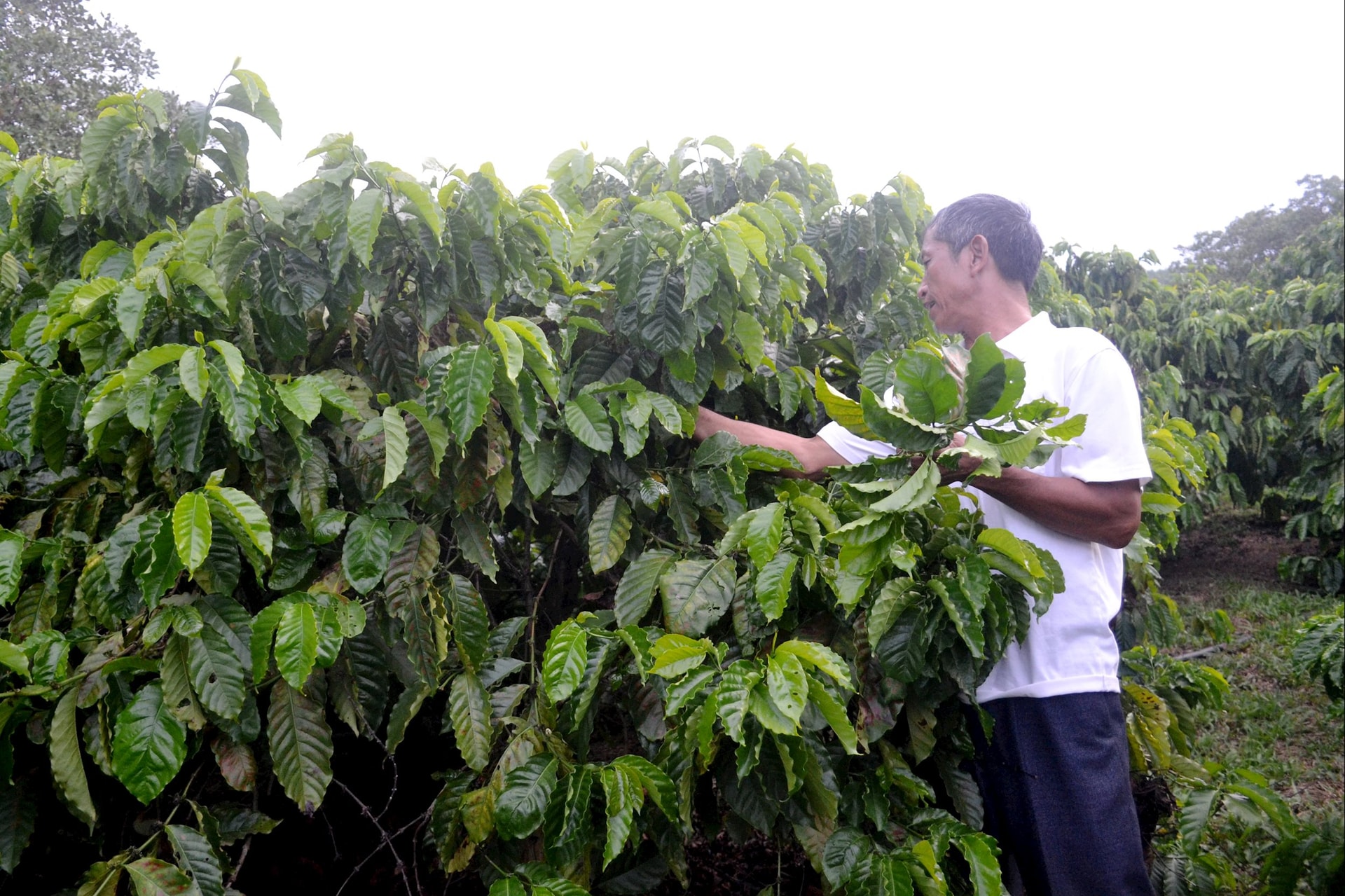
For over 15 years, the family of Mr. Dinh Van Truong, in Dak Ha village, Krong No commune, has not used herbicides in their 3-hectare coffee plantation. According to Mr. Truong, in the dry season, weeds grow slowly, making weeding and hoeing quite easy, but in the rainy season, weeding is much more labor-intensive. Typically, the family has to mow the grass 3-4 times each rainy season. Comparing the time it takes to clean the garden with 4 mowing sessions, which is equivalent to 2 herbicide applications, the family still chooses to mow manually.
When asked about his reasons for giving up herbicides, Mr. Truong explained that he was once very "addicted" to them, especially during the early days of his family's business. The garden was overgrown with weeds, and during the rainy season, they would grow back within about a month, making weeding and tilling impossible. He himself suffered from the overuse of herbicides, which affected his eyesight, requiring treatment at several hospitals and incurring significant costs before he recovered.
Mr. Truong emphasized that not only does spraying herbicides on gardens negatively impact one's own health, but after a few years, the plants also develop poorly because the soil becomes compacted, and the person doing the spraying is also more susceptible to illness. "Furthermore, the overuse of herbicides easily affects the quality of agricultural products and is unsafe for consumers. They may refuse to use our products due to the residue of toxic chemicals. Therefore, it's better to put in more effort for the long-term benefit of one's own health, family, and community," Mr. Truong asserted.
He admitted that giving up the habit of using herbicides was not easy. Perhaps he had to pay the price in terms of his own health before he could quit. However, after giving up those harmful chemicals, he and his family realized the great benefits they had gained. These included better health, stable coffee yields and production, and higher income.
Mr. Chảo Phu Nhân, residing in Group 4, Bắc Gia Nghĩa Ward, owns 3 sao (approximately 0.3 hectares) of rice paddies, producing two crops annually: winter-spring and summer-autumn. Mr. Nhân stated that he previously used herbicides about four times a year for his rice cultivation. However, for the past five years, he has only sprayed once a year, and some years he hasn't sprayed at all.
Explaining this, he said: "Every time I sprayed herbicide, I felt tired, sluggish, and my throat felt hot and sore for several days before I felt normal again. It wasn't good for my health, so I gradually stopped. To control weeds, I prepared the soil more thoroughly and pulled them out manually. By using less herbicide, I feel healthier."
Besides people like Mr. Truong and Mr. Nhan, in reality, in some western localities of Lam Dong province, there are still many cases of herbicide abuse in agricultural production and transportation. It is not uncommon to see discarded bottles and containers left in fields, canals, and roads, negatively impacting the soil and water environment.
In recent years, several functional agencies and localities have issued regulations prohibiting the use of herbicides in agriculture, environmental sanitation, and transportation. Many communities, neighborhoods, villages, and hamlets have established regulations on this matter in their customs and conventions, but these regulations have not been fully implemented in practice.
According to the Provincial Department of Agriculture and Environment, the unit is promoting various forms of communication about environmentally safe farming practices and safe agricultural products through the development of models and technical training courses. In addition to the role of the relevant agencies, local authorities and organizations need to work more strongly together in monitoring the use of herbicides containing banned substances in Vietnam within the community, preventing their indiscriminate use.
According to the appendix of Circular 19/2022 of the Ministry of Agriculture and Environment, the herbicide with the single active ingredient 2.4.5 T is a plant protection product prohibited for use in Vietnam.
Source: https://baolamdong.vn/noi-khong-voi-thuoc-diet-co-391550.html













































































Comment (0)