

Mortgaging land ownership certificates to plant macadamia trees.
In 2019, Duong Van Ngoc, Director of Macca HD Kon Tum Co., Ltd., who had a stable job in the paper raw materials industry, decided to quit his job and spend nearly ten billion VND buying land, digging holes, and installing an irrigation system to plant a type of tree that many people in Kon Tum were unfamiliar with at the time - the macadamia tree.
He learned about macadamia trees through the Vietnam Macadamia Association. When the Association went around promoting and encouraging the planting of this tree in the Central Highlands, Mr. Ngoc approached them and decided to invest in planting it. It wasn't just because he heard good things about it; he had his own reasons.
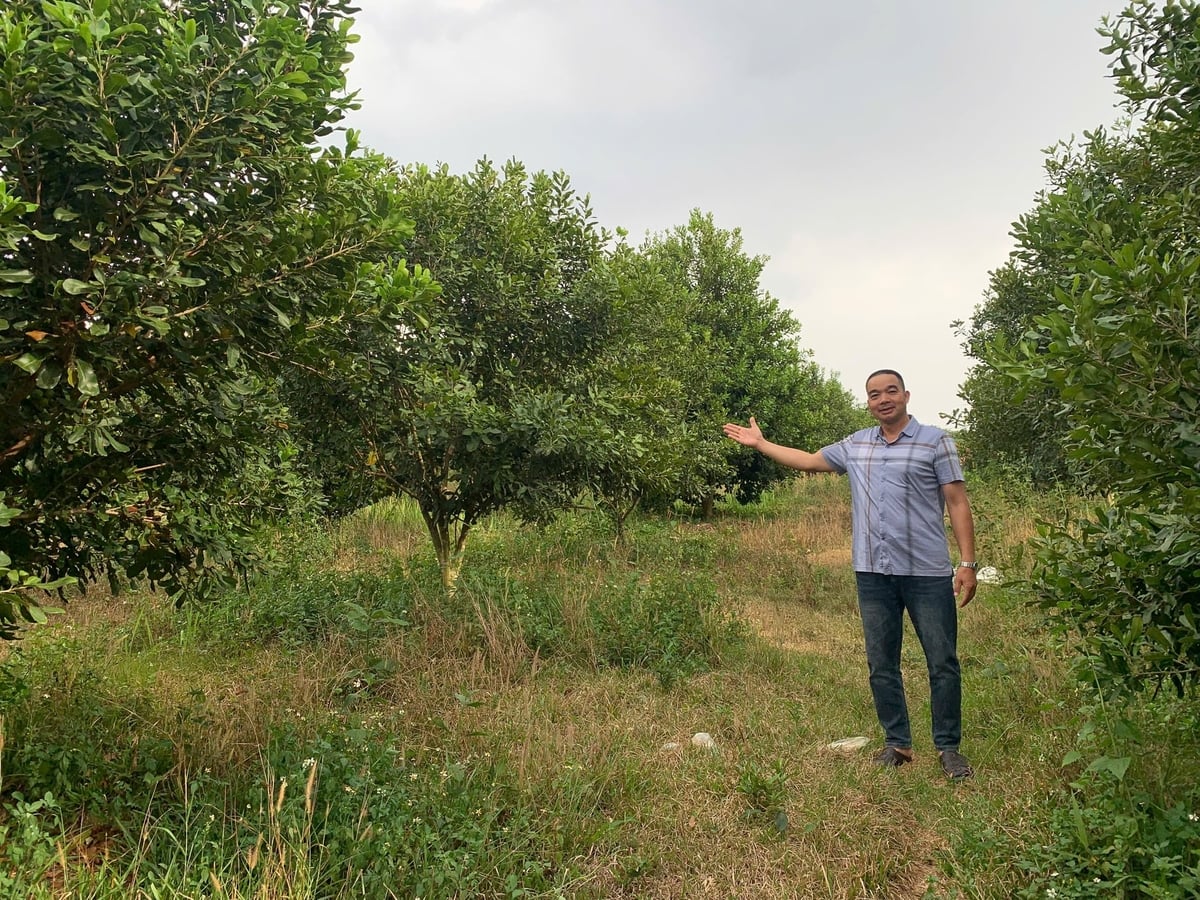
Mr. Ngoc started his business with 20 hectares of macadamia trees. Photo: Provided by the interviewee.
“This tree is a forest tree, very drought-resistant. Areas where it can be grown are rare; not every place can cultivate it. And since it's rare, the demand will be high,” he analyzed, calculating that macadamia nuts can be processed into many things, from ready-to-eat snacks, confectionery, cosmetics, to essential oils and functional foods… Then he looked a little further ahead: people are increasingly focusing on health, and macadamia nuts are rich in omega-3 fatty acids, good for cardiovascular health, pregnant women, and young children… That’s why he chose macadamia trees instead of coffee or pepper like most farmers in the Central Highlands.
In 2019, he invested in planting 20 hectares of macadamia trees, divided into two 10-hectare orchards. The land purchase cost approximately 5 billion VND. Digging holes, building internal roads, installing irrigation systems, constructing an administration building, plus fertilizer and annual labor costs… the total initial investment was nearly 10 billion VND. Some years, many trees died due to lack of water, requiring replanting. When funds were insufficient, he mortgaged his land title to borrow from banks and borrowed from everywhere else. “The pressure of paying bank interest was immense at that time,” he admitted.
To learn the techniques, he didn't have a mentor to guide him step-by-step. Instead, he had to visit the websites of macadamia associations in Australia, China, South Africa, Kenya, etc., to read documents and see how they cultivated the trees at each stage. "Some nights I would sit up until 2 or 3 in the morning, still awake, just trying to understand why the trees weren't flowering, or what treatment was needed during the fruiting stage," Mr. Ngoc confided.
The harsher the soil, the better the flavor.
Mr. Ngoc asserted that not all land is suitable for macadamia cultivation. Foreign literature describes one thing, but the practice in Kon Tum is completely different. The hilly terrain prevents the use of machinery, so everything must be done manually. Abroad, trees are planted in wide rows to receive more sunlight and to facilitate harvesting by machines, while in Vietnam, harvesting must be done by hand. They use machines for pruning, while in Vietnam, we have to use pliers to prune each tree individually.

Macadamia nut yield increases year by year with the age of the tree. Photo: Provided by the author.
"In the first few years, I had to do everything myself, pruning both gardens for up to two weeks each time. Later, when the trees grew bigger, it took a whole month," he recounted. Pruning must be done correctly; a wrong cut will ruin the tree. Currently, Mr. Ngoc cannot handle the entire workload himself, so he has to demonstrate for the workers to follow.
Because macadamia trees prefer sunlight, he planted them in a north-south direction to ensure optimal sunlight exposure, with a density of 400 trees per hectare, 4 meters between trees, and 6 meters between rows.
According to Mr. Ngoc, Kon Tum (formerly) is the hottest province in the Central Highlands, with abundant sunshine and rain, and a harsher climate compared to Gia Lai or Dak Lak . But it is precisely this harshness that creates the unique flavor of macadamia nuts. "The harsher the climate, the more special the taste of the agricultural products. Kon Tum macadamia nuts are more fragrant, rich, and creamy than those from many other places," Mr. Ngoc assessed.
The macadamia trees here typically only flower once a year, around the time before and after the Lunar New Year. This coincides with the dry season, with no rain, which is favorable for flowering and pollination. However, the dry season is also when pests and diseases thrive. Mr. Ngoc's biggest worry during the flowering stage is thrips, which dry out the flowers, kill the pollen, leading to flower blight and ruining the entire crop. During the young fruit stage, it's the turn of mosquito bugs, which sting the fruit's skin, creating conditions for fungi to invade and damage the kernel inside.

On his personal TikTok channel, Mr. Ngoc frequently shares his experience in growing macadamia trees. Photo: Screenshot.
From July to September each year is the macadamia harvesting season in Kon Tum. After harvesting, Mr. Ngoc prunes and shapes the trees, fertilizes them to help them recover, and prepares them for the new season starting in November.
Mr. Ngoc pays special attention to post-harvest processing. “Many places just moisten the macadamia nuts and sell them, but they lack the aroma. We have to go through the roasting process, and the roasting temperature is our secret,” he revealed. Therefore, from the beginning, he decided to establish a company and process the nuts himself, from start to finish, instead of selling raw nuts. In 2020, his macadamia nut product received a 3-star OCOP certification.
Currently, the wholesale price for large-sized finished beans is around 240,000 VND/kg, while the smaller ones are around 220,000 VND/kg. Sales are mainly through online channels and regular domestic customers. "Because the production volume isn't large enough yet, I haven't considered exporting," Mr. Ngoc shared.
Whether or not someone goes into debt depends on the grower.
In 2025, Mr. Ngoc's 10-hectare orchard yielded 12 tons of fresh fruit, generating revenue of approximately 500 million VND. Compared to his previous income, this figure is many times higher. He said this wasn't to boast, but to explain why he doesn't regret his decision to switch.
To get to where he is today, Mr. Ngoc spent nearly 7 years "living and breathing" his orchard. Macadamia trees usually don't start bearing fruit until the 3rd year, and the actual harvest only comes in the 4th year. Yields gradually increase with the age of the tree, and it's not until the 12th-13th year, when the canopy closes, that yields stabilize at 10-12 tons/ha. To recoup his investment (including the land purchase), he estimates it will take about 10 years.

Mr. Ngoc's macadamia orchard provides jobs for many local people. Photo: Provided by the owner.
That's why many people call macadamia "the tree of debt." Mr. Ngoc hears that phrase a lot. "That's what people say when they lack perseverance. They fail because they choose the wrong variety, don't know the techniques, or aren't persistent enough," he said.
Anh Ngoc recounted that many people, after planting for five years and seeing few fruits, become discouraged and cut down the trees to switch to other crops. Cutting them down at that point naturally leads to debt, as almost all the money has been invested without much return. "It's like digging a well until you're close to a water source and then abandoning it; you can't blame the well for not having water," he confided.
According to Mr. Ngoc, successful macadamia cultivation requires four key elements: the right variety, suitable land, proper techniques, and most importantly, sufficient long-term financial stability. His orchard currently grows A38, 246, 842, 849, and QN1 macadamia varieties, all carefully selected grafted varieties, not those readily available on the market.
“If you can accept a stable harvest after 5-7 years, then go with macadamia. But if you want quick results, choose another crop. In the next 10 years, I want to expand the raw material area around my two existing orchards, guide farmers on proper planting and care, and then bring the Kon Tum macadamia brand to a wider market, eventually exporting it. My 20 hectares are not only a production facility but also a model, proof to convince others that this type of tree, on this land, can absolutely yield sweet fruit if growers are patient enough and master the knowledge and techniques," Mr. Ngoc shared.
Source: https://nongnghiepmoitruong.vn/khi-cay-mac-ca-khong-con-la-cay-mac-no-d812033.html


![[Image] Hanoi's urban life under the challenge of a "scorching hot" environment](https://vphoto.vietnam.vn/thumb/1200x675/vietnam/resource/IMAGE/2026/05/25/1779706979265_nang-nong-t5-2026-minh-duy-7-4636-jpg.webp)



























































Comment (0)