

This was the opinion of several National Assembly delegates, experts, and managers at the forum "Building a Competitive and Transparent Energy Market: Challenges and Opportunities for Businesses," organized by the Business Forum Magazine on the afternoon of December 18th.
The demand for electricity is constantly increasing.
Mr. Nguyen Quang Huan, a member of the 15th National Assembly and Chairman of the Board of Directors of Halcom Vietnam JSC, stated that Resolution 70-NQ/TW of the Politburo, issued on August 20, 2025, on ensuring national energy security, continues to affirm the guiding principle: "Building a synchronous, competitive, transparent energy market with diversified ownership forms and business methods; applying market prices to all types of energy, without cross-subsidization between customer groups."
"The resolution emphasizes that only with a truly competitive market can the energy sector develop sustainably, in line with the requirements of modernization and energy transition," Mr. Huan said.
Mr. Huan also stated that the National Assembly has approved the revised National Master Plan, setting an economic growth target of 10% or more for the period 2026-2030, which means that electricity demand must grow by 12-13% or more each year.
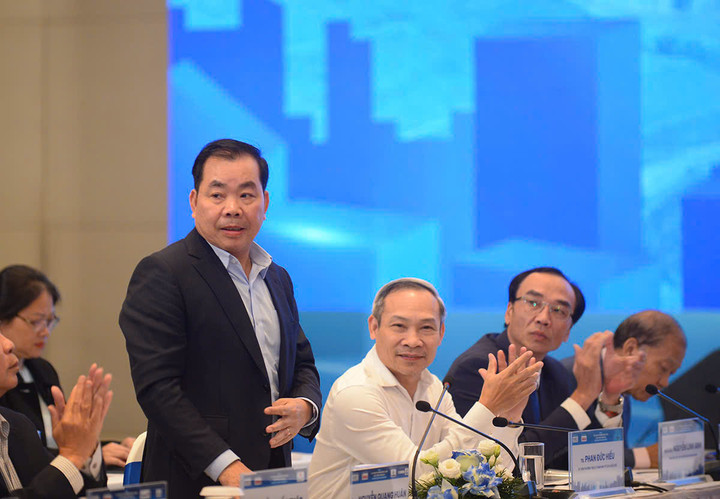
Mr. Nguyen Quang Huan (standing) speaks at the forum.
“This places immense pressure on the power system in terms of generation, transmission, and distribution. In this context, a lack of transparency and healthy competition will prevent the market from attracting social investment, creating incentives for efficiency improvement, and ensuring long-term energy security. Furthermore, the current pricing mechanism does not adequately reflect costs and risks, creating difficulties for investors and reducing the incentive for technological innovation. The electricity price adjustment mechanism is slow, lacks foresight, and fails to meet market demands,” Mr. Huan said.
Meanwhile, Mr. Nguyen Quoc Dung, Head of the Electricity Trading and Business Department (EVN), affirmed that ensuring energy security and providing sufficient electricity for the country is the highest priority.
According to Mr. Dung, the process of building a competitive electricity market must be considered within the specific context of Vietnam. Firstly, renewable energy has already accounted for 30% of the system's capacity (nearly 30,000 MW), creating significant pressure on dispatching and operation.
Secondly, the demand for electricity, growing at 12-15% per year, is very high compared to many developed countries, where the growth rate is only around 3%. If the market design is unsuitable, lacking competitiveness and transparency, Vietnam will find it difficult to attract new investment, especially from economic sectors involved in electricity investment.
"In some countries, to successfully develop the retail market, several criteria must be met, including achieving electricity saturation to reduce investment in power generation or transmission, thereby enabling better service delivery. In Vietnam, if we develop the retail market effectively, we can fully meet the country's electricity needs and avoid imbalances in supply and demand," Mr. Dung said.
Private investment is needed.
Dr. Nguyen Huy Hoach, a member of the Scientific Council of the Vietnam Energy Magazine, predicts that electricity demand will increase by an average of 10% per year in the coming period. Therefore, it requires strong participation from the private sector in renewable energy, LNG, pumped storage hydropower, transmission infrastructure, battery storage, and rooftop solar power in industrial parks.
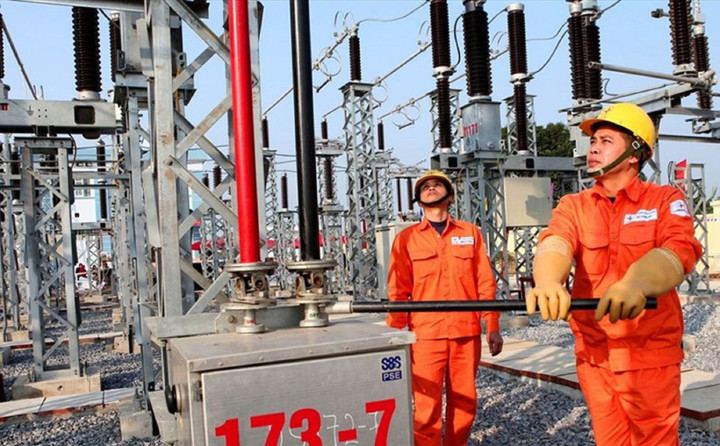
The energy market in Vietnam can only operate transparently if it is based on a stable, consistent, and predictable long-term legal framework.
Meanwhile, Mr. Hoang Quang Phong, Vice President of the Vietnam Chamber of Commerce and Industry (VCCI), believes that in order to achieve sustainable development and overcome current shortcomings, the energy sector needs to strictly adhere to the standards of a market mechanism.
Restructuring the energy sector is essential to gradually establish a healthy and transparent competitive energy market. Simultaneously, it is necessary to improve mechanisms and policies to encourage stronger participation of the private sector in energy investment, operation, and service provision.
"To encourage and facilitate the participation of domestic and foreign private sectors in the energy market, a stable investment environment, consistent policies, reasonable risk-sharing mechanisms, and equitable access to resources such as land, capital, infrastructure, and market information are required," Mr. Phong said.
Meanwhile, Mr. Nguyen Anh Tuan, Vice Chairman of the Energy Association, argued that a healthy competitive electricity market can only be formed when there is enough supply to buy and sell. Currently, only about 38% of the total capacity participates in the electricity market.
If BOT and renewable energy sources benefiting from the FIT mechanism continue to not participate in the market, this rate will be even lower. This means the market lacks "sellers," failing to accurately reflect the supply-demand relationship.
"Therefore, power plants, regardless of size and type, must participate in the competitive electricity market after the preferential period. Only when the proportion of participating sources gradually increases will electricity prices reflect real costs and create a signal for investment in the right direction. The current shortcoming is that electricity prices are still calculated based on a nationwide average, without differentiating between regions. This makes it difficult for investors to make decisions because it does not accurately reflect transmission and distribution costs."
"The association agrees with the proposal to study a mechanism for electricity pricing based on region or node (nodal pricing) to create more accurate investment signals and encourage large customers to participate in the market," said Mr. Nguyen Anh Tuan.
Resolution 70 of the Politburo on ensuring national energy security until 2030, with a vision to 2045, clearly states the specific targets for 2030: total primary energy supply of approximately 150-170 million tons of oil equivalent; total power generation capacity of approximately 183-236 GW, or potentially higher depending on system demand and socio-economic development over time; total electricity production of approximately 560-624 billion kWh. The proportion of renewable energy in the total primary energy supply is approximately 25-30%.
The vision for 2045 is to ensure robust national energy security; a healthy, fair, transparent, and efficient competitive energy market, consistent with the socialist-oriented market economy; and a comprehensive and sustainable development of the energy sector...
Source: https://vtcnews.vn/lam-gi-de-thi-truong-nang-luong-canh-tranh-minh-bach-ar993783.html


![[Photo] Prime Minister Pham Minh Chinh attends the Conference on the Implementation of Tasks for 2026 of the Industry and Trade Sector](/_next/image?url=https%3A%2F%2Fvphoto.vietnam.vn%2Fthumb%2F1200x675%2Fvietnam%2Fresource%2FIMAGE%2F2025%2F12%2F19%2F1766159500458_ndo_br_shared31-jpg.webp&w=3840&q=75)































































































Comment (0)